
Why Japan’s indigenous Jōmon women preferred “immigrant” Yayoi men
A historical account of demographic and technological drivers behind the forging of modern Japan.
Human history is, above all, a story of movement. Beginning with the Out of Africa migration some 60,000–70,000 years ago, our species spread across every habitable continent.
Later, between roughly 10,000 and 3,000 years ago, the Neolithic Revolution — the invention of agriculture — triggered a second great wave of human expansion. Farmers with domesticated plants, animals, and advanced technologies moved out of a few core regions, gradually displacing or absorbing the hunter-gatherers who had lived on those lands for millennia.
In Europe, Anatolian farmers replaced the indigenous western hunter-gatherers. In India, pastoralists from the steppe mixed with and overran the indigenous Dravidian hunter-gatherers. In sub-Saharan Africa, Bantu-speaking farmers expanded from Cameroon across the continent, absorbing or displacing Pygmy and San populations.
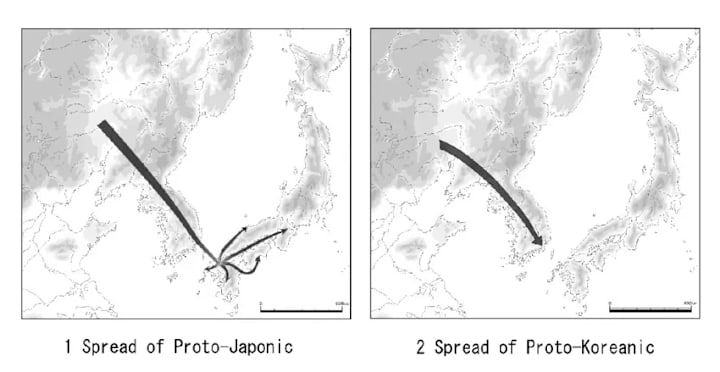
Japan was no exception to this global pattern. While often portrayed as uniquely isolated and homogeneous, the modern Japanese population is the product of a dramatic prehistoric encounter: the arrival of wet-rice agriculturalists from the Korean Peninsula around 300 BC, who transformed the archipelago and its aboriginal inhabitants forever.
One intriguing fact in the Japanese migration story is that the local women seemed to prefer men among the newcomers, rather than among their tribespeople. Why so?
The Jōmon
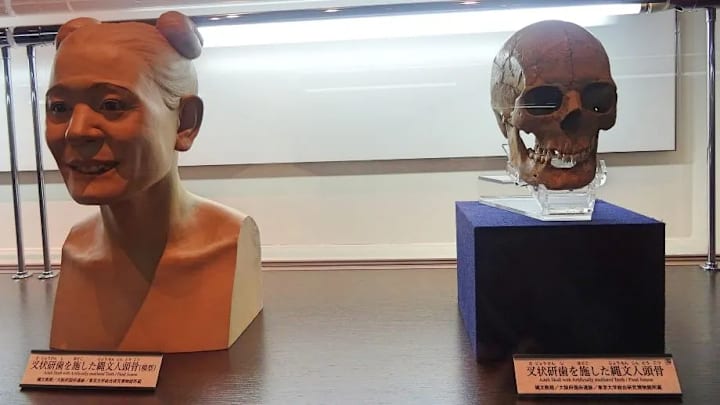
The Jōmon people were Japan’s original inhabitants for millennia — 14,000–300 BC. They featured a short stature (men 155–160 cm), a robust build, low facial height, pronounced brow ridges.
Archeological records show that they descended from Paleolithic hunter-gatherers who reached the Japanese archipelago via land bridges before rising sea levels flooded them c. 12,000 BC and from coastal routes from Southeast Asia. Related genetically to ancient Paleolithic populations of Southeast Asia and the Russian Far East.
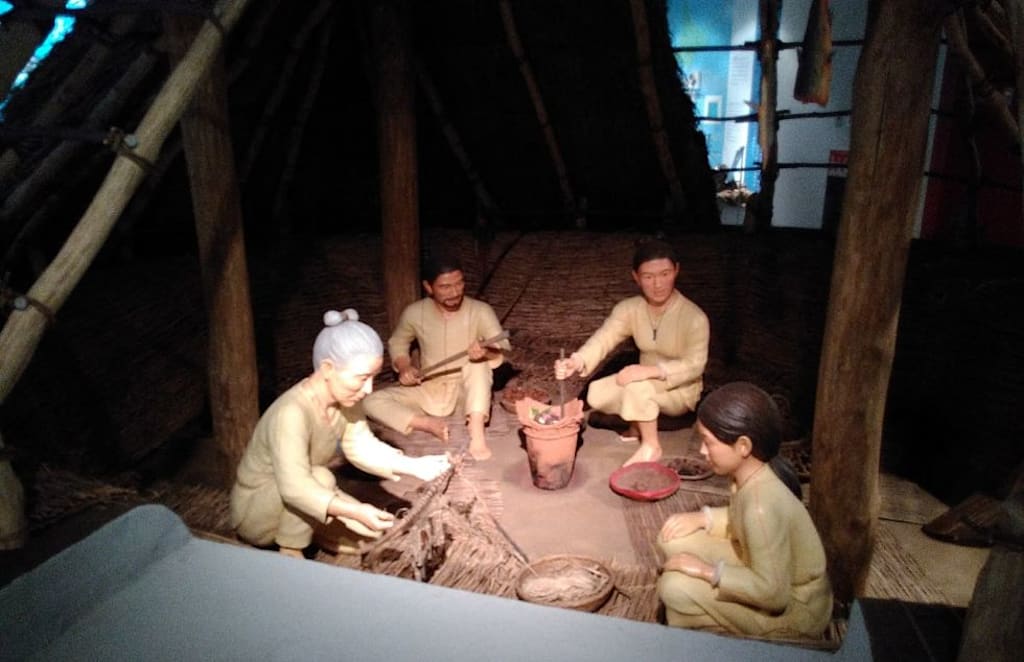
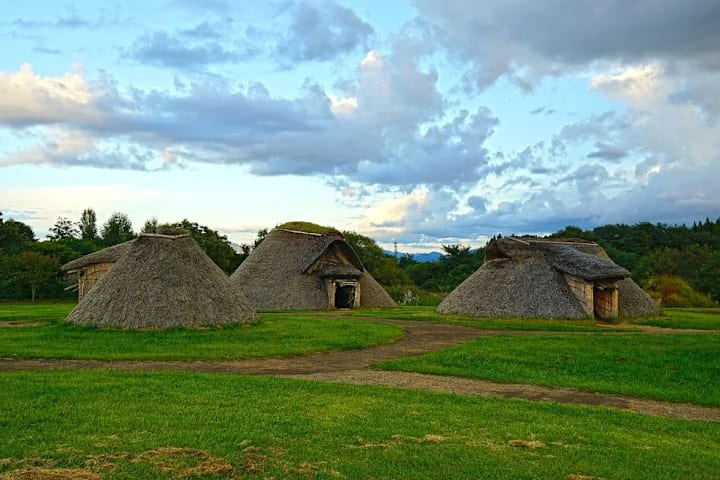
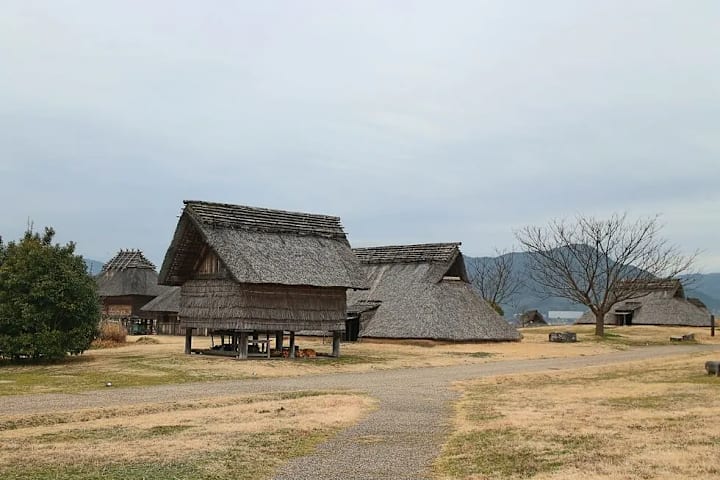
Semi-sedentary hunter-gatherers, fishers, and early horticulturalists, they lived in pit-houses organized into large villages, particularly in eastern Japan where nut trees (chestnuts, walnuts, acorns) were abundant.
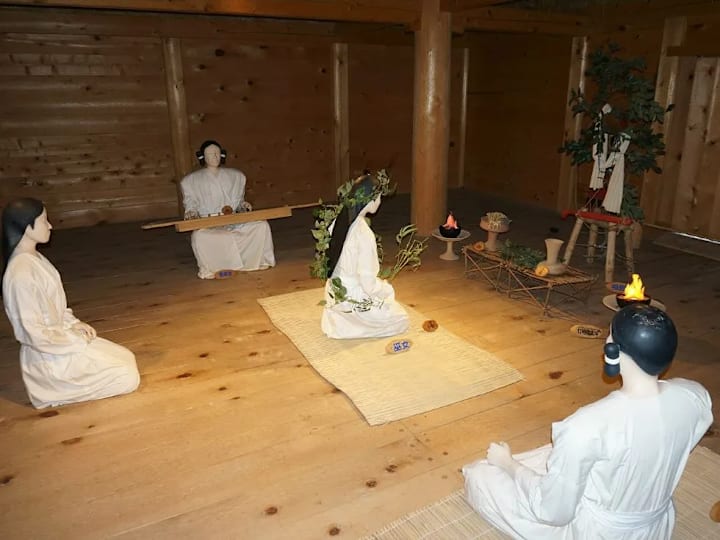
The Jōmon are considered to be among the world’s first designers of pottery vessels, enabling boiling and long-term food storage. They created enigmatic clay figurines called dogū, stone circles, and ritual objects, suggesting a rich spiritual life.
For over 14,000 years — longer than all of recorded history — the Jōmon lived in a stable, sustainable balance with their environment. At their peak (c. 2000–1000 BC), an estimated 75,000–260,000 people lived across the archipelago.
Their direct descendants today are the Ainu of Hokkaido and, to a significant degree, the Ryukyuans of Okinawa.
At around 300 BC, everything changed.
The Yayoi
The Yayoi people — named after a neighborhood in Tokyo where their distinctive, unornamented pottery was first found — were not a small raiding party. They were migrants from the Asian mainland sailing to the islands in sustained waves between c. 300 BC and AD 250.
Most evidence points to the Korean Peninsula, specifically the Mumun pottery culture. They crossed the Tsushima Strait in small boats, initially settling in northern Kyushu.
The Yayoi people were somewhat taller (men 162–165 cm), slenderer, with flatter, narrower faces. Genetically, they were closely related to modern Koreans and Han Chinese. Their Y-chromosome haplogroup O dominates modern mainland Japanese males.
The Yayoi mastered the wet-rice agriculture, which was a game-changer in a region surrounded by sea. It required coordinated irrigation, paddy fields, and a settled, organized labor force — factors leading to population explosions.
Equally important, they were familiar with metalworking, crafting tools like axes, sickles, and knives from iron and weapons from bronze. The Yayoi made pottery too — simpler and unadorned, but functional and often turned on a slow wheel for mass production.
They were both physically and technologically different from the locals.
The technological differences mattered. Rice farming supported 10–100 times more people per square kilometer than hunting-gathering. Within centuries, the Yayoi population exploded into the millions, while the Jōmon dwindled.
One of the reasons of the Jōmon population decline is that their women preferred husbands among immigrant Yayoi men. There’s little evidence, however, that Jōmon men had Yayoi wives.
Before we decode this claim, let’s have a look at the relationships between the two former groups.
From trade to replacement
The interaction between Jōmon and Yayoi was not a single event but a centuries-long process that varied dramatically by region. The immigrant tribes were not regarded as invaders or occupants in the classical sense. The locals considered them more like new noisy neighbors, sometimes unfriendly intruders and other times good trade buddies.
The nature of interaction between Jōmon and Yayoi swung between peaceful and conflictual. During the 300–200 BC timeframe, their relations were characterized by small trade and cautious co-existence in northern Kyushu. Jōmon exchanged furs, obsidian, and marine products for Yayoi bronze mirrors and iron tools.
Elsewhere, in central Honshu (e.g., Kanto Plain around modern Tokyo), Jōmon and Yayoi villages lived separately but nearby for centuries — till 100 AD. It was a period when intermarriage was frequent.
As the Yayoi population exploded, conflict with the Jōmon became inevitable. The time between 100 BC and 200 AD was marked by competition and violence. Archeologists found evidence of fortified Yayoi villages (moats, palisades, watchtowers), skeletons with embedded arrowheads, mass burials with traumatic injuries. The two groups competed over land and resources, small clashes often degenerating into lethal warfare.
As a result of these events, during 100–500 AD the Jōmon culture vanished from western Japan. Aboriginal Jōmon people were either absorbed into Yayoi society or pushed to the margins — north to Hokkaido, where they became the Ainu, and south to the Ryukyu islands.
The perspectives in a marriage
Bythe time intermarriages became common, Yayoi were no longer “immigrants” as they are called above; after centuries of sedentary life on the archipelago, they were already “locals.” I chose this description intentionally, to show that for the Jōmon people Yayoi were still strangers — just like the Normans were foreigners for the Anglo-Saxons, the Anglo-Saxons were foreigners for the Britons, and the Britons were foreigners for the Celts, and so on.
So, why did Jōmon women have Yayoi husbands — “strangers” — while Jōmon men almost never has Yayoi wives?
The answer to this question lies in demography, technology, and the universal human drive to secure the best possible future for one’s children.
Early Yayoi migration waves were dominated by young, unmarried men. Crossing the Tsushima Strait in small boats was dangerous; families rarely sent all members at once — including young children and the elderly — on such risky ventures. Establishing wet-rice agriculture was a brutally hard work: clearing forests, digging irrigation canals, building paddy fields.
Young men were the pioneers who constituted the primary labor and military force.
The result was a skewed sex ratio in early Yayoi settlements: significantly more men than women.
For a Yayoi man in a new settlement with few women of his own community, Jōmon women represented the only pathway to mating, family, and genetic foothold in new lands.
But for an aboriginal Jōmon woman, the calculation was equally rational, though from the opposite direction.
Marrying a Yayoi man offered many advantages:
- Material security: Access to reliable rice surplus (no more risk of famine), iron tools and weapons, bronze ornaments, and superior housing.
- Higher status: In a mixed marriage, Yayoi society was the dominant, wealthier, technologically superior one. A Jōmon woman marrying a Yayoi man moved up socially.
- Better prospects for offspring: Her children would inherit Yayoi technology, language, and social connections — a vastly improved life trajectory compared to remaining in a dwindling Jōmon band.
The reverse almost never happened.
A Yayoi woman marrying a Jōmon man would have experienced the opposite: moving down the social hierarchy. She would leave a wealthy farming village with metal tools and reliable food surplus for a hunter-gatherer band with stone tools and seasonal scarcity.
Her family would have strongly opposed it as well. In a patrilocal society (wives move to husbands’ villages), she would also lose access to her kin network, her source of security and status.
The DNA journey
This isn’t a speculation based on logical deductions. Genetic evidence is abundant to confirm this story. And the DNA shows a stark, almost brutal pattern.
Yayoi men — belonging to haplogroup O — thrived. Their lineage now appears in 70–80% of modern mainland Japanese men. They had children. Lots of them.
Jōmon men — carrying haplogroups D and C1 — largely vanished from the genetic record. Today, less than 5% of Japanese men carry their markers. Their male line was almost completely replaced.
But here’s the twist. Jōmon women — with haplogroups like N9b and M7a — did not disappear. Their DNA survives in about 8–12% of modern Japanese people. They became mothers. Their children, however, were likely raised as Yayoi — not as Jōmon.
As for Yayoi women: they arrived too, especially in later, more balanced migration waves. Their lineages are widespread as well.
The pattern is clear: Jōmon maternal DNA has survived. Jōmon paternal DNA is nearly extinguished.
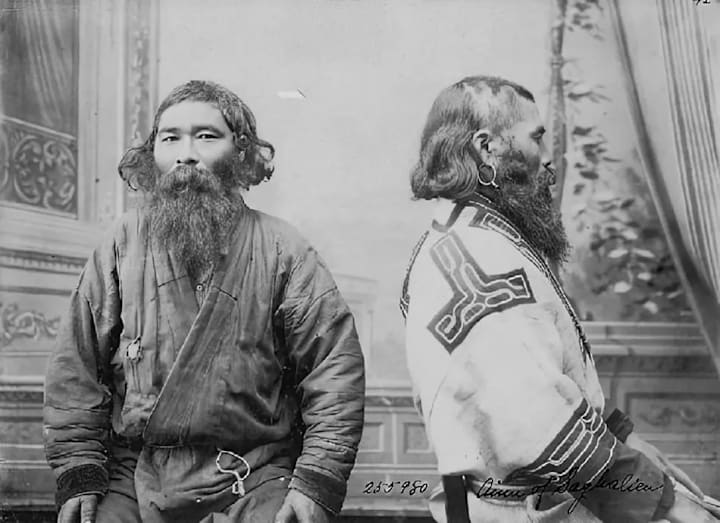
Where are Jōmon descendants now?
Bythe year 500 AD, the Jōmon as a distinct culture had disappeared from mainland Honshu, Kyushu, and Shikoku. Their population collapsed due to four interconnected factors:
1. Demographic swamping: The Yayoi population exploded into the millions; Jōmon had dwindled to tens of thousands.
2. Violence: Fortified villages and trauma skeletons indicate lethal conflict over land and resources.
3. Disease: New pathogens brought by the Yayoi from the mainland likely struck Jōmon populations with no prior immunity.
4. Assimilation: Children of Jōmon women and Yayoi men were raised as Yayoi — speaking the Japonic language, farming rice, using metal tools, and following Yayoi customs. Within a few generations, their Jōmon identity was forgotten.
The last holdouts survived only at the geographic margins:
- Northern Honshu (Tōhoku), where Jōmon groups adopted some Yayoi technology (iron tools) but rejected rice farming, evolving into the Epi-Jōmon culture (c. 100 BC — AD 700), which directly preceded the historical Ainu.
- Hokkaido, where indigenous Jōmon remained dominant, developing into the Ainu people.
- Ryukyu Islands (Okinawa): A separate but related Jōmon-derived population became the Ryukyuans.
The Yamato majority
Modern Japanese are often referred to as Yamato minzoku, the archipelago’s dominant ethnicity. The transition took place between 300 and 700 AD, when the Yayoi-descendant chiefdoms of the Kinki region (near modern Nara/Osaka) consolidated into the Yamato state, the first unified Japanese polity and the origin of the imperial line.
The people inherited 85–92% of Yayoi ancestry and 8–12% of indigenous Jōmon ancestry (from those Jōmon women who married into Yayoi lineages). They spoke Japonic, an ancestor of modern Japanese.
They claimed descent from the sun goddess Amaterasu and saw themselves as the “civilized” center, marginalizing the Ainu and Ryukyuans as “barbarians” — a pattern seen globally when agricultural empires encounter hunter-gatherers.
The Yamato — what most people simply call “Japanese” — make up the vast majority, about 97.5% of the population, or roughly 121 million people.
The Ryukyuans (Okinawans)
This ethnicity derived from Jōmon descendants on the southern islands who received limited Yayoi migration due to distance. They share 30–40% of Jōmon ancestry — the highest among mainland Japanese-speaking groups — and 60–70% of Yayoi’s.
The Ryukyuans adopted a Japonic language, which is distinct from but related to mainland Japanese while retaining their own genetic and cultural features.
The Ryukyuans of Okinawa and the surrounding islands number around 1.3 million people, about 1% of Japan’s total.
The Ainu minority
The Ainu, on the other hand, are the direct descendants of the Jōmon who retreated to Hokkaido and never adopted full-scale rice farming. Their distinct culture emerged around 700–1300 AD.
They share 70–80% of Jōmon ancestry and 20–30% of Yayoi’s from later, limited mixing with mainland Japanese and Okhotsk people from Sakhalin.
The Ainu language is distinguished and unrelated to Japanese, likely the last surviving relative of the lost language of the Jōmon.
From the 15th century onward, the Japanese (Yamato) expanded into Hokkaido, forcing the Ainu into a marginal existence. Official discrimination lasted until the 1997 Ainu Culture Law finally recognized them as the indigenous people. Centuries of stigma, ridicule and cultural persecution during World War Two force many Ainu to hide their heritage even today.
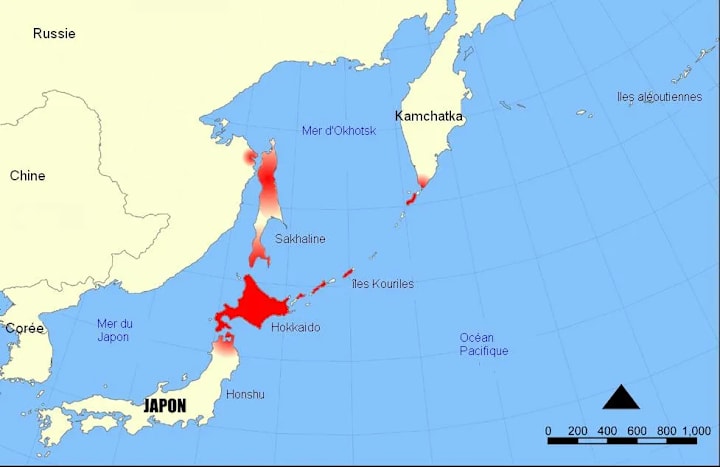
The Ainu — the indigenous people of Hokkaido, Sakhalin, and the Kuril Islands — are now the smallest group. Their population is difficult to pin down precisely, ranging from about 25,000 to as many as 200,000, depending on how identity is defined as many Ainu have assimilated into Yamato society over generations. That’s roughly 0.02–0.16% of Japan’s population.
The technological determinism
The Yayoi replacement we saw in the ancient DNA didn’t erase the Jōmon entirely. The Jōmon live on — disproportionately through women, and most strongly in the Ryukyuans and Ainu. But in the mainstream Yamato population, their genetic voice is a whisper.
It would be a mistake to frame the interbreeding between Jōmon women and Yayoi men in terms of personal physical traits or individual intelligence. There is no evidence that Yayoi men were universally more handsome or cleverer than Jōmon men, nor that Jōmon women found immigrant men inherently more attractive.
Instead, the explanation is structural and evolutionary.
The Yayoi brought with them a more advanced technological package: wet-rice agriculture, iron tools, bronze weapons, and organized social hierarchies. This package translated directly into material security: reliable food surplus, better tools, higher survival rates for children, and greater social status.
For a Jōmon woman, following a Yayoi man was not a matter of pure personal preference or romantic love as we understand it today. It was a rational calculation, likely unconscious, shaped by millions of years of evolutionary pressure: the natural, universal desire to secure the best possible life for one’s offspring.
Japan is not a single, pure ethnic block. It is a layered story of migration, dominance, absorption, and survival — written in the bones of the Jōmon and carried forward, quietly, in the blood of millions who would never guess it.
This story strikingly reminds of the Neanderthal-Sapiens saga and is, perhaps, best understood by the Basques in Spain, the Welsh in Britain, the Zapotechs or Aymara in Latin America, and hundreds of indigenous minority groups across Russia.
However, it is not about conquest by superior individuals. It dives into technological determinism — the same force that drove the spread of farming across every continent.
Indigenous peoples did not vanish because they were weak or foolish. They were absorbed because, in the cold calculus of survival and reproduction, the future belonged to the rice paddy, not the forest.
***
Sources and references:
1. Padgett, B. D. (2020). “The Bioarchaeology of Violence During the Yayoi Period of Japan”. Ohio State University. http://rave.ohiolink.edu/etdc/view?acc_num=osu1586549883443371
2. Narasimhan, V. M., et al. (2019). “The formation of human populations in South and Central Asia.” Science. https://www.science.org/doi/10.1126/science.aat7487
3. Yang, M. A. (2022). “A genetic history of migration, diversification, and admixture in Asia.” Human Population Genetics and Genomics. https://www.pivotscipub.com/hpgg/2/1/0001
5. Sequeira, J. J., Krishna, S., van Driem, G., Mustak, M. S., & Das, R. (2024). “Novel 4,400-year-old ancestral component in a tribe speaking a Dravidian language.” https://doi.org/10.1101/2024.03.31.587466
6. Spinage, C. A. (2012). “Man’s Place in the Ecology of Africa.” Springer Berlin Heidelberg. https://link.springer.com/chapter/10.1007/978-3-642-22872-8_29
7. Japanese Genome Variation Consortium (multiple studies). https://journals.plos.org/plosone/article?id=10.1371/journal.pone.0185487, https://www.nature.com/articles/srep17855, https://pure.teikyo.jp/en/publications/the-fine-scale-genetic-structure-and-evolution-of-the-japanese-po/, https://www.nature.com/articles/s41588-024-01913-5
8. General archaeological literature on the Jōmon and Yayoi periods (e.g., works by Imamura, Habu, Hudson, Mizoguchi). https://qa-www.nypl.org/research/research-catalog/bib/pb9911697053506421, https://catalog.hathitrust.org/Record/004717038, https://catalog.nccu.edu/trln/UNCb2990773
9. Wikipedia: https://en.wikipedia.org/wiki/Yamato_people, https://en.wikipedia.org/wiki/Yayoi_period, https://en.wikipedia.org/wiki/Yayoi_people, https://en.wikipedia.org/wiki/J%C5%8Dmon_period, https://en.wikipedia.org/wiki/J%C5%8Dmon_people, https://en.wikipedia.org/wiki/Ainu_culture
About the Creator
Keep reading
More stories from Aurel Stratan and writers in FYI and other communities.
An empire born from betrayal
In addressing the motives of the ongoing Russo-Ukrainian war, it is important to know the roots of relationships between Moscow and Kyiv. Here’s a chronicle of the failed Cossack-Muscovite alliance that split Ukraine for centuries and forged Greater Russia.
By Aurel Stratana day ago in History
How Healthcare Industry Services Help People Every Day
When you visit a doctor, everything feels easy and simple. You walk into a clinic, explain how you feel, and the doctor checks you and then gives you medicine or advice. It looks like a short and simple process, but there is much more happening behind the scenes.
By sakshi gehlot7 days ago in FYI
Bibbidi-Bobbidi-Booyah!
Dear Professor Donkeldong, I would like to formally apologize. Last night I snuck into your office. I sat in your chair and poured myself three fingers of Scotch from the bottle you’ve got stashed in the top desk drawer. Then I helped myself to your private library.
By Leslie Writes6 days ago in Humor




Comments
There are no comments for this story
Be the first to respond and start the conversation.