
Yuxian Skull discovered in China has challenged this long-standing narrative of Human Evolution
Rethinking Human Evolution: A Discovery That Changes the Timeline

Rethinking Human Evolution: A Discovery That Changes the Timeline
For decades, the story of human evolution appeared relatively straightforward. Scientists believed that early advanced humans emerged around one million years ago, belonging to the species Homo erectus. According to this widely accepted model, this species eventually split into two major branches around 600,000 years ago. One branch led to the Neanderthals, while the other gave rise to modern humans, Homo sapiens. This linear and orderly progression formed the foundation of how we understood our origins.
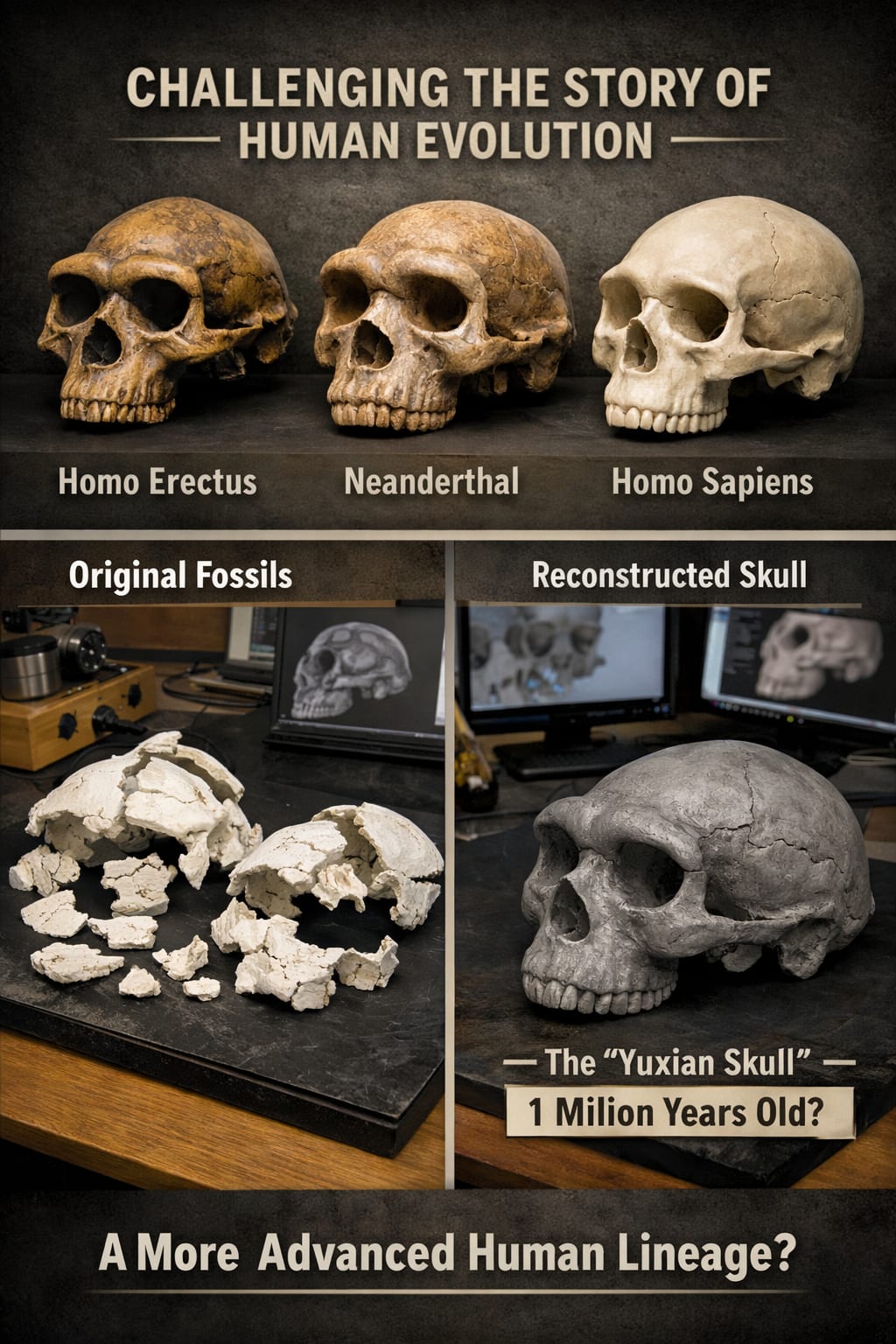
However, a remarkable fossil discovery in China is now challenging this long-standing narrative. A skull, estimated to be about one million years old and informally referred to as the “Yuxian skull,” is forcing scientists to reconsider the complexity of human evolution. Rather than fitting neatly into the existing evolutionary tree, this skull appears to represent a distinct and potentially more advanced human lineage.
What makes this discovery so significant is not just its age, but its features. At first glance, the Yuxian skull shares some similarities with Homo erectus. Both exhibit relatively large cranial structures and elongated shapes. However, upon closer examination, important differences emerge. Fossils of Homo erectus are typically characterized by pronounced brow ridges, a somewhat flattened skull, and a smaller brain capacity. In contrast, the Yuxian skull displays a smoother and more refined structure. Its brow ridges are less prominent, and its overall shape suggests a more advanced level of development.
The process through which scientists arrived at these conclusions is equally fascinating. The fossil remains were not discovered in pristine condition. Instead, they were fragmented, distorted, and incomplete, making direct analysis extremely difficult. To overcome this challenge, researchers employed advanced technologies such as CT scanning, digital reconstruction, and 3D printing. By scanning the fragments and using computer modeling, they were able to reconstruct the skull’s original shape with remarkable precision. These reconstructed models were then physically reproduced using 3D printers, allowing scientists to study them in detail.
This innovative approach revealed subtle yet crucial differences between the Yuxian skull and known Homo erectus fossils. These differences were significant enough for researchers to propose that the skull does not belong to Homo erectus at all, but rather to a previously unidentified human lineage. If this interpretation is correct, it would mean that multiple human species, some more advanced than previously thought, coexisted much earlier than our current models suggest.
One of the most profound implications of this discovery is its impact on the timeline of human evolution. If the Yuxian skull indeed represents a more advanced lineage dating back one million years, then the emergence of advanced human traits may have occurred much earlier than previously believed. In fact, scientists suggest that the evolutionary timeline may need to be pushed back by as much as 500,000 years. This challenges the idea of a simple, linear progression and instead supports a more complex, branching model of evolution.
In this revised model, human evolution resembles a tree with multiple branches rather than a straight line. Different human species may have evolved simultaneously, interacting, competing, and possibly even interbreeding with one another. This perspective aligns with other recent discoveries that have revealed unexpected diversity among ancient human populations.
Despite the excitement surrounding this discovery, not all scientists are fully convinced. While many researchers acknowledge the credibility of the findings, some caution that the evidence is not yet definitive. Fossil interpretation is inherently complex, and conclusions drawn from a limited number of specimens must be treated with care. Additional fossil discoveries and further analysis will be necessary to confirm whether the Yuxian skull truly represents a new human lineage.
Nevertheless, the discovery highlights an important truth about science: it is constantly evolving. What we consider established knowledge today can be reshaped by new evidence tomorrow. The Yuxian skull serves as a powerful reminder that the story of human evolution is far from complete. Each new discovery adds another piece to the puzzle, revealing a past that is richer, more complex, and more intriguing than we ever imagined.
In the end, this finding does more than just extend the timeline of human evolution—it transforms our understanding of who we are and where we come from.
About the Creator
Ibrahim Shah
I am an Assistant Professor with a strong commitment to teaching,and academic service. My work focuses on fostering critical thinking, encouraging interdisciplinary learning, and supporting student development.
Keep reading
More stories from Ibrahim Shah and writers in Futurism and other communities.
The Fears of AI And How Much Fun It Can Be
ChatGPT has come a long way, as has AI in general. There are those people who are scared of it, and for understandable reasons. People fear that as technologies advance, they’ll be replaced in the workforce. Then, there are the fears that AI could evolve into something that brings us to the brink of extinction.
By Jason Morton4 days ago in Futurism
Japan Office Real Estate Market: Hybrid Work Trends, Urban Demand & Space Optimization
Japan's office real estate market is undergoing a profound shift, propelled by hybrid work adoption, acute Grade-A shortages, and aggressive ESG mandates. Central to this evolution is the rise of smart, flexible workspaces—tech-infused environments blending wellness, sustainability, and adaptive design to meet the demands of a post-pandemic, tech-driven economy. With prime Tokyo vacancy rates hovering at historic lows of 2.8% (CBRE Q1 2026), developers are racing to deliver amenity-rich towers that prioritize human-centric features like biophilic elements and AI-optimized energy systems, ensuring offices remain vital hubs for innovation amid demographic pressures and global investment inflows.
By Kishan Kumar3 days ago in Futurism
Elderly Woman Behind the Table in a Large Town
The glass of Absinthe sat before me. It’s quite amazing how despite such terror rendered upon their stones in the preceding decades, these streets still held the beauty I first read about as a girl. I never dreamed I’d set foot on these cobbles, at least not safely.
By Matthew J. Fromm2 days ago in Art



Comments
There are no comments for this story
Be the first to respond and start the conversation.