
Washing Machine Market Outlook: Emerging Markets Growth, Affordability & Industry Forecast to 2034
How emerging markets growth, affordability improvements, and infrastructure development are creating new opportunities in the global washing machine market

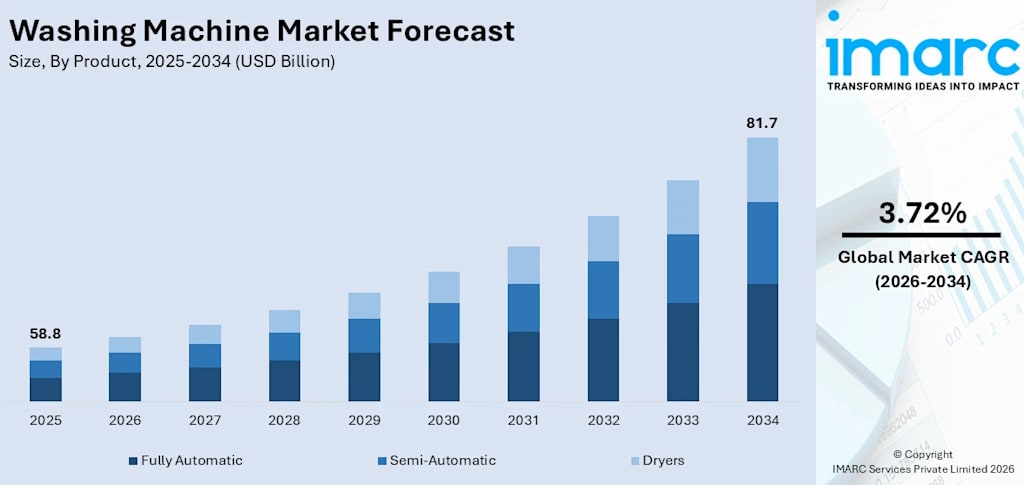
Rising demand for smart home integration, increasing disposable incomes, and a significant shift toward energy-efficient appliances are driving the washing machine market. This growth is further supported by urbanization in emerging economies, the rising adoption of fully automatic models, and the expansion of organized e-commerce retail. According to IMARC Group’s latest data, the global washing machine market size was valued at USD 58.8 Billion in 2025. Looking forward, IMARC Group estimates the market to reach USD 81.7 Billion by 2034, exhibiting a CAGR of 3.72% from 2026-2034.
The washing machine sector has evolved into a vital component of the global home appliance industry, now valued well over USD 50 billion. Modern consumers are increasingly moving away from manual or semi-automatic laundry methods in favor of fully automatic, high-tech solutions that offer significant time savings. Market expansion is heavily influenced by the "premiumization" trend, where households are willing to invest more in front-load machines and smart-connected units that feature AI-driven wash cycles and remote monitoring capabilities. Additionally, the proliferation of nuclear families and the rise of dual-income households have made efficient, high-capacity laundry appliances a non-negotiable staple for urban living across both developed and developing nations.
Washing Machine Market Growth Drivers:
- Accelerated Urbanization and Shifting Demographics
The rapid migration of populations to urban centers and the rise of nuclear family structures are fundamental catalysts for appliance demand. In cities, time-constrained consumers increasingly view washing machines as essential labor-saving tools rather than luxury items. This shift is particularly visible in emerging economies where rising disposable incomes allow households to transition from manual washing to automated solutions. Reports indicate that fully automatic models now capture approximately 55% of the global market share as urban dwellers prioritize convenience and integrated home management to balance demanding professional schedules with domestic responsibilities.
- Rising Focus on Energy and Water Efficiency
Environmental regulations and the desire to reduce utility costs are pushing consumers toward high-efficiency (HE) models. Modern inverter technology allows motors to use up to 20% less electricity, while front-load designs can reduce water consumption by nearly 40% to 50% compared to traditional top-load variants. Government certifications, such as the ENERGY STAR program in the United States, incentivize this transition by highlighting appliances that save households an average of USD 380 annually on resource costs. Consequently, manufacturers are aggressively innovating to meet these stringent eco-standards while delivering superior cleaning performance.
Get Your Free "Washing Machine Market" Forecast & Trends Report
- Technological Integration and Smart Connectivity
The integration of the Internet of Things (IoT) and Artificial Intelligence (AI) is redefining the laundry experience. Smart-connected washing machines, which reached a segment value of nearly USD 10 billion recently, allow users to control cycles via smartphones and receive predictive maintenance alerts. AI-powered sensors can now detect fabric weight and soil levels to automatically adjust detergent dosage and water temperature. These advancements appeal to tech-savvy consumers looking for "intelligent" homes, transforming the washing machine into a networked hub that maximizes operational efficiency and extends the lifespan of garments through specialized care.
Washing Machine Market Trends:
- E-commerce Expansion and Omnichannel Retailing
The distribution landscape is undergoing a massive transformation as digital platforms become the primary research and purchase point for home appliances. Online retail allows consumers to compare technical specifications, energy ratings, and user reviews in real-time, leading to more informed high-value purchases. Major manufacturers are strengthening their "omnichannel" presence, combining the convenience of doorstep delivery and flexible financing with in-store demonstrations. Data suggests that the synergy between e-commerce and organized retail is significantly increasing market penetration in secondary cities and semi-urban areas where physical showrooms were previously limited.
- Preference for Front-Load and High-Capacity Models
There is a distinct consumer move toward front-load washing machines due to their superior stain removal capabilities and resource conservation. These units are increasingly popular in space-constrained urban apartments because they are often stackable, reflecting a 25% increase in the adoption of integrated laundry units in new residential constructions. Furthermore, as households consolidate laundry tasks to save time, demand for "Large Capacity" drums (above 8 kg) is rising. This trend toward larger, more efficient machines aligns with the needs of modern families who prefer fewer, more effective wash cycles per week.
- Innovation in Health and Hygiene Features
Post-pandemic consumer awareness regarding hygiene has led to the inclusion of advanced sanitization features in mid-to-high-range washing machines. Technologies such as built-in steam generators, anti-allergen cycles, and antimicrobial gaskets are now major selling points. Brands are incorporating specialized "Deep Clean" programs that claim to eliminate 99.9% of bacteria and common allergens. This focus on wellness, combined with features like "Cold Plus" technology which maximizes cleaning at lower temperatures, allows manufacturers to command premium pricing while addressing the specific health concerns of households with young children or sensitive skin.
Recent News and Developments in Washing Machine Market
- April 2025: GE Appliances launched a new top-load laundry suite featuring "Cold Plus" technology, designed to maximize cleaning performance in cold water, potentially reducing laundry-related energy consumption by up to 90%.
- August 2025: Samsung Electronics unveiled an updated AI-driven Bespoke laundry line that uses advanced machine learning to optimize water and detergent usage, specifically targeting the growing eco-conscious consumer segment in Europe and North America.
- September 2025: LG Electronics announced the expansion of its "ThinQ" smart ecosystem, integrating diagnostic AI that can predict motor wear-and-tear and schedule service appointments automatically, reducing appliance downtime for residential users.
Note: If you require specific details, data, or insights that are not currently included in the scope of this report, we are happy to accommodate your request. As part of our customization service, we will gather and provide the additional information you need, tailored to your specific requirements. Please let us know your exact needs, and we will ensure the report is updated accordingly to meet your expectations.
About the Creator
Andrew Sullivan
Hello, I’m Andrew Sullivan. I have over 9+ years of experience as a market research specialist.
Keep reading
More stories from Andrew Sullivan and writers in Futurism and other communities.
Oleochemicals Market Analysis: Rising Demand for Eco-Friendly Chemicals & Industry Forecast to 2034
The shift toward bio-based solutions and renewable feedstocks is transforming the global industrial landscape, with oleochemicals emerging as a sustainable alternative to petroleum-derived chemicals. According to IMARC Group’s latest data, the global oleochemicals market size was valued at USD 28.8 Billion in 2025. Looking forward, IMARC Group estimates the market to reach USD 46.2 Billion by 2034, exhibiting a CAGR of 5.41% from 2026-2034.
By Andrew Sullivanabout 7 hours ago in Futurism
How machines can learn from human behaviour
In order to understand where we are and where we are going, we need to understand where we were first. - Susan Fourtane Could a human behaviour simulator be embedded into a robot or online avatar to the point that it’s hard to distinguish between a real person or artificial intelligence? Scientists have been upping the stakes in this “Turing test” for years, to the point that human-mimicking programmes are ready to answer tricky questions, assist people with online shopping or be companions.
By Susan Fourtané 21 days ago in Futurism
Cloud Kitchen Market: Delivery Trends, Virtual Brands & Global Growth Outlook
According to IMARC Group's latest research publication, The global cloud kitchen market size was valued at USD 85.5 Billion in 2025. Looking forward, IMARC Group estimates the market to reach USD 185.7 Billion by 2034, exhibiting a CAGR of 9.00% from 2026-2034.
By sujeet. imarcgroupa day ago in Futurism


Comments
There are no comments for this story
Be the first to respond and start the conversation.