
Smart Meters Market Trends: Advanced Metering, IoT Integration & Industry Forecast to 2034
How advanced metering infrastructure, IoT-enabled devices, and real-time data analytics are transforming energy monitoring, consumption efficiency, and utility management across global smart meters market ecosystems

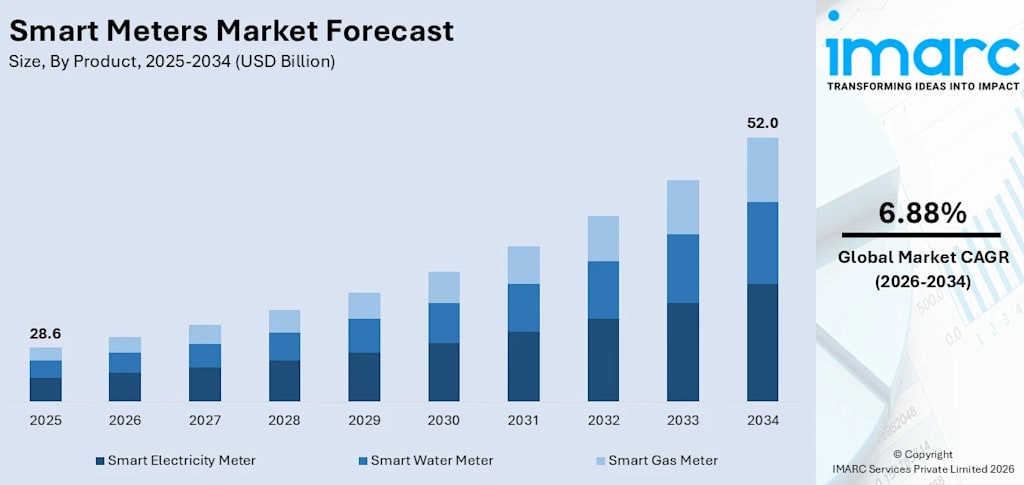
Modernizing power grids and improving utility management are driving the demand for smart meters, supported by government mandates, the rise of smart cities, and a global shift toward energy efficiency and decarbonization. According to IMARC Group’s latest data, the global smart meters market size was valued at USD 28.6 Billion in 2025. Looking forward, IMARC Group estimates the market to reach USD 52.0 Billion by 2034, exhibiting a CAGR of 6.88% from 2026-2034.
Smart meters have evolved from simple digital readers into essential components of the modern energy ecosystem, surpassing a market valuation of USD 28 billion. This growth is propelled by the urgent need for utilities to reduce non-technical losses, such as energy theft, and to integrate fluctuating renewable energy sources like solar and wind into the grid. Beyond just electricity, the expansion into smart gas and water metering is gaining speed as municipalities look to prevent leaks and automate billing. With the integration of 5G and IoT, these devices now offer real-time data flow, allowing both providers and consumers to monitor usage patterns with unprecedented precision.
Get Your Free "Smart Meters Market" Strategic Insights Sample
Smart Meters Market Growth Drivers:
- Global Push for Grid Modernization and Energy Efficiency
Governments and utility providers are aggressively replacing aging analog infrastructure with advanced digital systems to create a more resilient energy web. This transition is essential for managing the rising electricity demand, which is projected to grow by over 3% annually in many developing economies. By implementing smart grids, utilities can significantly reduce transmission losses and improve outage detection. In regions like India, the Revamped Distribution Sector Scheme (RDSS) has already sanctioned the installation of nearly 200 million smart meters to stabilize the power sector and enhance operational transparency.
- Rapid Integration of Renewable Energy Sources
As the world pivots toward green energy, smart meters act as the critical interface between decentralized power sources and the main grid. They facilitate "net metering," allowing homeowners with solar panels to sell excess power back to the utility. Since renewable energy is often intermittent, these meters provide the real-time visibility required to balance supply and demand dynamically. This capability is vital for hitting international sustainability targets, as smart metering infrastructure ensures that green energy is distributed efficiently without compromising the stability of the local electrical frequency.
- Rising Consumer Demand for Transparency and Cost Control
Modern consumers are increasingly proactive about managing their utility bills and environmental footprint. Smart meters empower them by providing detailed insights through mobile apps, showing exactly when and where energy is being used. This transparency encourages a shift toward off-peak usage, which can lower monthly costs for households while reducing the "peak load" strain on power plants. Real-world data indicates that homes equipped with smart displays can achieve energy savings of up to 3% simply through better awareness and minor behavioral adjustments in daily routines.
Smart Meters Market Trends:
- Evolution of Advanced Metering Infrastructure (AMI) and 5G Connectivity
The industry is shifting from basic automated reading to sophisticated two-way communication systems powered by 5G and IoT. This allows for remote firmware updates, instant disconnect/reconnect services, and high-frequency data collection that was previously impossible. By utilizing 5G networks, utilities can manage millions of endpoints simultaneously with minimal latency. This trend is particularly visible in the United States and Europe, where providers are investing in "intelligent nodes" that not only measure consumption but also monitor the health of the entire distribution transformer in real-time.
- Integration with Electric Vehicle (EV) Charging Infrastructure
The explosion of electric vehicle ownership is creating a massive new load on residential power grids, often occurring simultaneously overnight. Smart meters are becoming the primary tool for managing this "EV surge" through smart charging protocols. These devices can communicate with EV chargers to pause or slow down charging during periods of high grid stress. In the U.S. alone, where EV sales recently surpassed 1.2 million units annually, smart meters are indispensable for ensuring that neighborhood transformers aren't overwhelmed by the collective power draw of dozens of vehicles.
- Focus on Cybersecurity and Tamper-Proof Technologies
As utility grids become more digitized, they also become potential targets for cyber-attacks and sophisticated fraud. Consequently, a major trend is the development of meters with "bank-grade" encryption and hardware-based security modules. These advanced devices can detect physical tampering such as magnetic interference or unauthorized opening of the casing and send an immediate alert to the utility. Manufacturers are now prioritizing standardized security protocols to protect consumer data and national infrastructure, making cybersecurity a core feature of the latest hardware releases across North America and East Asia.
Recent News and Developments in Smart Meters Market
- March 2026: A major industry report confirmed that the UK’s smart meter rollout reached a milestone, with over 71% of all domestic and small business meters now operating in smart or advanced mode, targeting a near-total transition by 2030.
- September 2025: In India, the Ministry of Power reported that under the RDSS initiative, over 5.28 crore (52.8 million) smart meters have been successfully installed across various states to curb AT&C losses and improve billing efficiency.
- March 2025: Honeywell launched its new NXU Residential Smart Gas Meter in North America, featuring remote operability and automated safety shut-offs to enhance utility management and consumer safety through the Honeywell Forge platform.
Note: If you require specific details, data, or insights that are not currently included in the scope of this report, we are happy to accommodate your request. As part of our customization service, we will gather and provide the additional information you need, tailored to your specific requirements. Please let us know your exact needs, and we will ensure the report is updated accordingly to meet your expectations.
About the Creator
Andrew Sullivan
Hello, I’m Andrew Sullivan. I have over 9+ years of experience as a market research specialist.
Keep reading
More stories from Andrew Sullivan and writers in Futurism and other communities.
Insurtech Market Opportunities: API Integration, Personalized Policies & Industry Forecast to 2034
The insurance industry is undergoing a radical digital overhaul as legacy systems give way to agile, data-driven platforms. No longer just a buzzword, "Insurtech" has become the operational backbone for modern carriers looking to slash overhead and meet the demands of a mobile-first generation. According to IMARC Group’s latest data, the global insurtech market size was valued at USD 10.3 Billion in 2025. Looking forward, IMARC Group estimates the market to reach USD 152.9 Billion by 2034, exhibiting a CAGR of 31.51% from 2026-2034.
By Andrew Sullivana day ago in Futurism
The Fears of AI And How Much Fun It Can Be
ChatGPT has come a long way, as has AI in general. There are those people who are scared of it, and for understandable reasons. People fear that as technologies advance, they’ll be replaced in the workforce. Then, there are the fears that AI could evolve into something that brings us to the brink of extinction.
By Jason Morton3 days ago in Futurism
Space Tourism Market Insights: Orbital Travel, Innovation & Forecast to 2033
What was once the exclusive domain of astronauts is rapidly becoming a commercial industry. Wealthy adventurers, private researchers, and forward-thinking brands are all staking claims on the final frontier — and the numbers reflect it. According to IMARC Group's latest research, the global space tourism market size was valued at USD 1.3 Billion in 2024. Looking forward, IMARC Group estimates the market to reach USD 20.1 Billion by 2033, exhibiting a CAGR of 34.0% during 2025-2033. North America currently dominates the market, holding a market share of over 38.9% in 2024. Rapid technological advancements, increasing competition among private space companies, rising public interest in space exploration, government support, and diversification of offerings are driving the market in this region.
By Suhaira Yusuf2 days ago in Futurism
Something Is Beginning, I Think Challenge Winners
This challenge wasn’t about clean starts. It was about that weird in-between where something is beginning, but no one really knows what yet. A lot of these stories leaned into hesitation, into pauses and false starts and that feeling that something is about to happen but hasn’t quite.
By Vocal Curation Teama day ago in Resources



Comments
There are no comments for this story
Be the first to respond and start the conversation.