
Sensor Fusion Market Trends: Autonomous Systems Growth & Forecast to 2033
How increasing adoption of autonomous vehicles, robotics, and real-time analytics is accelerating innovation in the global sensor fusion market

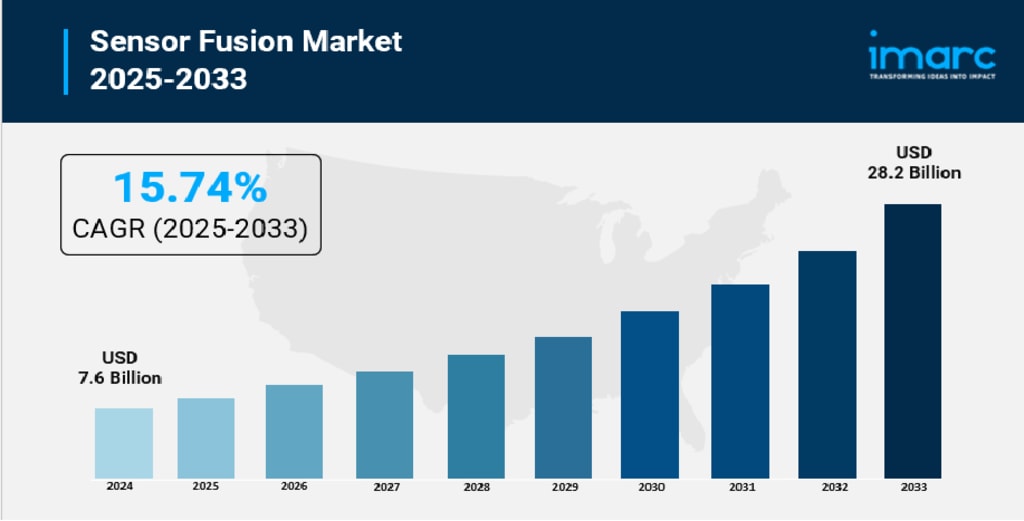
Rising adoption of IoT devices, growing demand for autonomous vehicles, and rapid advancements in AI-powered analytics are fueling the need for smarter, more integrated sensor technologies. According to IMARC Group's latest research, the global sensor fusion market size reached USD 7.6 Billion in 2024. Looking ahead, IMARC Group projects the market to reach USD 28.2 Billion by 2033, reflecting a CAGR of 15.74% from 2025 to 2033. Asia Pacific currently dominates the market, driven by investments in smart infrastructure, booming automotive electronics, and a strong push toward autonomous vehicle development and smart city deployment.
Sensor fusion — the process of combining data from multiple sensors like radar, LiDAR, cameras, and IMUs into a single coherent output — has become foundational to modern technology. From the car that keeps you in your lane to the robot arm assembling your smartphone, sensor fusion is quietly working in the background. The market spans segments including Radar Sensors, Image Sensors, IMU, and Temperature Sensors, with IMU holding the largest share. By technology, MEMS dominates due to its compact size, affordability, and high accuracy, while key industry verticals served include Automotive, Healthcare, Consumer Electronics, and Military & Defense.
Sensor Fusion Market Growth Drivers:
Surge in IoT Device Adoption
With more than 18 billion connected IoT devices already deployed globally and that number expected to exceed 40 billion by the end of the decade, the demand for reliable, multi-source data processing has never been higher. Sensor fusion ties together inputs from temperature, motion, humidity, and light sensors into actionable intelligence. Smart factories, logistics hubs, and connected health devices all depend on this capability. Without fusion, you just have data noise — with it, you get real decisions. That practical value is what's pushing adoption higher across sectors.
Accelerating Demand for Autonomous Vehicles and Drones
Self-driving vehicles depend entirely on the ability to merge radar, LiDAR, camera, and ultrasonic sensor data in real time — there is no safe AV without effective sensor fusion. With global AV investments surpassing USD 50 billion and governments from the U.S. to China actively funding autonomous mobility programs, demand for robust fusion algorithms is intensifying. The same logic applies to commercial drones. Companies like Waymo and Baidu have put sensor fusion R&D at the center of their stack, reinforcing its role as mission-critical infrastructure.
Need for Better Accuracy in Healthcare and Industrial Automation
In healthcare, fusing biometric sensor data — think ECG, SpO2, and motion — enables continuous patient monitoring that is far more reliable than single-sensor readings. Hospitals using multi-sensor wearables have seen diagnostic accuracy improve significantly for conditions like arrhythmia and sleep apnea. In industrial automation, fused sensor data drives predictive maintenance models, reducing unplanned downtime by up to 30% in some manufacturing settings. Both sectors are scaling fast, and governments in the EU and U.S. have backed digital health and Industry 4.0 programs that directly fund this kind of infrastructure.
Sensor Fusion Market Trends:
Real-Time Data Processing Becomes the Standard
Organizations are no longer satisfied with batch-processed sensor data — they want answers in milliseconds. Edge computing platforms and AI accelerator chips are making real-time sensor fusion viable even on compact, battery-powered hardware. In logistics, for example, real-time fused data from warehouse robots has cut picking errors by over 20% in pilot deployments. The shift to real-time is not just a technical preference; it is a competitive differentiator. Companies that can act on live fused sensor outputs are making faster, better-informed decisions than those still working with delayed data streams.
MEMS Miniaturization Opens New Application Frontiers
MEMS-based sensors — gyroscopes, accelerometers, magnetometers — have shrunk to the point where they fit comfortably inside a smartwatch or hearing aid. This miniaturization is expanding sensor fusion into consumer devices that would have been impractical five years ago. AR/VR headsets, next-generation earbuds, and even smart clothing are beginning to integrate fused MEMS data for enhanced user experiences. Bosch Sensortec and STMicroelectronics have both announced next-gen MEMS platforms targeting sub-milliwatt power consumption, a critical milestone for wearable applications where battery life is everything.
AI and Machine Learning Integration Reshaping Fusion Algorithms
Traditional sensor fusion relied on deterministic algorithms — Kalman filters and the like. The industry is now layering deep learning on top of these foundations, training models to dynamically weight sensor inputs based on environmental conditions. NVIDIA's DRIVE platform and Qualcomm's automotive chips both embed AI-driven fusion frameworks. This matters because real-world environments are messy: a camera loses performance in fog, radar struggles with stationary objects. AI-enhanced fusion learns which sensors to trust under which conditions, making systems more resilient and reducing failure rates in critical deployments.
Recent News and Developments in the Sensor Fusion Market
August 2025: Bosch Sensortec unveiled its next-generation BMI323 IMU, featuring an advanced sensor fusion core optimized for always-on wearable applications. The chip integrates hardware-accelerated fusion algorithms, reducing host processor load by up to 60% — a significant step toward practical, low-power health monitoring devices.
September 2025: Qualcomm announced an expansion of its Snapdragon Ride platform with enhanced multi-sensor fusion capabilities targeting Level 3 and Level 4 autonomous driving. The update includes dedicated AI inference units designed to process fused LiDAR, radar, and camera data simultaneously at vehicle-grade reliability standards.
October 2025: The U.S. Department of Defense extended its investment in multi-domain sensor fusion programs under the DARPA-backed Mosaic Warfare initiative, committing an additional USD 320 million toward research into battlefield sensor integration technologies. This underscores growing government confidence in sensor fusion as strategic defense infrastructure.
November 2025: STMicroelectronics introduced its ISM330IS intelligent sensor module with an embedded AI core for on-device sensor fusion. Targeting industrial IoT applications, the module delivers real-time motion and vibration analytics without requiring a separate microcontroller — cutting both system cost and power draw for factory-floor deployments.
Note: If you require specific details, data, or insights that are not currently included in the scope of this report, we are happy to accommodate your request. As part of our customization service, we will gather and provide the additional information you need, tailored to your specific requirements. Please let us know your exact needs, and we will ensure the report is updated accordingly to meet your expectations.
About the Creator
Suhaira Yusuf
I specialize in Consumer Insights, focusing on transforming detailed market data into strategic business solutions that accelerate growth and improve customer engagement.
Keep reading
More stories from Suhaira Yusuf and writers in Futurism and other communities.
Transcritical CO2 Market Insights: Industrial Cooling, Efficiency & Forecast to 2033
According to IMARC Group's latest research publication, “Transcritical CO2 Market: Global Industry Trends, Share, Size, Growth, Opportunity and Forecast 2025–2033,” the global transcritical CO2 market size reached USD 60.3 Billion in 2024. Looking forward, IMARC Group expects the market to reach USD 210.2 Billion by 2033, exhibiting a growth rate (CAGR) of 14.9% during 2025–2033.
By Suhaira Yusuf11 days ago in Futurism
The Fears of AI And How Much Fun It Can Be
ChatGPT has come a long way, as has AI in general. There are those people who are scared of it, and for understandable reasons. People fear that as technologies advance, they’ll be replaced in the workforce. Then, there are the fears that AI could evolve into something that brings us to the brink of extinction.
By Jason Morton4 days ago in Futurism
Foreign Exchange Market Trends: Currency Volatility, Digital Trading Platforms & Industry Forecast to 2034
As the financial world becomes more interconnected, the need for seamless, high-volume currency conversion has never been greater. Driven by a surge in cross-border trade, evolving central bank policies, and the rapid integration of high-frequency trading technologies, the foreign exchange landscape is shifting toward a more transparent and digitally-led ecosystem. According to IMARC Group’s latest data, the global foreign exchange market size was valued at USD 917.9 Billion in 2025. Looking forward, IMARC Group estimates the market to reach USD 1,592.1 Billion by 2034, exhibiting a CAGR of 6.31% from 2026-2034.
By Andrew Sullivana day ago in Futurism



Comments
There are no comments for this story
Be the first to respond and start the conversation.