
Retail Market Insights: Private Label Growth, Competitive Strategies & Industry Forecast to 2034
How private label expansion, competitive pricing strategies, and retailer-driven innovation are strengthening margins and reshaping competition within the evolving retail landscape

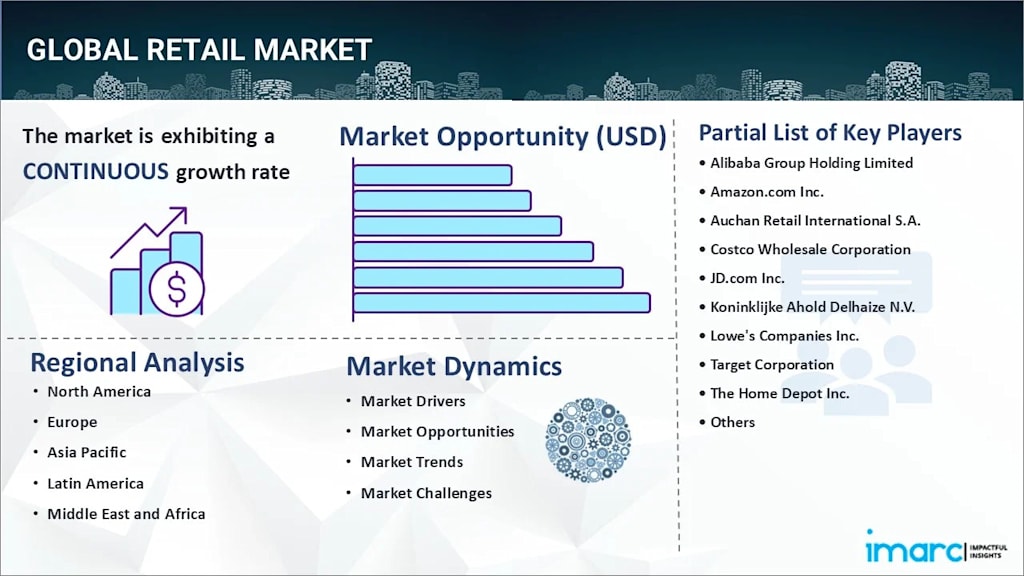
Rising retail media importance, accelerated digitalization, and the growing influence of private labels are driving global retail demand, supported by AI-driven personalization, omnichannel logistics, and expanding e-commerce penetration. According to IMARC Group’s latest data, the global retail market size reached USD 31,674.6 Billion in 2025. Looking forward, IMARC Group estimates the market to reach USD 50,010.7 Billion by 2034, exhibiting a CAGR of 5.05% from 2026-2034.
The retail landscape has evolved into a massive global ecosystem exceeding USD 31 trillion, characterized by a shift toward "phygital" experiences that blend physical storefronts with digital convenience. Demand is increasingly influenced by value-seeking consumer behavior, where shoppers prioritize price transparency and loyalty rewards. Technological integration, particularly in AI for inventory management and AR for virtual try-ons, is further accelerating market maturity. Major product segments include food and beverages, which hold the majority share, followed by apparel, electronics, and household care, with consumers across all demographics demanding more sustainable sourcing and faster fulfillment options like BOPIS (Buy Online, Pick Up In-Store).
Retail Market Growth Drivers:
- Rapid Integration of AI and Automation
Retailers are moving beyond experimental phases to full-scale AI execution to combat labor shortages and rising operational costs. By 2026, roughly 68% of industry leaders expect to adopt agentic AI to handle complex tasks like real-time pricing and predictive scheduling. These systems allow stores to adjust staffing based on weather patterns or local events, significantly boosting productivity. Automation in warehouses and the use of self-checkout lanes are now standard, helping businesses protect margins while freeing human staff to focus on high-value customer interactions and specialized expert guidance.
- Surge in Retail Media and Data Monetization
Retailers are transforming into advertising powerhouses by leveraging their vast pools of first-party customer data. Retail media has become a critical profit engine, with digital advertising margins reaching up to 50%, far outpacing traditional product sales. By selling targeted ad space on their apps and websites, major chains are offsetting the pressure of tight margins in the core business. This shift is particularly evident in the grocery sector, where brands pay a premium to appear at the top of search results, creating a multi-billion-dollar secondary revenue stream for retailers.
- Expansion of Omnichannel and BOPIS Models
The line between online and offline shopping has blurred, with the "Buy Online, Pick Up In-Store" (BOPIS) market in the U.S. alone reaching approximately USD 112 billion recently. Consumers now demand the instant gratification of physical shopping combined with the ease of digital browsing. Retailers are redesigning store layouts to act as mini-fulfillment centers, optimizing "the last mile" to reduce shipping times. This hybrid approach caters to the modern urban lifestyle, where shoppers value flexibility, leading to a projected 16% annual growth in omnichannel-related transactions through the end of the decade.
Retail Market Trends:
- The Structural Shift Toward Value and Private Labels
High-income and middle-class households alike are increasingly becoming "deal-driven" due to persistent cost-of-living pressures. This has led to a major resurgence in private-label goods, which now account for over 38% of food sector sales in Europe, totaling roughly €352 billion. Retailers are no longer just offering "budget" alternatives but are launching premium, organic, and functional store brands that compete directly with national names. This trend strengthens the retailer's bargaining power with suppliers and fosters deep consumer loyalty through exclusive, high-quality products that offer better value for every dollar spent.
- Hyper-Personalization via Generative AI
Marketing is being reimagined as nearly 67% of retail executives deploy AI-driven personalization capabilities. Instead of generic mass-mailing, shoppers now receive tailored recommendations and unique brand experiences based on their specific browsing history and preferences. By 2026, AI "shopping agents" are expected to influence a significant portion of global e-commerce, acting as intermediaries that help consumers find the best deals. This transition allows retailers to scale creative ideas and customer data across multiple channels, making every interaction feel curated and personal rather than transactional or repetitive.
- Sustainability and Circular Economy Initiatives
Environmental stewardship has moved from a niche interest to a regulatory and consumer mandate, influencing over a third of purchase decisions globally. Retailers are investing heavily in "push to zero" carbon initiatives and redesigning packaging to be 100% recyclable or reusable. Governments are also stepping in; for instance, the U.S. Economic Development Administration (EDA) has funneled millions into infrastructure projects that help communities revitalize their local retail bases with a focus on sustainable growth. This trend includes a "return economy" overhaul, where retailers implement fees to deter waste and optimize logistics for a lower environmental footprint.
Recent News and Developments in Retail Market
- January 2026: Deloitte’s Global Retail Outlook highlighted a massive shift toward "Agentic AI," predicting that autonomous AI agents will handle up to 25% of all online consumer transactions by 2030, fundamentally changing how retailers interact with their digital audience.
- November 2025: The National Retail Federation (NRF) advocated for the Credit Card Competition Act, a legislative move aimed at saving U.S. businesses an estimated USD 16 billion annually in "swipe fees," allowing retailers to reinvest those savings into lower prices for consumers.
- September 2025: Major global retailers announced a "Supply Chain Redesign" initiative to combat rising costs from trade policies, shifting from minor adjustments to end-to-end infrastructure overhauls to ensure resilience against geopolitical volatility and shipping disruptions.
Note: If you require specific details, data, or insights that are not currently included in the scope of this report, we are happy to accommodate your request. As part of our customization service, we will gather and provide the additional information you need, tailored to your specific requirements. Please let us know your exact needs, and we will ensure the report is updated accordingly to meet your expectations.
About the Creator
Andrew Sullivan
Hello, I’m Andrew Sullivan. I have over 9+ years of experience as a market research specialist.
Keep reading
More stories from Andrew Sullivan and writers in Futurism and other communities.
Foreign Exchange Market Trends: Currency Volatility, Digital Trading Platforms & Industry Forecast to 2034
As the financial world becomes more interconnected, the need for seamless, high-volume currency conversion has never been greater. Driven by a surge in cross-border trade, evolving central bank policies, and the rapid integration of high-frequency trading technologies, the foreign exchange landscape is shifting toward a more transparent and digitally-led ecosystem. According to IMARC Group’s latest data, the global foreign exchange market size was valued at USD 917.9 Billion in 2025. Looking forward, IMARC Group estimates the market to reach USD 1,592.1 Billion by 2034, exhibiting a CAGR of 6.31% from 2026-2034.
By Andrew Sullivanabout 9 hours ago in Futurism
The Fears of AI And How Much Fun It Can Be
ChatGPT has come a long way, as has AI in general. There are those people who are scared of it, and for understandable reasons. People fear that as technologies advance, they’ll be replaced in the workforce. Then, there are the fears that AI could evolve into something that brings us to the brink of extinction.
By Jason Morton4 days ago in Futurism
How Elementor Theme Builder Works and Why Designers Use It in 2026
The first time I built a website with Elementor, I spent hours designing the perfect page layout. The content area looked exactly the way I wanted it. Clean sections, consistent typography, a color palette that reflected the brand. Then I previewed the page on the live site and noticed something that immediately deflated all that effort. The header at the top and the footer at the bottom looked completely different from everything I had just designed. They belonged to the WordPress theme, and no amount of work inside Elementor could touch them.
By Shane Smith5 days ago in Futurism



Comments
There are no comments for this story
Be the first to respond and start the conversation.