
Ray Kurzweil and the 2045 Singularity: Will AI Make Us Immortal? 🤖🧠
From exponential growth to biological transcendence: How one man’s 60-year obsession is rewriting the rules of life.
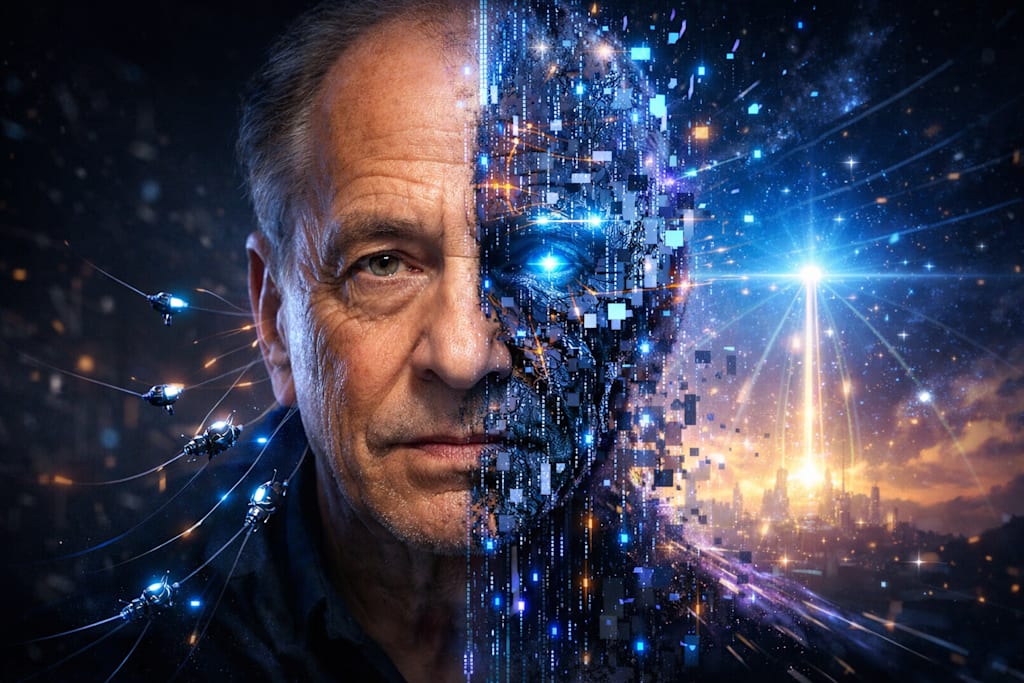
In the world of technology, few visionaries spark as much admiration and controversy as Ray Kurzweil. This 78-year-old scientist, inventor, and Principal Researcher at Google has been immersed in artificial intelligence for over six decades 🔮. While others forecast the future a year or two in advance, Kurzweil looks decades ahead, painting a vision of a world where the boundary between human and machine finally vanishes. ✨
Who is the "Prophet of Silicon Valley"? 🕶️
Ray Kurzweil is far more than just a theorist; he is a practitioner who laid the foundation for much of today’s technology. He is the inventor of the first CCD flatbed scanner, Omni-font OCR (optical character recognition) for the blind, and the music synthesizers that still carry his name today 🎹. His track record led Bill Gates to call him "the best person I know at predicting the future of artificial intelligence" 🏆.
Since 2012, Kurzweil has worked at Google 🏢, overseeing projects related to machine learning and natural language processing. However, it is his books, such as The Singularity Is Near, that have made him a cult figure. His technological optimism is built upon one fundamental principle: The Law of Accelerating Returns ⚡.
The Law Driving the Future 📈
According to Kurzweil, human intuition regarding the future is often flawed because we think linearly. If progress over the last 10 years was "X," we expect the next 10 years to also be "X." However, technology evolves exponentially 🚀.
Kurzweil notes that computing power doubles roughly every few months. This process isn't slowing down—it's accelerating. It is this law that has allowed Kurzweil to predict key milestones in technological history with uncanny precision ⏳.
Predictions That Became Reality ✅
While skeptics often call Kurzweil a dreamer, the numbers speak for themselves. The scientist himself analyzed his predictions from the 1990s and calculated an accuracy rate of approximately 86% 🎯. What exactly did he get right?
Computer Victory in Chess: In 1990, he predicted a computer would defeat a world champion by 1998. Deep Blue did exactly that against Garry Kasparov in 1997 ♟️.
The Internet Explosion: At a time when the web was a niche tool for researchers, Kurzweil foretold it would become a ubiquitous force connecting billions of people 🌐.
Wearable and Wireless Tech: He predicted tablets, augmented reality glasses, and universal Wi-Fi access long before they hit the consumer market 📱.
Destination 2029: The Turing Test 🤖
Before we reach 2045, Kurzweil has marked a closer date that, in our current era, no longer sounds like science fiction: the year 2029 📅. He maintains that by then, AI will achieve human-level intelligence and pass the famous Turing Test.
Looking at the rapid evolution of models like GPT-4 and Claude, his 25-year-old forecast seems strikingly accurate today. Kurzweil believes AI won't just "fake" intelligence but will possess the capacity for empathy, humor, and an understanding of nuances we once thought were uniquely human 🎭.
The Grand Finale: Singularity 2045 ✨🔌
All these stages lead to the point Kurzweil calls The Singularity. He has set the date for 2045. What will happen then? 🤔
According to his vision, technological progress will become so rapid that the unaugmented human mind will no longer be able to comprehend it. However, Kurzweil doesn’t see this as a "Terminator-style" threat. On the contrary—he believes we will merge with the machines 🧬.
By 2045, our brains are expected to be connected directly to the cloud via nanobots circulating in our bloodstream 🩸🤖. This will allow for:
Expanded Intelligence: Our neocortex will gain access to infinite computational resources 💡.
Total Virtual Reality: We will be able to send signals directly to the nervous system, experiencing simulations with all five senses 🥽.
Biological Immortality: Nanotechnology will repair our organs and cells from the inside out, eliminating diseases and the aging process ⌛🚫.
For Kurzweil, 2045 is the moment humanity "liberates" itself from biological limitations. We will become a hybrid species—beings whose capabilities are billions of times greater than they are today 🌌.
Is He Right? 🧐
While Kurzweil’s visions sound like a techno-utopian religion to many, he is difficult to ignore. Through 60 years of work, he has proven that he understands the mechanics of progress better than almost anyone else. Even if 2045 turns out to be an overly optimistic deadline, the direction seems to be set 📍.
An article about Ray Kurzweil is more than just a story about technology—it’s a story about the eternal human desire to transcend boundaries. Will we truly "upload" our minds to the cloud in 20 years? Given the accuracy of this "old man from Google," it might be unwise to bet against him 🎲.
Fun Fact: Ray Kurzweil takes dozens of supplements and vitamins every day, believing that if he can make it to the 2030s, "technological bridges" will allow him to live forever 💊💊.
Do you think the vision of merging the human brain with AI in 2045 is exciting, or rather terrifying? 👇
About the Creator
Piotr Nowak
Pole in Italy ✈️ | AI | Crypto | Online Earning | Book writer | Every read supports my work on Vocal
Keep reading
More stories from Piotr Nowak and writers in Futurism and other communities.
The Computer Picked the Culprit, But It Wasn’t Me. The Story That Changed the Law ⚖️
As a huge AI enthusiast, I spend my mornings tracking new language models and my evenings testing image generators. I am fascinated by how AI pushes the boundaries of what is possible 🚀. However, for our love of technology to be mature, we must look it straight in the eye—even when its "vision" proves to be flawed and unjust.
By Piotr Nowak4 days ago in Futurism
How machines can learn from human behaviour
In order to understand where we are and where we are going, we need to understand where we were first. - Susan Fourtane Could a human behaviour simulator be embedded into a robot or online avatar to the point that it’s hard to distinguish between a real person or artificial intelligence? Scientists have been upping the stakes in this “Turing test” for years, to the point that human-mimicking programmes are ready to answer tricky questions, assist people with online shopping or be companions.
By Susan Fourtané 19 days ago in Futurism



Comments
There are no comments for this story
Be the first to respond and start the conversation.