
How I Quit Social Media and Discovered I Was Still Real
What I learned when I stopped performing my life and started actually living it

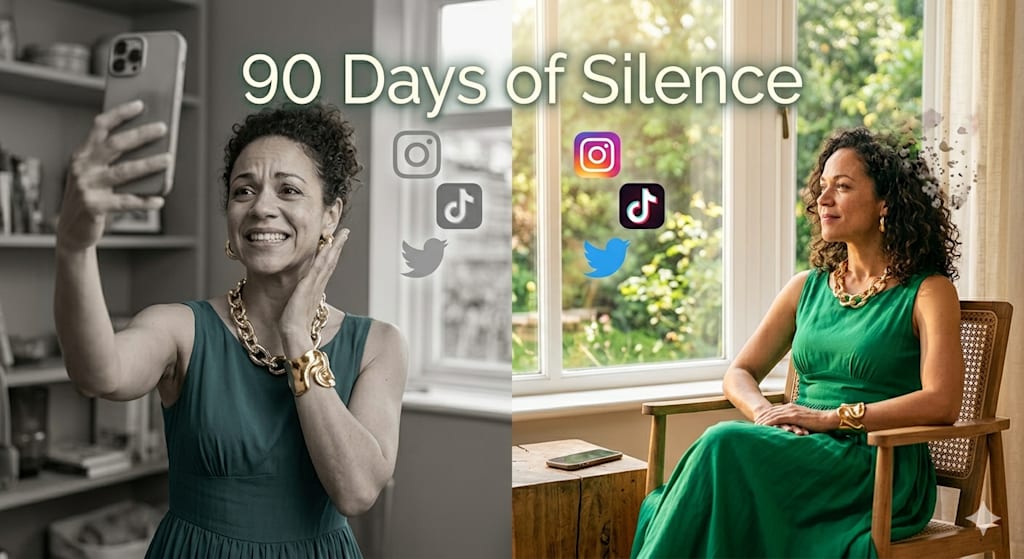
It started with a number.
Not a big number. Not something that would make sense to anyone else. Just a notification that said I'd spent 7 hours and 43 minutes on Instagram yesterday. Seven hours. In one day. Almost a third of my waking hours, scrolling through pictures of other people's lives while my own life happened in the background, unwatched and undocumented.
I stared at that screen time notification for a full five minutes, waiting for it to feel normal. It didn't.
Then I did what I always do when I'm uncomfortable: I opened TikTok.
The Woman Who Lived on Her Phone
Let me paint you a picture of who I was in 2025.
I was twenty-six years old, which is young enough to have grown up with social media but old enough to remember what life was like before it. I was one of those hybrid people—someone who could theoretically function without my phone but who, practically speaking, never tried.
I had 47,000 followers on Instagram. Not influencer numbers, but respectable. Enough that when I posted something, people noticed. Enough that I'd started getting PR companies asking if I wanted free products in exchange for posts. Enough that I'd convinced myself I was "building a brand."
What I was actually doing was performing.
Every morning, I'd wake up and think about what would be interesting to share. Not what I actually wanted to do—what would be interesting to share. I'd go to coffee shops not because I wanted coffee, but because coffee shops have good lighting. I'd wear outfits that looked good in photos, not outfits that felt good to wear. I'd have experiences and immediately think about how to capture them, frame them, filter them, caption them, post them.
The problem was, I was so busy documenting my life that I'd stopped living it.
My real friends—the ones I'd known since college—noticed first. They'd text me to come over, and I'd be there physically but mentally I'd be composing captions. I'd be at dinner with them and simultaneously be thinking about the angles for the food photo. I'd laugh at something funny and immediately think about whether I could turn it into a TikTok.
"You're not even here," my best friend Maya said once, after I'd been scrolling for twenty minutes at her birthday dinner. "Like, physically you're here, but you're not actually here."
She was right. I wasn't there. I was somewhere in the cloud, in the algorithm, in the space between reality and the performance of reality.
But I didn't know how to stop.
The Addiction That Doesn't Look Like Addiction
Here's what nobody tells you about social media: it's specifically designed to be addictive, and the addiction is invisible.
I could go to therapy and talk about my relationship problems. I could go to the doctor and get treated for anxiety. I could even quit drinking if I wanted to (I didn't, but I could). But social media addiction doesn't have a DSM diagnosis. It doesn't look like addiction. It looks like being young. It looks like being connected. It looks like having your life together.
The truth is way darker.
I was checking my phone approximately 347 times a day. I'm not exaggerating—I actually counted once. Three hundred and forty-seven times. That's every 2.5 minutes of my waking life, on average. Not because I was expecting important messages. Not because I had a good reason. Just because something in my brain had been rewired to seek that dopamine hit—the notification, the like, the comment, the validation from strangers on the internet.
My sleep was terrible because I'd scroll until 2 AM, then wake up and immediately check my phone. My work was suffering because I couldn't focus for more than five minutes before feeling the urge to scroll. My relationships were deteriorating because I was emotionally unavailable—I was giving all my presence to my phone and leaving crumbs for the actual humans in my life.
But the worst part? I didn't think it was a problem.
I thought everyone was like this. I thought this was just what it meant to be young in 2025. I thought this was normal, healthy, fine.
It wasn't until my mom asked, casually, over a video call, "Do you ever just sit without your phone?" that I realized I couldn't answer the question. I genuinely couldn't remember the last time I'd sat anywhere—my apartment, a coffee shop, the park—without my phone in my hand.
That was the moment something shifted.
The Breaking Point That Looked Like a Breakdown
I didn't quit social media because I had a dramatic realization. I quit it because I had a complete breakdown.
It sounds more dramatic than it was, and less dramatic at the same time. I was sitting in my apartment on a Thursday evening, scrolling through Instagram, and I saw a photo of my ex-girlfriend with her new partner. They looked happy. And instead of feeling the normal mixture of sadness and jealousy that you're supposed to feel in that situation, I felt... nothing. Except for a deep, horrifying sense of shame.
Because I realized: I didn't actually care about my ex. What I cared about was the story I was telling myself about caring. I cared about how sad I looked caring. I cared about whether my sadness would resonate with my followers.
I was so removed from my own emotions that I could only feel them if they were performing well.
That's when I broke.
Not like a dramatic, crying-on-the-floor kind of break. More like a hairline fracture that, once you see it, you can't unsee. A fundamental crack in the system that I'd built my entire identity on.
I closed Instagram.
I deleted TikTok.
I deactivated Twitter.
And then—this is the part that sounds insane but is completely true—I sat in silence for three hours and felt like I was going to die.
The withdrawal was real. The anxiety, the boredom, the constant low-level panic that I was missing something. My fingers kept reaching for my phone and then realizing it wasn't there. Or it was there, but the apps weren't, and that felt worse somehow. Like phantom limb syndrome, but for my identity.
By hour four, I had convinced myself this was a mistake. I should reactivate. One more scroll wouldn't hurt. Just to check if anyone had responded to my posts—
But I didn't.
Instead, I picked up a book I'd been meaning to read for six months and made it through approximately two pages before my attention span completely betrayed me. I watched a movie but couldn't actually follow the plot because my brain was clearly used to jumping between fifteen different stimuli simultaneously. I tried to meditate and lasted forty seconds before my nervous system started screaming that something was wrong.
Everything felt wrong. Because social media had been my default setting for so long that being without it felt like being unplugged from reality itself.
Days 1-30: The Digital Detox That Feels Like Punishment
The first week was hell.
Not metaphorically. Actual, honest-to-God, I-want-to-crawl-out-of-my-skin hell. My anxiety was through the roof. Every notification on my phone—even text messages from real people—sent my heart racing. I kept having this weird, paranoid thought that if I wasn't posting, nobody would remember I existed. That by disappearing from social media, I was disappearing from reality.
Which is a horrifying thing to realize about yourself.
I started noticing things that used to seem normal but now seemed absolutely insane. How many conversations my friends would have that started with "I saw this on TikTok." How much of our actual interaction was secondhand—we'd experienced things through the internet before we'd experienced them in person. How performative everything had become. We weren't having experiences; we were having Content.
The boredom was unbearable.
Without social media, I had to actually sit with my own thoughts. I had to actually figure out what I wanted to do with my time, without the algorithm telling me what to do. I'd wake up and think, "What should I do today?" and immediately feel paralyzed by the emptiness of that question.
So I did the most millennial thing possible: I started planning content.
Even without the apps, I was still thinking in content. I'd go for a walk and think about how I would have captioned that moment. I'd cook dinner and think about the filter I would have used. I'd have a thought and immediately wonder if it would get good engagement.
The digital world had colonized my brain so thoroughly that removing it from my hands didn't remove it from my mind.
But something else happened in those first thirty days. Something slower and quieter than the withdrawal symptoms. Something that felt like waking up.
Days 30-60: The Quiet Revolution
By day thirty, the acute withdrawal had faded.
I wasn't constantly reaching for apps that didn't exist anymore. I wasn't panicking every time I had a thought and realized I couldn't share it. I was starting to exist in a way that felt almost... present.
The boredom was still there, but it had transformed into something else. Something that almost felt like peace.
I started noticing things.
Like: I could have a conversation with someone and actually remember it afterward, because I wasn't simultaneously performing the conversation in my head for an imaginary audience. Like: I could read a book for longer than five minutes without my attention completely fragmenting. Like: I could just sit in my apartment and not feel like I was wasting time.
These things sound small. They're not small.
I called my parents for the first time in months and actually talked to them for two hours instead of the usual fifteen-minute obligation call. I had coffee with Maya without checking my phone once, and realized how much I'd missed actually seeing her face—not the Instagram version, the real, unfiltered, unedited version.
I went to the grocery store and didn't take a single photo of my haul. I cooked a meal and ate it instead of filming it. I had a great moment and just... let it be a moment, without documenting it for posterity.
This is going to sound ridiculous, but it felt revolutionary.
What I was discovering was that my thoughts were still my own. My experiences were still valid even if nobody knew about them. My life had value even if it wasn't being curated for public consumption.
I was still real.
The Part Where Everything Gets Complicated
Here's where the story gets messy, because real life is messy.
I was at a party around day forty, and someone mentioned my Instagram. "I noticed you haven't posted in a while," they said. "Are you okay?"
And I had to explain—to a stranger at a party—that I'd quit social media. And immediately, people got weird about it. Like I'd announced I was joining a cult. Some people were defensive (as if my quitting social media was a judgment on their social media use, which, fair). Some people were condescending (suggesting I'd eventually return to "reality" and rejoin). Some people were genuinely confused about how I could possibly be okay.
"But how do people know what you're doing?" someone asked.
"They... don't," I said. "And it's great."
But there were real consequences.
I lost some followers during those first sixty days. Not because I was posting less (obviously), but because people unfollowed me, presumably because my account looked inactive. Some PR opportunities dried up because I wasn't "actively building my brand." I had to turn down free products and sponsorships because they no longer applied to me.
I was also, it turned out, slightly isolated.
A lot of my social life had been mediated through social media. Making plans, staying in touch, hearing about events—all of it happened on Instagram or TikTok or group chats. Without those platforms, I had to be more intentional. I had to actually text people. I had to actually remember birthdays instead of relying on Facebook to remind me.
This sounds like a benefit, and it is. But it's also harder. Intentional socializing requires more energy than algorithmic socializing.
But what I was discovering was that the relationships that survived without social media were the real ones. The people who stayed in touch even though I wasn't posting, who reached out even though I wasn't visible—those were my real friends. Everyone else had been audience members pretending to be friends.
Days 60-90: The Woman I'd Forgotten About
By day sixty, something incredible happened: I got bored of being off social media.
Not in a "I want to go back" way. More in a "I've integrated this into my life and now I need to figure out what to do with all this time and mental space" way.
I had so much more time. Like, an absurd amount of time. Seven to eight hours a day that I used to spend scrolling. That's like gaining another full day every week. That's like getting forty extra days per year.
I started using the time to do things I'd always said I wanted to do but never had time for.
I learned to paint, badly. I read three books, which sounds like nothing but actually felt like a miracle because my attention span had expanded. I went to the gym not to document it but because I actually felt like moving my body. I cooked elaborate meals just for the joy of cooking them. I took walks without my phone just to experience the world around me.
But the most important thing I did was: I got to know myself again.
This is going to sound absurd, but I'd kind of forgotten who I was without the filter of social media. What I actually liked versus what I performed liking. What actually brought me joy versus what would photograph well. What my actual personality was versus the character I'd developed for my audience.
I realized I genuinely liked puns, which my "brand" had never made space for because they weren't aesthetically pleasing enough. I realized I actually found spreadsheets satisfying, which I'd always been embarrassed about. I realized I was much more introverted than my social media presence suggested—I actually preferred small groups and quiet evenings to big parties and experiences.
I was rediscovering myself like I was discovering a stranger. And the person I was discovering was... actually kind of cool. Different than the algorithm version of me, but better. More interesting. More real.
By day eighty, I felt genuinely happy for the first time in years. Not happy because something good happened. Happy because I was present for my life as it was actually happening.
The Decision to Stay Gone
Day ninety came and went.
I didn't reactivate my accounts. Not because I was afraid of relapsing (though that was part of it), but because I didn't want to. I didn't miss social media. I didn't feel like I was missing out. I wasn't constantly wondering what everyone was posting.
I was just... living.
For the first time in nearly a decade, I was having experiences without immediately thinking about how to translate them into content. I was developing opinions without wondering if they'd be controversial for my brand. I was being myself without filtering myself through the lens of public perception.
But here's the thing nobody tells you about quitting social media: you still have to live in a world that's obsessed with it.
My friends still sent me TikToks through text. My family still shared Instagram posts in the family group chat. The world had kind of moved on without me, and there were definitely moments where I felt a phantom FOMO—fear of missing out. What was everyone talking about? What trends had I missed? What inside jokes had been created in the communities I used to be part of?
The answer, I eventually realized, was: nothing that actually mattered.
I was missing a lot of noise. I wasn't missing anything real.
The Messier Truth: I'm Still Not Perfect
I need to be honest about something: I'm not some enlightened social-media-free guru now. I didn't quit and become a different person. I still have anxiety. I still struggle with my attention span. I still get bored. I still have moments where I feel the pull toward checking my phone obsessively, except now there's nothing to check.
Sometimes I wonder what would happen if I reactivated. Not seriously, but intellectually curious. What would the response be? Would anyone care that I'd been gone? Would I want to jump back in?
And then I remember: the reason I'd quit was because I'd lost myself. Not in a dramatic way, but in a slow, gradual way that I didn't notice until it was almost too late. I'd become a character in my own story, and that character was exhausting to maintain.
I'm not going to sit here and tell you that quitting social media fixed my life. I still have problems. I'm still figuring out who I am. I still make mistakes and second-guess myself and feel anxious about the future.
But I'm doing all of those things as myself. The actual, unfiltered, real version. And that matters.
What I Want You to Know
If you're reading this and you recognize yourself—if you're someone who spends hours on their phone without remembering why, who takes photos before experiencing moments, who feels a constant background anxiety about not being documented or visible—I want you to know that you can change this.
Not by being perfect about it. Not by deleting all your apps permanently and becoming some anti-technology crusader. But by being honest with yourself about what social media is actually costing you.
For me, it was costing me my presence. My ability to experience my own life. My sense of self that wasn't mediated through a screen.
The 90 days off social media showed me something I'd forgotten: I'm still real without the likes. I'm still valuable without the engagement. I'm still interesting without an audience.
And that's not sad. That's actually kind of beautiful.
The Epilogue: The Woman Choosing Silence
I'm now six months off social media. I haven't gone back. I don't plan to. My friends have adjusted. My family has adjusted. The world has adjusted to the fact that I'm not constantly broadcasting my life.
Sometimes people ask me about the PR opportunities I lost, the followers I could be building, the brand I could be developing. And honestly? I don't care. I have other plans.
I've started a small business teaching people about intentional digital living—not in a preachy way, but in an honest way. I write about my experience, and I get messages from people saying they're thinking about quitting too. I don't try to convince them. I just tell them the truth: it's hard, it's worth it, and you're still real without the algorithm.
I'm also just... living. Quietly. Without documentation. Without performance. Without the constant anxiety of being seen and judged and measured against an invisible standard.
Is it lonely sometimes? Yeah. Do I miss some aspects of connection that social media provided? Absolutely. But I'd trade that loneliness a thousand times over for the peace of being present in my own life.
The woman in the mirror now is someone I recognize. She's not perfect. She's not always interesting. She's not constantly curating and performing and trying to be seen.
She's just real.
And for the first time in a decade, that's enough.
The End
But also, the beginning of actually being here.
About the Creator
Muhammad Abbas khan
Writer....
Keep reading
More stories from Muhammad Abbas khan and writers in Futurism and other communities.
Apple iPhone Manufacturing in Pakistan – A New Era for Local Technology Industry
Apple iPhone Manufacturing in Pakistan – A New Era for Local Technology Industry Introduction Pakistan’s technology and manufacturing sector is on the verge of a historic transformation. With global smartphone giant Apple planning to begin iPhone refurbishment and manufacturing operations in the country, the development signals a powerful shift in Pakistan’s role within the international electronics supply chain.
By Muhammad Abbas khanabout a month ago in Futurism
The Fears of AI And How Much Fun It Can Be
ChatGPT has come a long way, as has AI in general. There are those people who are scared of it, and for understandable reasons. People fear that as technologies advance, they’ll be replaced in the workforce. Then, there are the fears that AI could evolve into something that brings us to the brink of extinction.
By Jason Morton6 days ago in Futurism
Forklift Battery Market Forecast: Green Energy Adoption, Cost Efficiency & Outlook to 2034
Market Overview The global forklift battery market size was valued at USD 5.4 Billion in 2025. Looking forward, the market is estimated to reach USD 8.2 Billion by 2034, exhibiting a CAGR of 4.61% during 2026-2034. Asia-Pacific currently dominates the market, holding a significant market share of over 41.8% in 2025. What's driving this growth? It comes down to a fundamental shift happening across warehouses, factories, and distribution hubs worldwide — industries are ditching diesel and internal combustion engine forklifts in favor of electric alternatives, and they need reliable, high-performance batteries to power them.
By Suhaira Yusuf3 days ago in Futurism
Something Is Beginning, I Think Challenge Winners
This challenge wasn’t about clean starts. It was about that weird in-between where something is beginning, but no one really knows what yet. A lot of these stories leaned into hesitation, into pauses and false starts and that feeling that something is about to happen but hasn’t quite.
By Vocal Curation Team4 days ago in Resources


Comments
There are no comments for this story
Be the first to respond and start the conversation.