
Honey Market Trends: Natural Sweeteners, Organic Demand & Forecast to 2034
Growing consumer shift toward organic and raw honey, along with rising applications in food, beverages, and pharmaceuticals, is reshaping the Honey Market globally.

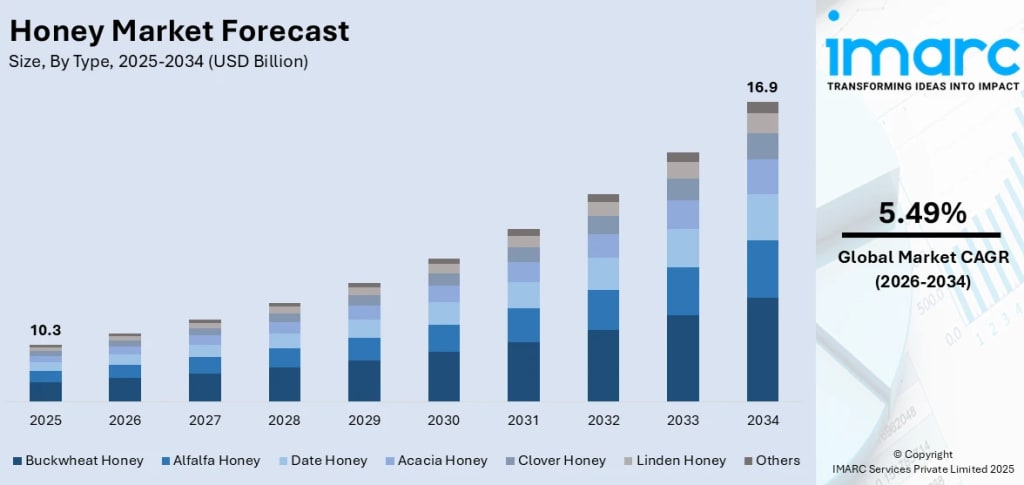
Rising health consciousness, growing preference for natural sweeteners, and expanding applications across food, cosmetics, and pharmaceuticals are driving honey demand, supported by clean-label trends, organic sourcing, and widening retail and online distribution channels. According to IMARC Group's latest data, the global honey market size was valued at USD 10.3 Billion in 2025. Looking forward, IMARC Group estimates the market to reach USD 16.9 Billion by 2034, exhibiting a CAGR of 5.49% from 2026-2034. Asia Pacific currently dominates the market, holding a market share of over 37.6% in 2025.
Honey has grown well beyond the kitchen shelf. Today it spans food and beverages, personal care, and wellness — and that multi-sector appeal is exactly what makes this market so resilient. Consumers are actively moving away from refined sugars and artificial additives, and honey is capturing much of that shift. Nearly 68% of Americans say maintaining healthy eating habits is essential to a long and healthy life, and honey's profile as a natural, minimally processed ingredient fits that mindset squarely. From buckwheat honey leading the specialty food segment to honey-infused serums appearing in premium skincare lines, this market is expanding in more directions than ever before.
Get a Sample Report for Actionable Market Insights
Honey Market Growth Drivers:
- Rising Health Consciousness
Consumers are actively rethinking what they eat, and refined sugar is increasingly losing out. Honey offers something it simply cannot — antioxidants, antimicrobial compounds, vitamins, and enzymes that support immunity and overall wellness. With chronic conditions like diabetes and obesity prompting millions to seek cleaner alternatives, honey's reputation as a functional food keeps strengthening. A recent survey shows roughly 68% of American consumers consider healthy eating essential for longevity. Brands are responding with clean-label, nutrient-dense formulations across energy bars, herbal teas, and fortified foods, and market uptake continues to reflect that consumer shift consistently.
- Versatile Applications Across Food, Cosmetics, and Pharmaceuticals
Few ingredients hold shelf space in three industries simultaneously, but honey does exactly that. In food and beverages — the largest application segment at around 65.8% of market share — honey features prominently in confectionery, bakery, craft beverages, and sauces. In personal care, over 5,000 cosmetic and beauty manufacturers in the US alone actively formulate with honey for its hydrating and antibacterial properties. In pharmaceuticals and traditional medicine, its role in sore throat remedies and wound care keeps institutional demand steady. This multi-sector pull is one of the most durable structural advantages the honey market holds today.
- Clean-Label Demand and the Organic Sourcing Premium
Today's shoppers read labels carefully and actively avoid additives, MSG, and artificial preservatives. Honey fits the clean-label brief almost perfectly — a single-ingredient, naturally produced product with a traceable supply chain. This has made it especially attractive to brands targeting health-conscious, premium-willing consumers. India alone had over 41,000 registered food processing units per the Annual Survey of Industries, and a growing share incorporate honey as a key ingredient. Dabur India's commitment of approximately USD 160 Million to a new South India manufacturing plant — partly to produce Dabur Honey — reflects how seriously major brands are treating this opportunity.
Honey Market Trends:
- Premiumization and Specialty Honey Varieties Taking Centre Stage
The honey shelf is no longer a single golden jar. Buckwheat honey, which holds around 30% of the market by type, leads because consumers associate dark, robust varieties with higher nutritional potency and distinct flavour depth. Specialty segments — manuka, raw unfiltered, single-origin, and hot honey — are gaining fast. Local Hive's three new Hot Honey flavours at Walmart and Amazon, and Rowse Honey's limited-edition Hot Honey returning exclusively to Waitrose, both show how brands are leveraging specialty formats to premiumize and differentiate. These launches consistently command higher price points and attract adventurous, health-driven buyers.
- Honey's Expanding Role in Natural Beauty and Personal Care
The beauty industry is deep into a clean formulation shift, and honey is a clear beneficiary. A single recent year saw record venture capital investment in beauty — USD 3.3 Billion across 388 deals — flowing heavily into natural, ingredient-transparent brands. Honey's antibacterial, anti-inflammatory, and moisturising properties make it an excellent fit for serums, facial masks, shampoos, and lip balms. US skincare brands are actively expanding honey-based lines to serve the clean beauty segment. As cruelty-free, chemical-free formulations become consumer expectations rather than niche preferences, honey's relevance in personal care will only continue deepening across global markets.
- E-Commerce Expansion Unlocking Access to Niche Honey Products
Online retail is fundamentally reshaping who can sell honey and who can reach it. In the UAE alone, online shoppers grew from 4.5 million to 6.5 million within five years — a 44% jump — and similar trajectories are playing out across Latin America, Southeast Asia, and Africa. Digital platforms let small artisanal producers reach urban health-conscious consumers far beyond local markets, while enabling subscription models and specialty varieties to build loyal audiences. Wisdom Natural Brands' US rollout of Drizzle Honey via Amazon and Fresh Thyme perfectly illustrates how e-commerce is accelerating the global reach of premium honey brands significantly.
Recent News and Developments in Honey Market
- March 2025: Wisdom Natural Brands launched Drizzle Honey in the US following its acquisition of the Canadian brand, introducing Golden Raw Honey, White Raw Honey, and Turmeric Gold Raw Honey at Fresh Thyme, Amazon, and Drizzle's own website, with additional products and retail locations expected later in the year.
- February 2025: Blue Diamond Almonds launched Hot Honey Almonds in collaboration with Mike's Hot Honey, combining US raw and unfiltered honey with chili for a sweet-spicy snack now available on Amazon and at select Walmart locations, targeting consumers seeking bold flavor innovation in the better-for-you snack segment.
- August 2024: Nestlé's Nespresso launched honey and honey syrup under its new Nespresso Bloom line — the brand's first product expansion beyond coffee in 40 years. Sourced from bees pollinating Colombian coffee plants, the products target sustainability-conscious consumers and meet growing demand for natural sweeteners in premium beverage culture.
- May 2024: Rowse Honey relaunched its limited-edition Hot Honey product exclusively through Waitrose in-store and online, reinforcing the continuing consumer appetite for spicy-sweet honey formats and the trend of premium flavour innovation within well-established honey brands competing for shelf presence.
- January 2024: Dabur India Ltd. announced an investment of approximately USD 160 Million to build a new greenfield manufacturing facility in South India, with the plant set to produce several products including Dabur Honey, reflecting strong long-term confidence in domestic honey demand across food and wellness categories.
Note: If you require specific details, data, or insights that are not currently included in the scope of this report, we are happy to accommodate your request. As part of our customization service, we will gather and provide the additional information you need, tailored to your specific requirements. Please let us know your exact needs, and we will ensure the report is updated accordingly to meet your expectations.
About the Creator
Rahul Pal
Market research professional with expertise in analyzing trends, consumer behavior, and market dynamics. Skilled in delivering actionable insights to support strategic decision-making and drive business growth across diverse industries.
The Fears of AI And How Much Fun It Can Be
ChatGPT has come a long way, as has AI in general. There are those people who are scared of it, and for understandable reasons. People fear that as technologies advance, they’ll be replaced in the workforce. Then, there are the fears that AI could evolve into something that brings us to the brink of extinction.
By Jason Morton4 days ago in Futurism
When The Story Pivots and Changes
My writing journey has been a bit of a roller coaster. I don't have any accolades to claim, though if I actually attempted to get serious about writing contests and submitting my work, I could change that. After I finished my rewrite and recording of the audiobook of "Memoirs of the In-Between" I decided that I needed to decide what to do next.
By Hope Martin4 days ago in Writers



Comments
There are no comments for this story
Be the first to respond and start the conversation.