
Healthcare Furniture Market Trends: Ergonomic Designs, Patient Comfort Solutions & Industry Forecast to 2034
How ergonomic designs and patient comfort solutions are improving healthcare experiences, enhancing recovery outcomes, and driving demand for advanced furniture across hospitals and care facilities

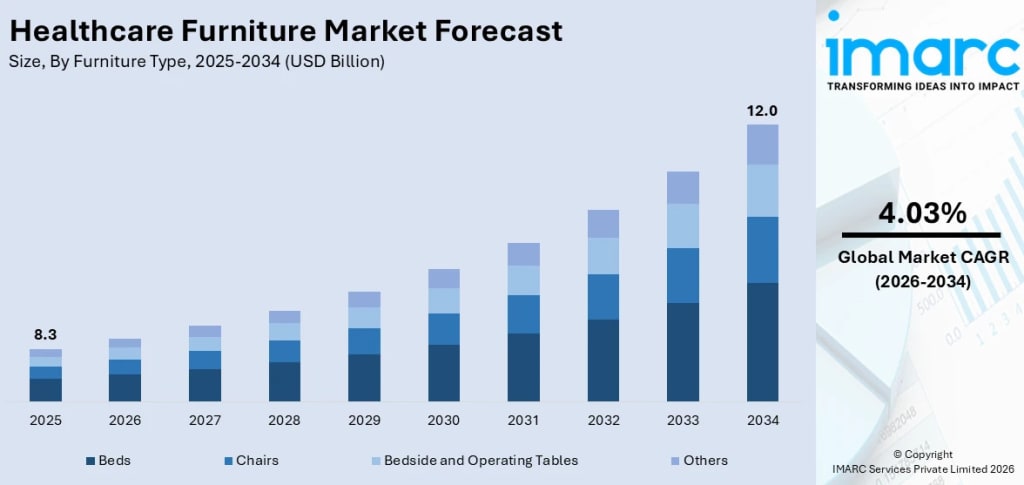
Healthcare infrastructure is undergoing a significant transformation as providers move toward patient-centric environments that prioritize comfort, infection control, and operational efficiency. The demand for specialized medical furniture is rising, fueled by an aging global population, a surge in chronic disease prevalence, and a massive wave of hospital expansions in emerging markets. According to IMARC Group’s latest data, the global healthcare furniture market size was valued at USD 8.3 Billion in 2025. Looking forward, IMARC Group estimates the market to reach USD 12.0 Billion by 2034, exhibiting a CAGR of 4.03% from 2026-2034. North America currently dominates the market, holding a market share of over 36.5% in 2025.
Modern healthcare furniture has evolved far beyond basic utility, now representing a sophisticated sector where ergonomic design meets clinical rigor. Facilities are increasingly investing in high-quality beds, specialized chairs, and modular storage units that can withstand the heavy-duty demands of 24/7 clinical environments. The shift is particularly visible in the private sector, where hospitals use premium furnishings as a key differentiator to attract patients seeking a more "homelike" recovery experience. Key segments driving this growth include hospital beds—which remain the largest product category—followed by surgical tables and specialized seating designed to reduce caregiver strain and improve patient mobility.
Download Your Free "Healthcare Furniture Market" Strategic Analysis Sample
Healthcare Furniture Market Growth Drivers:
- Expansion of Healthcare Infrastructure and Hospital Capacity
The rapid construction of new hospitals and specialized clinics, particularly in developing regions, is a primary catalyst for market growth. In 2026, many healthcare systems are shifting from emergency reactive spending to long-term infrastructure development. For instance, the Indian government allocated over INR 95,957 crores for health in the 2025-26 budget, significantly boosting the National Health Mission and the creation of new AIIMS facilities. These large-scale projects require thousands of new hospital beds, examination tables, and medical carts. This global wave of infrastructure modernization ensures a steady demand for durable furniture that meets both aesthetic and clinical standards across newly established wards.
- Rising Geriatric Population and Chronic Disease Prevalence
The demographic shift toward an older population is placing unprecedented pressure on healthcare facilities to upgrade their long-term care furniture. With approximately 8.87% of the global population now aged 65 and above, there is a surging need for bariatric beds, mobility-assisted chairs, and pressure-ulcer prevention surfaces. Chronic conditions requiring extended hospital stays are driving a 72% upgrade rate in hospital furniture as facilities look to improve patient comfort during long recoveries. This trend is especially pronounced in North America and Europe, where healthcare providers are investing in "healing environments" that utilize ergonomic furniture to speed up patient rehabilitation and reduce the risk of secondary complications.
- Focus on Infection Control and Caregiver Ergonomics
Modern healthcare facilities are prioritizing furniture that actively contributes to patient safety and staff well-being. Approximately 76% of healthcare facilities have recently adopted antimicrobial-coated furniture to mitigate the risk of healthcare-associated infections (HAIs). Simultaneously, there is a growing realization that caregiver burnout is linked to physical strain, leading to a higher demand for height-adjustable workstations and motorized beds that reduce manual lifting. Industry data indicates that over 69% of procurement heads now prioritize hygiene-certified materials and ergonomic designs. By investing in furniture that is easy to sanitize and physically supportive for nurses, hospitals are enhancing operational efficiency and improving overall clinical outcomes.
Healthcare Furniture Market Trends:
- Integration of Smart Technologies and IoT Features
The "Smart Hospital" concept is revolutionizing furniture design, with traditional items being replaced by tech-enabled versions. We are seeing a significant rise in sensor-equipped beds that monitor patient movement, exit-risk, and vital signs, with 33% of new ICU installations now featuring these capabilities. These smart units integrate directly with hospital information systems, providing real-time data to nursing stations. Furthermore, the growth of telemedicine has led to a 27% increase in the procurement of tech-integrated chairs and mobile workstations that allow doctors to conduct virtual consultations from the patient's bedside. This trend reflects a broader shift toward data-driven care where furniture acts as an active participant in the treatment process.
- Shift Toward Sustainable and Eco-Friendly Materials
Sustainability has moved from a corporate talking point to a core procurement requirement. Healthcare facilities are increasingly seeking furniture made from reclaimed wood, bamboo, or recycled plastics to reduce their environmental footprint. This is supported by the fact that the furniture industry contributes roughly 2% to global CO2 emissions, prompting brands to innovate with circular economy practices. Many manufacturers are now aiming to lower production costs through automation and sustainable sourcing, aligning with global climate objectives. In 2026, approximately one-third of purchase decisions in the healthcare sector are influenced by a product’s sustainability credentials, as hospitals look to balance high-traffic durability with eco-conscious design.
- Rise of Home Healthcare and Modular Adaptability
As care shifts from traditional hospitals to home settings, there has been a 57% rise in the procurement of medical-grade furniture for residential use. Consumers and providers are opting for adjustable beds and therapeutic recliners that blend into a home environment while providing clinical functionality. Additionally, modularity has become a critical trend within hospitals, with 61% of newly renovated rooms now featuring modular drawer systems and foldable overbed tables. These adaptable designs allow facilities to quickly repurpose rooms for different clinical needs, providing the flexibility required to manage fluctuating patient volumes. This trend toward "mobile and modular" is helping healthcare providers maximize their available floor space without compromising on patient care quality.
Recent News and Developments in Healthcare Furniture Market
- February 2026: The Indian government’s Union Budget for 2026 emphasized the expansion of emergency trauma care centers at the district level and the establishment of "NIMHANS-2," creating massive new procurement opportunities for specialized psychiatric and emergency furniture.
- January 2026: Leading manufacturers showcased a new generation of "Disassembly-Ready" furniture at global trade fairs, designed for 100% recyclability to meet the increasing demand from hospitals for sustainable, circular-economy-aligned furnishing solutions.
- October 2025: Major healthcare providers in the United States initiated a large-scale transition to antimicrobial-coated surfaces across all outpatient clinics, responding to new clinical guidelines aimed at reducing cross-contamination in high-traffic waiting areas.
Note: If you require specific details, data, or insights that are not currently included in the scope of this report, we are happy to accommodate your request. As part of our customization service, we will gather and provide the additional information you need, tailored to your specific requirements. Please let us know your exact needs, and we will ensure the report is updated accordingly to meet your expectations.
About the Creator
Andrew Sullivan
Hello, I’m Andrew Sullivan. I have over 9+ years of experience as a market research specialist.
Keep reading
More stories from Andrew Sullivan and writers in Futurism and other communities.
Railroad Market Outlook: Green Rail Initiatives, Carbon Reduction Goals & Industry Forecast to 2034
The global railroad sector is undergoing a massive transformation, driven by a combination of aggressive infrastructure funding, a push for green logistics, and the integration of high-level automation. As supply chains seek more resilient and low-carbon alternatives to road transport, rail has re-emerged as the backbone of modern industrial strategy. According to IMARC Group’s latest data, the global railroad market size was valued at USD 343.8 Billion in 2025. Looking forward, IMARC Group estimates the market to reach USD 462.3 Billion by 2034, exhibiting a CAGR of 3.24% from 2026-2034. North America currently dominates the market, holding a significant position with the United States market alone reaching USD 74.4 Billion in 2025.
By Andrew Sullivan15 days ago in Futurism
The Fears of AI And How Much Fun It Can Be
ChatGPT has come a long way, as has AI in general. There are those people who are scared of it, and for understandable reasons. People fear that as technologies advance, they’ll be replaced in the workforce. Then, there are the fears that AI could evolve into something that brings us to the brink of extinction.
By Jason Morton4 days ago in Futurism
Lithium-Ion Battery Separator Market Outlook: Rising Electric Vehicle Adoption and Growing Demand for Energy Storage Solutions Driving Market Growth
According to IMARC Group's latest research publication, The global lithium-ion battery separator market size was valued at USD 8.3 Billion in 2025. Looking forward, IMARC Group estimates the market to reach USD 15.4 Billion by 2034, exhibiting a CAGR of 6.93% from 2026-2034.
By James Whitmanabout 15 hours ago in Futurism
Swan
“During the Metal Age, humans took photographs of everything beautiful, which was everything, yet machines did not even wear shoes. The Fauxna thought of a better way. They colored all of the light rose, for a corrupted source cannot be verified.” - Origin Parable, 011
By Nicky Frankly2 days ago in Fiction



Comments
There are no comments for this story
Be the first to respond and start the conversation.