
From Digital Noise to Masterpieces: How AI Actually "Sees" and Creates Images 🎨✨
No, It’s Not Copy-Paste: The Secret Life of AI Pixels

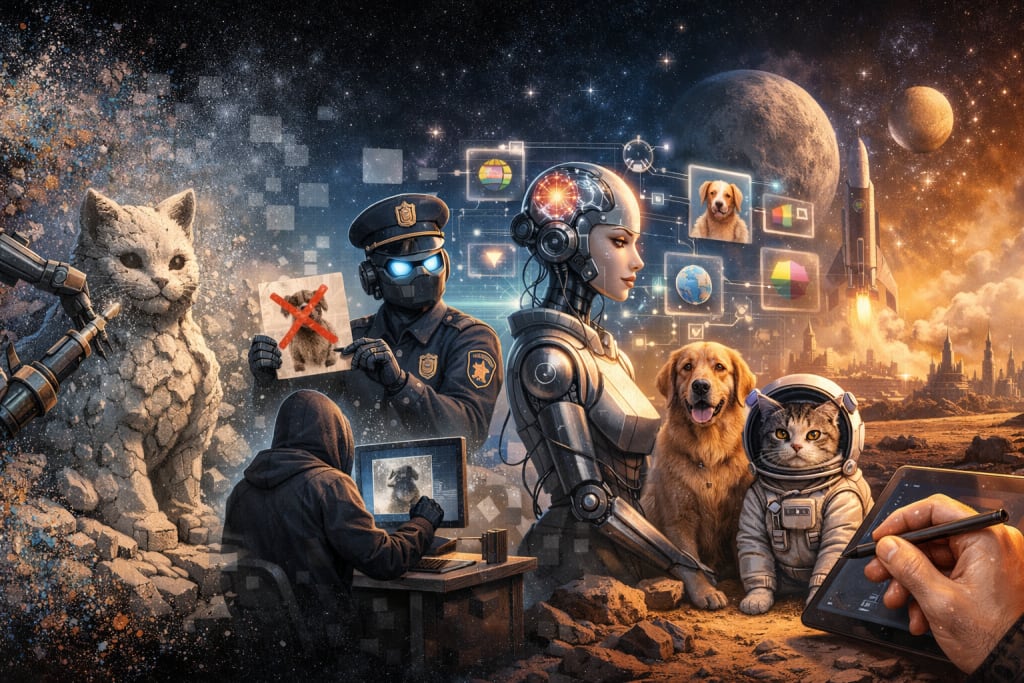
You type three simple words: "cat in space," hit enter, and a few seconds later, you’re looking at a graphic that a professional illustrator would be proud of. Magic? 🌌 To most of us, it certainly feels that way. However, behind those few seconds lies a fascinating mathematical battle and processes I came to understand better thanks to a course from IBM 🎓. I decided to explain it "in plain English" because while we’re all generating images like crazy, few people know what’s actually happening "under the hood" 🤖.
Forget "Copy-Paste" ❌✂️
The biggest myth about AI is the belief that it’s a sort of super-fast editor that searches Google Images, cuts out a piece of a cat, a piece of a star, and glues them together. That is not how it works. AI doesn't store any specific photos in its memory. Instead, it possesses something much more powerful: an understanding of visual principles 🧠.
Imagine you’re learning to draw a face. You don't copy your neighbor's photo; you learn that eyes are usually halfway down the head and the nose is in the center. AI does the same, just across billions of examples.
Step 1: Sculpting in Digital Snow ❄️🗿
Most modern tools, like Midjourney or DALL-E, use what are called Diffusion Models. How do we explain this simply?
Imagine you have a block of marble. A sculptor doesn't glue on pieces of arms or legs—they chip away what’s unnecessary until a figure emerges from the stone. In the world of AI, that "block of marble" is noise. Remember the "static" on old TVs 📺 when there was no signal? That’s the AI's starting point. Pure, colorful chaos.
AI looks at this noise and, with your prompt (command) in mind, starts slowly removing the pixels that "don't fit" the image. It’s a step-by-step process. In the first second, it sees only a blur; by the fifth, shapes emerge; and by the tenth—you have a finished image 🐕.
Step 2: The Strict Judge, or Why Does It Look So Good? 👮♂️⚖️
This brings us to a mechanism often mentioned in IBM courses—the role of evaluating and rejecting errors. Although today’s machines "sculpt in noise," they first had to go through grueling training under the eye of a digital judge.
During the learning phase, the AI operated in a system we can call the battle of the "Forger vs. the Police":
The Forger (Generator): Tried to create an image. At first, it was terrible at it.
The Police (Discriminator/Judge): Had access to real photos and ruthlessly judged the Forger's work.
Every time the Forger showed something that didn't look like reality, the Police said: "Rejected! That’s not a dog, that’s a smudge! Fix it!" 🚫. This battle lasted for months on powerful servers. Thanks to this constant "rejection" of faulty versions, today's models have a built-in intuition—they can judge in a fraction of a second whether a pixel fits the image or is an error.
Step 3: The Translator Who Understands Your Words 🗣️🗺️
How does the AI know that a "dog" is a dog and not a "chair"? That’s the job of a module called CLIP. It’s a sort of digital translator that connects the world of words with the world of images. It doesn't see letters; it sees "association maps." Because of CLIP, the model knows that the word "warm" 🔥 should manifest as orange colors, and "fuzzy" as a specific texture.
Why Does AI Still "Hallucinate" and Draw 6 Fingers? 🖐️🧐
Despite the brilliant evaluation system during training, AI isn't infallible. Why does it struggle so much with hands? Because to the algorithm, a hand is just a statistical cluster of pixels that often appear together.
AI doesn't "know" that there are bones and joints under the skin 🧬. If the training photos showed hands intertwined or hidden, the model sees a "smudge of fingers" and reproduces it that way. To the judge inside the AI, six fingers still look "similar enough" to a hand to pass through the statistical filters.
Summary: It’s Engineering, Not Magic ⚙️🚀
When we realize that AI is a process of "denoising" guided by knowledge gained under a strict judge, we start to look at these graphics differently. It isn't a conscious artist. It’s powerful mathematics that has learned what we humans consider aesthetic.
The next time you generate an image, think about the billions of "rejected" and "corrected" attempts that had to happen during that model's training just so you could enjoy a perfect view in a matter of seconds. ✨
About the Creator
Piotr Nowak
Pole in Italy ✈️ | AI | Crypto | Online Earning | Book writer | Every read supports my work on Vocal
Keep reading
More stories from Piotr Nowak and writers in Futurism and other communities.
🚀 AI for the People: Why I’ve Dethroned the "King" in Favor of Gemini
When I open my browser in the morning, my eyes naturally dart to my bookmark bar. 🖥️ That’s where the heavyweights of the current AI landscape reside: Gemini, Claude, and ChatGPT. Just three months ago, I was convinced the hierarchy was set in stone, with OpenAI as the undisputed king of the hill. 👑
By Piotr Nowak2 days ago in Futurism
Construction Robots Market Outlook: Automation in Building Processes and Infrastructure Development Opportunities
According to IMARC Group's latest research publication, The global construction robots market size reached USD 171.4 Billion in 2024. Looking forward, IMARC Group expects the market to reach USD 556.1 Billion by 2033, exhibiting a growth rate (CAGR) of 13.27% during 2025-2033.
By James Whitman6 days ago in Futurism
The Forsyth House Fire
Since 1851, Forsyth House has stood on the corner of Union Street and Gordon Street in the heart of Glasgow. Its iconic, or was... because on Sunday 8th of March, 2026, a fire broke out in a small, seemingly un-named shop in the building and tore all that history down. As I write, the rubble is still unsettled and the street is still blocked off. Central Station is quiet on the upper level, and around 30 small businesses have quite literally gone up in smoke.
By S. A. Crawford5 days ago in The Swamp


Comments
There are no comments for this story
Be the first to respond and start the conversation.