
Electric Three-Wheeler Market Trends: Government Incentives, Urban Mobility Shift & Industry Forecast to 2034
How government subsidies, rising fuel prices, and eco-friendly transportation trends are accelerating adoption of electric three-wheelers across urban and semi-urban mobility ecosystems

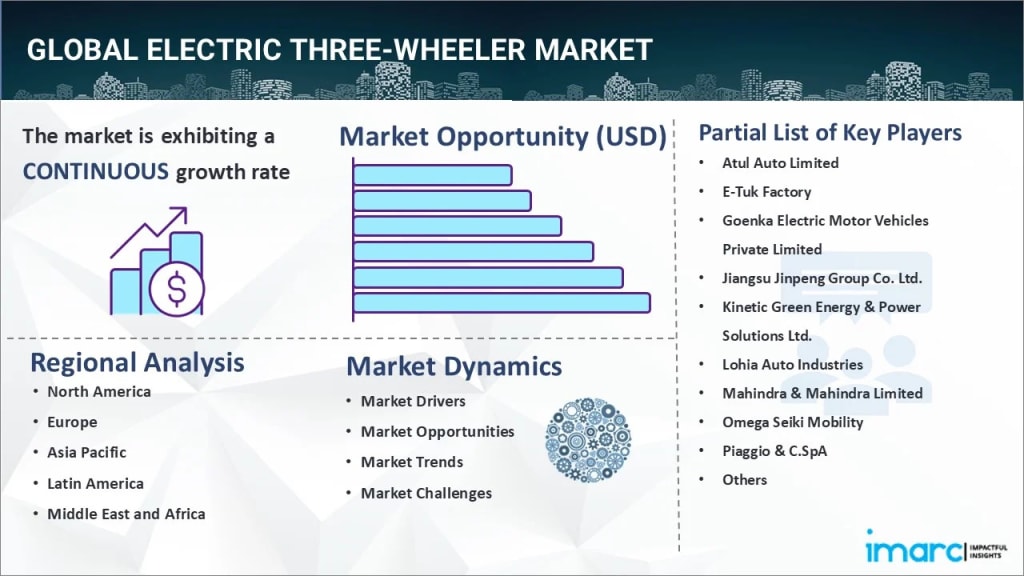
Rising urbanization, the urgent need for last-mile delivery solutions, and a global shift toward sustainable mobility are propelling the demand for electric three-wheelers. These vehicles are increasingly favored for their low operational costs, compact maneuverability in congested city centers, and zero-emission profiles. According to IMARC Group’s latest data, the global electric three-wheeler market size was valued at USD 845.2 Million in 2025. Looking forward, IMARC Group estimates the market to reach USD 1,635.0 Million by 2034, exhibiting a CAGR of 7.38% from 2026-2034.
The electric three-wheeler sector has evolved into a vital pillar of the global "green" transport ecosystem, particularly in emerging economies where they serve as the backbone of affordable public transit and logistics. Beyond environmental benefits, the transition is fueled by the rapid expansion of e-commerce, which requires agile vehicles for short-haul goods movement. Major segments include passenger carriers and load carriers, with a significant shift toward lithium-ion battery integration and high-torque motors ranging from 1000W to 1500W. As battery swapping infrastructure matures and fuel prices fluctuate, these electric variants are becoming the go-to investment for fleet operators and individual entrepreneurs alike.
Electric Three-Wheeler Market Growth Drivers:
- Surge in Last-Mile Logistics and E-commerce
The explosion of online shopping has created a massive need for efficient, cost-effective delivery tools that can navigate narrow urban streets. Electric three-wheelers, particularly load carriers, are filling this gap perfectly. Logistics giants are increasingly integrating these vehicles into their fleets to meet "green delivery" targets. For instance, in dense urban hubs, these vehicles provide a 30-40% reduction in delivery costs compared to traditional fuel-based vans. This demand is a primary catalyst for the industry, currently valued at over USD 845 million, as businesses prioritize agility and lower overheads in the competitive delivery landscape.
- Aggressive Government Incentives and Subsidies
National policies are acting as a powerful tailwind for adoption. In India, the PM E-DRIVE scheme has allocated approximately Rs 10,900 crore to subsidize electric two- and three-wheelers, with specific incentives capped for vehicles priced up to Rs 2.5 lakh. Similar frameworks in Southeast Asia and parts of Africa offer tax exemptions and reduced registration fees. These financial cushions significantly lower the upfront purchase price—which has historically been a barrier—making the transition to electric a financially superior choice for daily wage earners and small-scale transport operators globally.
Get Instant Access to the "Electric Three-Wheeler Market" Sample Report Today
- Lower Total Cost of Ownership (TCO)
One of the most compelling reasons for the shift is the sheer economic advantage over the vehicle's lifespan. Electric three-wheelers have significantly fewer moving parts than internal combustion engines, leading to drastically lower maintenance expenses. When combined with the rising cost of petrol and diesel, the "fuel" savings are substantial. Data indicates that operators can save upwards of 60% on energy costs per kilometer. This efficiency is driving massive adoption in the passenger carrier segment, which holds nearly 60% of the market share, as drivers see immediate improvements in their daily take-home earnings.
Electric Three-Wheeler Market Trends:
- Transition from Lead-Acid to Lithium-Ion Technology
The market is witnessing a decisive move toward Lithium-ion (Li-ion) batteries, which now account for a dominant portion of new registrations. While lead-acid was once the budget-friendly choice, Li-ion offers superior energy density, faster charging, and a lifespan that is three to four times longer. This technological shift allows for a higher range—often exceeding 100km on a single charge—which is critical for commercial applications. Manufacturers are responding by launching high-performance models that support fast-charging capabilities, ensuring that vehicles spend more time on the road and less time plugged into a wall.
- Rapid Expansion of Battery Swapping Ecosystems
To combat "range anxiety" and the downtime associated with charging, battery swapping is emerging as a game-changing trend. Instead of waiting hours for a charge, drivers can swap a depleted battery for a fully charged one in under three minutes at dedicated kiosks. This "Battery-as-a-Service" (BaaS) model decouples the cost of the battery from the vehicle, lowering the initial purchase price by nearly 40%. Companies like Sun Mobility and various startups in the Asia-Pacific region are scaling these networks, making electric three-wheelers as convenient to "refuel" as their petrol counterparts.
- Integration of Smart Connectivity and Telematics
Modern electric three-wheelers are no longer just mechanical tools; they are becoming data-driven assets. Fleet operators are now demanding "smart" features such as GPS tracking, remote diagnostics, and battery health monitoring. This trend is particularly prevalent in the 1000W to 1500W power segment, where real-time data helps optimize delivery routes and prevent unexpected breakdowns. By using integrated apps, drivers can locate the nearest charging point or swap station, while owners can monitor driver behavior and energy consumption, leading to a more professionalized and efficient urban transport sector.
Recent News and Developments in Electric Three-Wheeler Market:
- March 2026: The Indian government updated the guidelines for the PM E-DRIVE scheme, confirming that electric three-wheelers, including e-rickshaws and e-carts registered until March 2028, will remain eligible for significant financial incentives to bolster zero-emission public transit.
- December 2025: Major automotive players reported that the target for the electric three-wheeler (L5) sub-component under previous incentive frameworks was met ahead of schedule, signaling an unprecedented pace of adoption among commercial fleet operators.
- September 2025: Mahindra Electric expanded its "Treo" range with a new high-capacity load carrier featuring advanced telematics, specifically designed to handle the rigorous demands of Amazon and Flipkart’s last-mile delivery networks in emerging markets.
Note: If you require specific details, data, or insights that are not currently included in the scope of this report, we are happy to accommodate your request. As part of our customization service, we will gather and provide the additional information you need, tailored to your specific requirements. Please let us know your exact needs, and we will ensure the report is updated accordingly to meet your expectations.
About the Creator
Andrew Sullivan
Hello, I’m Andrew Sullivan. I have over 9+ years of experience as a market research specialist.
Keep reading
More stories from Andrew Sullivan and writers in Futurism and other communities.
Smart Coatings Market Analysis: Anti-Microbial Innovations, Sustainability Trends & Industry Forecast to 2033
Revolutionizing surface protection through advanced material science and responsive technologies, the global smart coatings market is witnessing a major shift toward high-performance, multifunctional solutions. According to IMARC Group’s latest data, the global smart coatings market size was valued at USD 3.19 Billion in 2024. Looking forward, IMARC Group estimates the market to reach USD 13.31 Billion by 2033, exhibiting a CAGR of 16.34% from 2025-2033.
By Andrew Sullivan3 days ago in Futurism
The Fears of AI And How Much Fun It Can Be
ChatGPT has come a long way, as has AI in general. There are those people who are scared of it, and for understandable reasons. People fear that as technologies advance, they’ll be replaced in the workforce. Then, there are the fears that AI could evolve into something that brings us to the brink of extinction.
By Jason Morton4 days ago in Futurism
Wood Pulp Market To Reach USD 261.5 Billion by 2035 at 3.7% CAGR
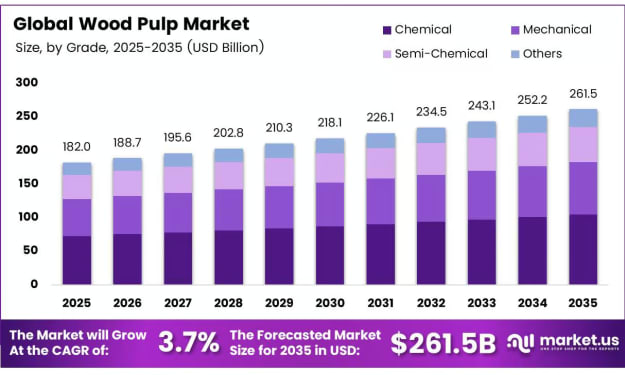
Market Overview The Global Wood Pulp Market is projected to grow from USD 182.0 billion in 2025 to approximately USD 261.5 billion by 2035, registering a compound annual growth rate (CAGR) of 3.7% during the forecast period from 2026 to 2035. Wood pulp is a fibrous, cellulose-based material obtained from processed wood and serves as the primary raw material for manufacturing paper, packaging, hygiene products, and specialty textiles. Its essential role across multiple industries makes it a critical commodity in global supply chains.
By Hayden Kulas3 days ago in Futurism
Swan
“During the Metal Age, humans took photographs of everything beautiful, which was everything, yet machines did not even wear shoes. The Fauxna thought of a better way. They colored all of the light rose, for a corrupted source cannot be verified.” - Origin Parable, 011
By Nicky Frankly2 days ago in Fiction



Comments
There are no comments for this story
Be the first to respond and start the conversation.