
Black Soldier Fly Larvae Market Impressive Growth at 30.8%
Black Soldier Fly Larvae Market Outlook 2025–2035: Growth, Trends, and Opportunities

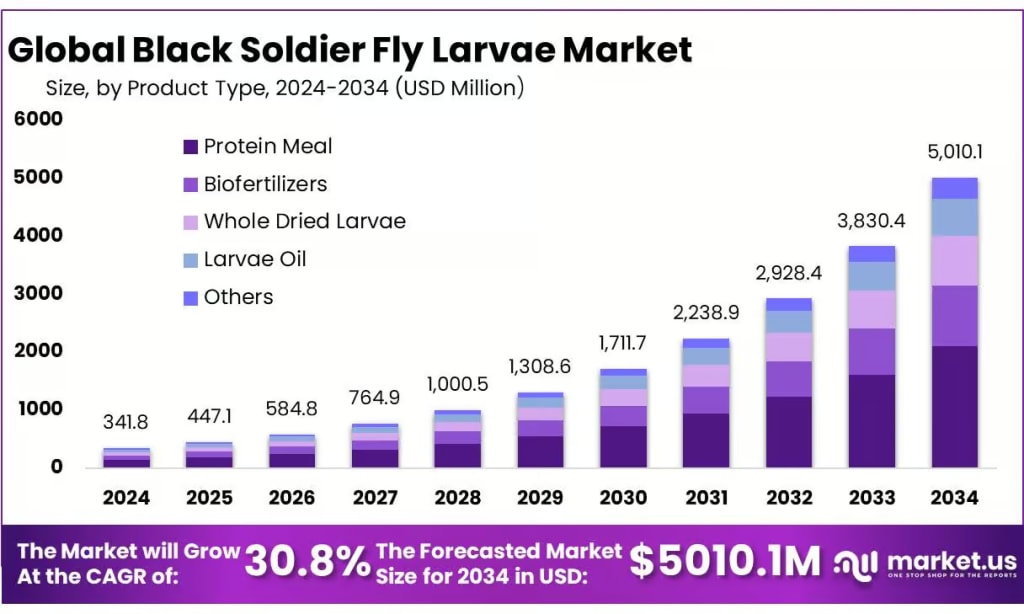
The global Black Soldier Fly Larvae Market is projected to grow significantly from USD 341.8 million in 2024 to about USD 5,010.1 million by 2034, registering a strong CAGR of 30.8% (2025–2034), with Europe holding a 37.1% share valued at USD 126.8 million. Industrial scaling is evident from projects like InnovaFeed’s Decatur facility, designed to produce 60,000 metric tons of insect protein, 20,000 tons of oil, and 400,000 tons of fertilizer annually, reflecting a shift toward integrated biorefinery models.
Regulatory support is a key growth driver, with the EU enabling insect protein use in aquaculture under Regulation (EU) 2017/893 and subsequent expansions, while in the US, evolving AAFCO standards (2025 updates) for dried Black Soldier Fly larvae are helping standardize feed-grade usage and accelerate mainstream adoption.
Key Takeaways
- Black Soldier Fly Larvae Market is expected to be worth around USD 5010.1 Million by 2034, up from USD 341.8 Million in 2024, and is projected to grow at a CAGR of 30.8%.
- Protein Meal held a dominant market position, capturing more than a 42.7% share.
- Animal Feed held a dominant market position, capturing more than a 53.9% share.
- Europe emerged as the dominating region in the Black Soldier Fly Larvae market, accounting for 37.1% of the total market share, valued at USD 126.8 Mn.
Market Segmention
By Product Type Analysis
In 2024, Protein Meal led the market with a 42.7% share, driven by rising demand for sustainable feed alternatives. It is widely used in aquaculture, poultry, and livestock feed as a substitute for fishmeal and soybean meal. Its high digestibility and balanced amino acid profile make it attractive for improving feed efficiency while reducing environmental impact. Increasing volatility in fishmeal supply further boosted its adoption in commercial feed formulations.
By Application Analysis
In 2024, Animal Feed dominated with a 53.9% market share, supported by the growing shift toward sustainable protein sources in aquaculture, poultry, and swine farming. Black Soldier Fly larvae are increasingly replacing conventional ingredients due to their strong nutritional value and eco-friendly profile. The need to enhance feed efficiency and manage fluctuating raw material costs, especially in aquaculture, has accelerated their use in feed production.
Regional Insights
Europe led the Black Soldier Fly Larvae market in 2024 with a 37.1% share, valued at USD 126.8 million, supported by strong regulatory frameworks and a focus on sustainability. The region’s growth is driven by well-established waste management systems and clear approvals for using insect-based proteins in animal feed. Initiatives under the EU’s Farm to Fork Strategy and circular economy policies have encouraged adoption, while regulatory clarity for insect protein use in aquaculture, poultry, and pig feed has boosted confidence among producers and feed manufacturers.
Use Cases
Animal feed: the largest and most commercial use case: BSFL are mainly used in animal feed, especially for aquaculture, poultry, and swine. This is the biggest use case because the larvae are rich in nutrients and can replace part of fishmeal or soybean meal. FAO-linked data shows BSFL meal contains about 41% crude protein on average and 29% crude fat on a dry-matter basis, with reported protein ranges of 38%–45% and fat ranges of 13%–42%.
Pet food: moving from niche to regulated premium nutrition: BSFL are also becoming a real ingredient in pet food, especially in premium formulas focused on alternative proteins and sustainability. AAFCO’s January 2025 materials say dried BSFL are allowed in adult dog food and adult cat food as a source of protein and fat.
Organic waste treatment: turning low-value waste into high-value biomass: A major use case for BSFL is organic waste conversion. The larvae can feed on food and agro-industrial residues and turn them into usable outputs such as protein, oil, and frass. A 2025 review reports BSFL-based systems can reduce organic waste volume by up to 85.5%.
Recent Developments
In 2024, Bioflytech expanded its production of BSFL-derived flours and fats and announced a €2.8 million investment to upgrade its hatchery, aiming to increase egg production capacity from 180 kg/month to 350 kg/month to support faster scaling.
Entofood (Malaysia) strengthened its industrial capabilities through its collaboration with the Veolia Bioconversion Malaysia facility, which has a production capacity of around 3,000 tonnes of insect meal annually, supplying ingredients to various animal nutrition markets.
Conclusion
From a market research perspective, Black Soldier Fly Larvae (BSFL) are emerging as a strong solution at the intersection of sustainable protein production, waste management, and circular economy systems. Their ability to convert organic waste into valuable outputs is a key differentiator, with studies showing waste reduction rates of 50%–80% under normal conditions and up to 85.5% in optimized systems, significantly lowering landfill dependency and environmental impact.
About the Creator
Hayden Kulas
I am blogger, digital marketing pro since 5 years and writes for Market.us. Computer Engineer by profession. I love to find new ideas that improve websites' SEO. He enjoys sharing knowledge and information about many topics.
Keep reading
More stories from Hayden Kulas and writers in Futurism and other communities.
Synthetic Ester Lubricants Market Report: USD 3.0 Billion by 2035 at 4.0% CAGR
Overview The Global Synthetic Ester Lubricants Market is projected to reach approximately USD 3.0 billion by 2035, expanding from USD 2.0 billion in 2025 at a CAGR of 4.0% during the forecast period from 2026 to 2035. Synthetic ester lubricants are advanced, high-performance fluids produced through the chemical reaction of alcohols and organic acids. They offer outstanding thermal stability, excellent biodegradability, and superior fluidity at low temperatures, making them ideal for demanding environments.
By Hayden Kulas9 days ago in Futurism
The Fears of AI And How Much Fun It Can Be
ChatGPT has come a long way, as has AI in general. There are those people who are scared of it, and for understandable reasons. People fear that as technologies advance, they’ll be replaced in the workforce. Then, there are the fears that AI could evolve into something that brings us to the brink of extinction.
By Jason Morton3 days ago in Futurism
How Elementor Theme Builder Works and Why Designers Use It in 2026
The first time I built a website with Elementor, I spent hours designing the perfect page layout. The content area looked exactly the way I wanted it. Clean sections, consistent typography, a color palette that reflected the brand. Then I previewed the page on the live site and noticed something that immediately deflated all that effort. The header at the top and the footer at the bottom looked completely different from everything I had just designed. They belonged to the WordPress theme, and no amount of work inside Elementor could touch them.
By Shane Smith4 days ago in Futurism



Comments
There are no comments for this story
Be the first to respond and start the conversation.