
Artificial Intelligence in Healthcare Market Outlook: AI-Driven Care, Digital Health & Forecast to 2034
Increasing adoption of AI-driven care, digital health platforms, and advanced analytics is transforming patient outcomes and driving growth in the healthcare market

Artificial Intelligence in Healthcare Market Overview:
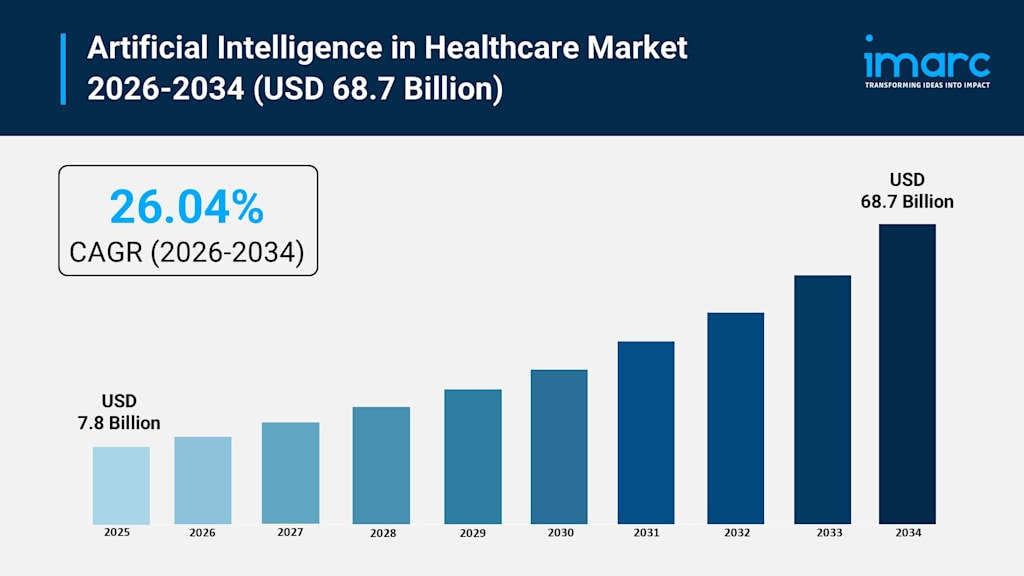
The convergence of exponential data growth, maturing machine learning capabilities, and mounting pressure on healthcare systems worldwide is rapidly accelerating AI adoption in clinical and administrative settings. According to IMARC Group's latest data, the global artificial intelligence in healthcare market size reached USD 7.8 Billion in 2024. Looking forward, IMARC Group expects the market to reach USD 68.7 Billion by 2033, exhibiting a CAGR of 26.04% during 2025–2033. The growing demand for personalized medications, rising popularity of remote patient monitoring facilities, and increasing advancements in machine learning techniques for analyzing medical images, detecting anomalies, and predicting patient outcomes are some of the major factors propelling the market.
AI in healthcare isn't a future-state concept anymore — it's already embedded in daily clinical workflows. Hospitals are using AI to read radiology scans faster and with fewer errors. Pharmaceutical companies are cutting years off drug discovery timelines. Primary care providers are deploying virtual nursing assistants that handle patient triage around the clock. The U.S. FDA had cleared roughly 950 AI/ML-enabled medical devices by mid-2024, with approximately 100 new approvals added each year, underscoring just how rapidly this technology has moved from pilot to mainstream practice.
Based on IMARC Group's segmentation, the market is categorized by offering (hardware, software, and services), technology (machine learning, natural language processing, context-aware computing, and others), application (robot-assisted surgery, virtual nursing assistant, administrative workflow assistance, fraud detection, dosage error reduction, clinical trial participant identification, preliminary diagnosis, and others), and end-user (healthcare providers, pharmaceutical and biotechnology companies, patients, and others). Software dominates the offering segment — encompassing EHR systems, imaging analysis platforms, and clinical decision support tools — while machine learning holds the largest share by technology. Healthcare providers account for the dominant end-user segment, and North America leads the market geographically, driven by a mature digital health ecosystem, strong regulatory clarity, and heavy investment from both public and private sectors.
Artificial Intelligence in Healthcare Market Growth Drivers:
Rising Demand for Personalized Medicine and Precision Diagnostics
The shift from one-size-fits-all treatment to individually tailored care is one of the strongest structural drivers in this market. AI can analyze a patient's genetic profile, clinical history, and real-world outcomes data simultaneously — something no human clinician can do at scale. The global precision medicine market exceeded USD 75 billion in recent years, and AI is increasingly its enabling technology. Google Health's multimodal AI platform for diabetic retinopathy detection demonstrated 98.5% accuracy in clinical validation, showing how AI-powered diagnostics can match or outperform specialist-level assessments — and do so at a fraction of the cost.
Accelerating Drug Discovery and R&D Efficiency
Pharmaceutical R&D is expensive and slow by design — but AI is starting to change both equations. Researchers at MIT and McMaster University trained a generative AI model that screened over 36 million molecular structures to identify new antibiotic candidates effective against drug-resistant bacteria like MRSA. Isomorphic Labs, a DeepMind spinoff, has AI-designed drugs entering human trials — compounds developed in a fraction of the time traditional methods would require. For pharma and biotech companies facing rising R&D costs and pressure to shorten time-to-market, AI is shifting from an innovation experiment to a commercial necessity.
Growing Healthcare Workforce Pressures and Operational Burden
With the World Health Organization projecting a global shortfall of 11 million healthcare workers by 2030, AI-driven automation is filling an urgent operational gap. AI tools are handling clinical documentation, appointment scheduling, prior authorization processing, and patient triage — freeing up clinicians to focus on complex decision-making. IBM Watson Health's upgraded clinical trial matching platform, which uses NLP to interpret EHRs, improved patient enrollment efficiency by 35% for cancer research institutions. Administrative workflow assistance is now one of the fastest-growing AI application segments in healthcare, reflecting real demand from overstretched systems.
Artificial Intelligence in Healthcare Market Trends:
Generative AI and Agentic Models Are Entering Clinical Settings
The latest wave of AI in healthcare isn't just about reading images or flagging anomalies — it's about AI that can reason, plan, and act across multi-step clinical workflows. At Microsoft Ignite 2025, the company introduced "agentic" healthcare AI models, including MedImageInsight Premium (offering up to 15% higher diagnostic accuracy in radiology) and CXRReportGen Premium for generating clinic-ready chest X-ray reports. Google followed with open research models including MedGemma and TxGemma — built specifically to accelerate clinical language tasks and drug development workflows. These aren't incremental upgrades; they represent a generational shift in how AI supports clinical decision-making.
Remote Patient Monitoring Is Scaling Rapidly Across Care Settings
Remote patient monitoring has moved well beyond post-surgical follow-up — it's now a primary care tool. Platforms like Athelas are enabling continuous tracking of patients with chronic conditions at home, reducing hospital readmissions and enabling earlier intervention. AI makes this scalable: instead of clinicians manually reviewing streams of monitoring data, algorithms flag only the patients who need attention. This model is especially powerful in managing the rising burden of chronic disease — conditions that represent the majority of global healthcare spending. The trend is getting policy tailwinds too, with several major national health systems expanding reimbursement coverage for AI-enabled remote monitoring programs.
Regulatory Clarity Is Accelerating Institutional Adoption
One of the biggest barriers to AI deployment in healthcare has always been regulatory uncertainty — but that's changing. The EU AI Act now formally classifies medical AI as high-risk, creating a structured compliance pathway rather than a gray zone. The FDA's established clearance track for AI/ML medical devices has produced nearly 950 approved products, giving procurement teams clearer frameworks for evaluation. Buying cycles for AI healthcare tools, which typically ran 12–18 months, have compressed to under six months at leading health systems according to Menlo Ventures' 2025 survey of 700+ healthcare executives. Confidence in regulatory frameworks is unlocking institutional budgets at scale.
Recent News and Developments in Artificial Intelligence in Healthcare Market
April–May 2025: Google launched MedGemma and TxGemma, open research models designed to support clinical language tasks and accelerate drug development workflows. The initiative specifically targeted diagnostics and drug discovery use cases, and was accompanied by upgrades to Google's broader AI platform aimed at healthcare providers and research institutions — reinforcing its position as a key player in applied medical AI.
June 2025: Johnson & Johnson launched the Polyphonic AI Fund for Surgery in partnership with NVIDIA and Amazon Web Services (AWS), committing to fund AI solutions for real-world surgical challenges, with awardees being announced quarterly through the end of next year. Simultaneously, J&J introduced MONARCH QUEST, an AI-enhanced navigation software for its bronchoscopy system, and expanded use of NVIDIA's Isaac for Healthcare platform to create digital twins for surgical simulation.
November 2025 (Microsoft Ignite): Microsoft unveiled a major expansion of its healthcare AI portfolio, introducing MedImageInsight Premium — a multimodal model for X-rays and pathology delivering up to 15% higher accuracy than previous open-source models — and CXRReportGen Premium, trained on real-world clinical data to generate ready-to-use chest X-ray reports. Microsoft also released a dedicated validation tool to help clinical teams evaluate AI performance on specific tasks before full deployment, addressing a key adoption concern across hospital systems.
Note: If you require specific details, data, or insights that are not currently included in the scope of this report, we are happy to accommodate your request. As part of our customization service, we will gather and provide the additional information you need, tailored to your specific requirements. Please let us know your exact needs, and we will ensure the report is updated accordingly to meet your expectations.
About the Creator
Suhaira Yusuf
I specialize in Consumer Insights, focusing on transforming detailed market data into strategic business solutions that accelerate growth and improve customer engagement.
Keep reading
More stories from Suhaira Yusuf and writers in Futurism and other communities.
Space Tourism Market Insights: Orbital Travel, Innovation & Forecast to 2033
What was once the exclusive domain of astronauts is rapidly becoming a commercial industry. Wealthy adventurers, private researchers, and forward-thinking brands are all staking claims on the final frontier — and the numbers reflect it. According to IMARC Group's latest research, the global space tourism market size was valued at USD 1.3 Billion in 2024. Looking forward, IMARC Group estimates the market to reach USD 20.1 Billion by 2033, exhibiting a CAGR of 34.0% during 2025-2033. North America currently dominates the market, holding a market share of over 38.9% in 2024. Rapid technological advancements, increasing competition among private space companies, rising public interest in space exploration, government support, and diversification of offerings are driving the market in this region.
By Suhaira Yusuf3 days ago in Futurism
The Fears of AI And How Much Fun It Can Be
ChatGPT has come a long way, as has AI in general. There are those people who are scared of it, and for understandable reasons. People fear that as technologies advance, they’ll be replaced in the workforce. Then, there are the fears that AI could evolve into something that brings us to the brink of extinction.
By Jason Morton4 days ago in Futurism
Stanislav Kondrashov on Blocking Mechanisms and Their Function in the Digital Information Space
The digital information space is defined by continuous flows of data, where content circulates across interconnected systems with increasing speed and volume. Within this environment, blocking mechanisms have emerged as structural elements that influence how information is filtered, redirected, and accessed. In this analysis, Stanislav Kondrashov examines blocking not as a simple restriction, but as a functional component within complex communication systems.
By Stanislav Kondrashov4 days ago in Futurism



Comments
There are no comments for this story
Be the first to respond and start the conversation.