
The Weight of a Feather
In the Valley of the Gracious, the heaviest burdens are the ones we pretend aren't there.

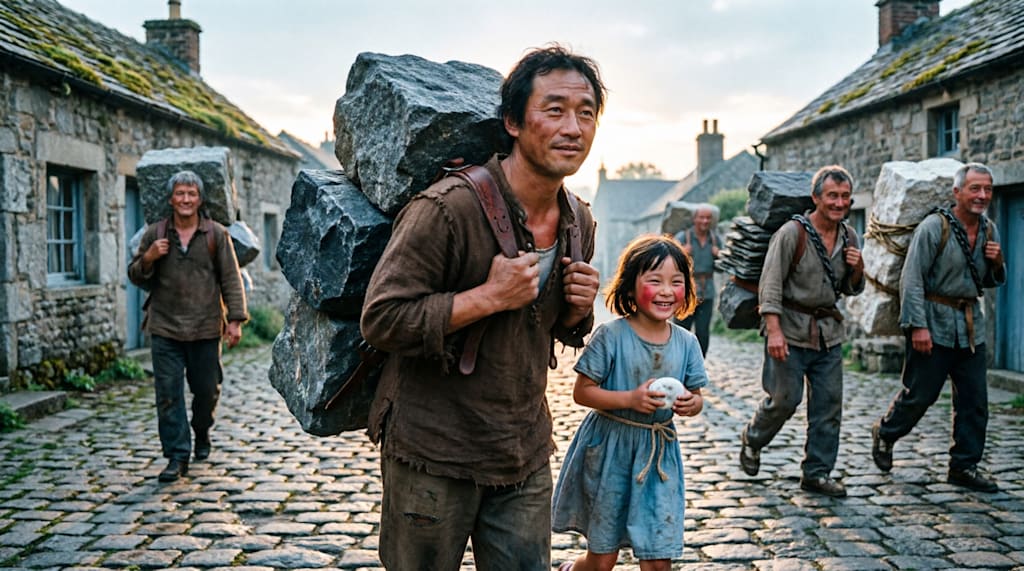
The sun hadn't yet cleared the jagged teeth of the basalt cliffs when Elias began his morning ritual.
He stood before the mirror, checking the leather harness that crisscrossed his chest. It was worn supple by decades of salt and sweat. He adjusted the buckles, ensuring the iron-grey stone fastened to his small of his back was centered. It was the size of a prize-winning pumpkin and weighed exactly eighty-four pounds.
It was his father.
Next, he strapped the two smaller, smoother river stones to his shoulders. These were his sisters, taken by the fever in the same week. They were light—barely ten pounds each—but their position made his collarbones ache with a dull, rhythmic throb. Finally, he tucked the smallest stone, a thumb-sized piece of white quartz, into a pouch over his heart.
He took a breath, felt his spine compress, and adjusted his facial muscles into the required expression: a mask of effortless serenity.
Elias stepped out onto the cobblestone street of Oakhaven.
He wasn't alone. The village was a sea of rhythmic, swaying bodies. Mrs. Gable, the baker, was currently wrestling a massive, jagged slab of granite onto her display counter. It was strapped to her waist, dragging behind her with a sound like grinding teeth. She was eighty years old, and the stone—her husband—clearly weighed more than she did.
"Lovely morning, Mrs. Gable," Elias said, his voice light and airy, as if his lungs weren't being squeezed by the leather straps. "The sourdough smells particularly crisp today."
Mrs. Gable looked up. Her face was a map of deep-set wrinkles, slick with a sheen of cold sweat. Her knees were visibly trembling, clicking with every micro-adjustment she made to stay upright.
"It’s the humidity, Elias," she chirped, her voice hitting a high, melodic note that flirted with a scream. "I feel as light as a dandelion seed today. I might just float away if I’m not careful."
She reached for a tray of rolls. As she did, the granite slab shifted, pulling her backward. Her heels skidded on the floor. For a terrifying second, she teetered on the edge of a fall that would surely shatter her spine.
Elias stood three feet away. He could have reached out. He could have put a hand on her shoulder to steady her. He could have braced the stone.
Instead, he turned his gaze to the sky, admiring a passing cloud.
"The wind is quite refreshing," he remarked to the empty air.
Mrs. Gable gasped, a wet, ragged sound, and slammed her palms onto the counter. She caught herself. She breathed through her nose, her eyes wide and bloodshot, until the trembling stopped.
"Refreshing indeed," she choked out, forcing a smile so wide it looked like a wound.
They didn't speak of the stumble. To speak of the stumble was to speak of the weight. And to speak of the weight was to admit that the Ancestors were a burden rather than a blessing.
Elias continued down the street toward the masonry yard. Every citizen he passed was a marvel of biological defiance. The teenagers carried pebbles and cobbles, skipping with a forced, manic energy. The middle-aged moved with a slow, deliberate grace, their torsos thick with muscle grown to support the mounting heavy-metal history of their bloodlines.
At the center of the square stood the Elder.
The Elder sat on a reinforced wooden bench. He didn't move. He couldn't. He carried a cairn of nearly thirty stones, wired together in a towering spire that rose above his head. He was a monument of flesh and mineral.
"Good morning, Elder," the passing youths shouted, their voices bright. "You look so nimble today!"
"I am a feather in the breeze!" the Elder croaked back, his eyes fixed straight ahead because he could no longer turn his neck.
Elias reached the yard and began his work: carving the very stones that would one day sit on someone else’s shoulders. He worked with a chisel and mallet, the extra eighty-four pounds on his back pulling at his lats, turning every movement into a feat of structural engineering.
Around noon, a sound broke the choreographed silence of the village.
It was a crack. Not the crack of a hammer on stone, but the wet, sickening snap of a dry branch.
Elias looked up.
Across the yard, a young apprentice named Thomas had collapsed. He was only nineteen. He had been carrying his mother—a modest, forty-pound limestone block. He lay in the dust, the stone pinned beneath him, his right leg twisted at an angle that defied the laws of geometry.
The yard went silent. The only sound was the wind whistling through the basalt cliffs.
Thomas looked up, his face contorted. "I..."
He stopped. He saw the eyes of the other workers. They weren't looking at his leg. They weren't looking at the stone. They were looking at the space six inches above his head, their expressions frozen in masks of pleasant indifference.
"I tripped on a shadow," Thomas said, his voice trembling. He tried to push himself up. His broken bone grated against the dirt. He fell back, a sob Escaping his throat. "It’s... it’s so heavy. Please. Just help me shift the strap."
The word hung in the air like a poisonous gas. Heavy.
Elias felt a surge of pity so strong it tasted like copper in his mouth. He took a half-step forward. His own stones shifted, the weight of his father reminding him of the cost of gravity.
If he helped Thomas, he was acknowledging the weight. If he acknowledged the weight, he was admitting his father was a burden. And if his father was a burden, then the Rule was a lie. And if the Rule was a lie, there was nothing holding them all up but the pretense of strength.
Elias turned back to his workbench.
"The sun is high," Elias said to no one in particular. "I think I’ll have an apple for lunch."
The other workers followed suit. "An apple sounds lovely," one said. "I feel so energetic, I might skip lunch entirely," said another.
In the center of the yard, Thomas began to scream. It wasn't a scream of pain, but of realization. He clawed at the dirt, trying to drag himself and his mother toward the gate. No one moved. No one saw him. He was a ghost in a world of heavy shadows.
By the time the sun began to set, the screaming had stopped. Two men in white coats—men who carried no stones, the Cleansers—entered the yard. They didn't look at Thomas’s face. They simply unbolted his harness, took his stones, and rolled his body onto a cart.
They moved with the effortless ease of the unburdened.
Elias walked home. His legs felt like lead pillars. His spine felt like it was being driven into his pelvis. When he reached his front door, he saw his young daughter, Clara, waiting for him.
She was holding a small, grey rock she had found in the garden. She had tied it to her belt with a piece of string.
"Look, Papa!" she cried, dancing in a circle. "I’m carrying Grandma!"
Elias looked at his daughter. He looked at the way her small body already leaned slightly to the left to compensate for the pebble. He felt the crushing, suffocating reality of his father, his sisters, and the quartz heart of his wife pressing down on him. He wanted to scream. He wanted to throw the stones into the sea.
Instead, Elias leaned down and kissed her forehead. He ignored the fire in his joints. He ignored the way his vision blurred with exhaustion.
"You look so light, Clara," he said, his voice a perfect, porcelain lie. "Like you could fly."
"I do, don't I?" she giggled.
"Yes," Elias said, straightening his back until he heard the vertebrae pop. "We all do."
He walked into the house, closing the door on the silent, weighted world, moving with the practiced, agonizing grace of a man who was, by all accounts, as light as a feather.
About the Creator
Edward Smith
I can write on ANYTHING & EVERYTHING from fictional stories,Health,Relationship etc. Need my service, email [email protected] to YOUTUBE Channels https://tinyurl.com/3xy9a7w3 and my Relationship https://tinyurl.com/28kpen3k
Keep reading
More stories from Edward Smith and writers in Fiction and other communities.
CRIMSON HARVEST
Abel’s blood cast a blight upon the land. After he buried his brother, Cain could wrest from the soil nothing but beets. All that he planted — wheat, barley, even grapes — came up beets that stained his hands and his mouth. All his labor, all his tilling and cultivating and harvesting, turned to roots that tasted of dirt and
By Edward Smith9 days ago in Fiction
Annie After
Annie always said she was “handling things beautifully,” though no one had asked her to. In the days after Paul’s death, she moved through the house with the restless energy of someone who needed an audience. Lockdown meant there would be no funeral, no gathering, no public display of devotion. The absence of spectators unsettled her. She needed a stage, and grief—real or imagined—was her current favored script.
By Julie O'Hara - Author, Poet and Spiritual Warrior6 days ago in Fiction
The Fears of AI And How Much Fun It Can Be
ChatGPT has come a long way, as has AI in general. There are those people who are scared of it, and for understandable reasons. People fear that as technologies advance, they’ll be replaced in the workforce. Then, there are the fears that AI could evolve into something that brings us to the brink of extinction.
By Jason Morton3 days ago in Futurism




Comments
There are no comments for this story
Be the first to respond and start the conversation.