
The Starweaver's Last Thread
In a universe where reality is woven from light, one seamstress discovers the fatal flaw in existence itself.

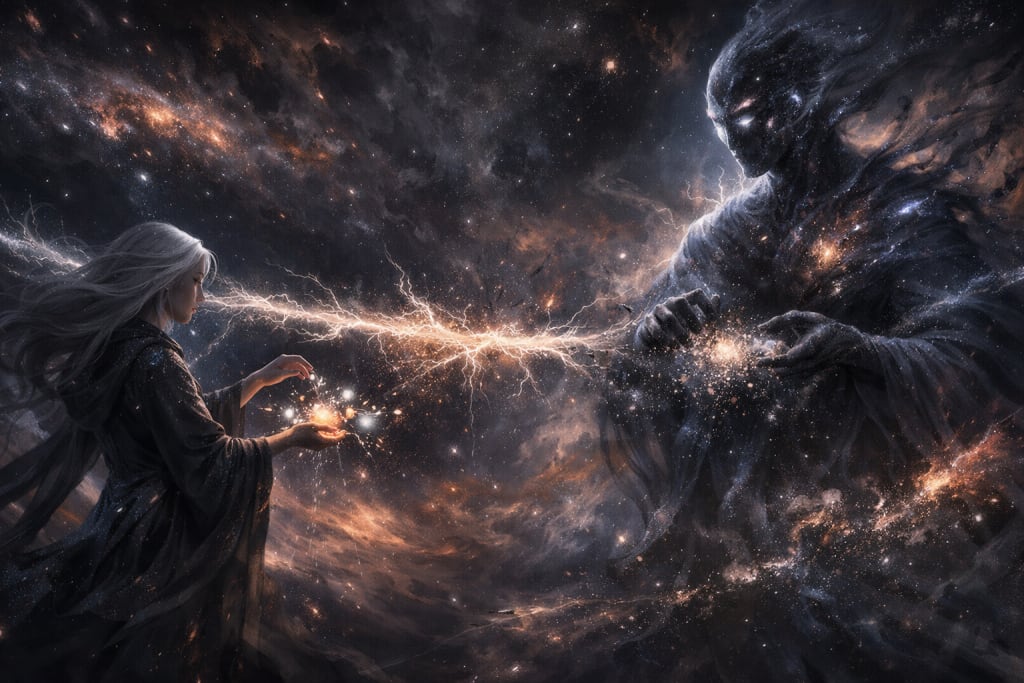
Mira's fingers moved through the void, pulling threads of starlight into intricate patterns that would become tomorrow's constellations. She worked alone in the Loom Chamber, suspended in the space between dimensions where causality bent like silk.
She'd been a Starweaver for three centuries—long enough to forget what it felt like to walk on solid ground, short enough that the elder Weavers still called her 'apprentice' behind her back. Her specialty was binary systems: twin stars locked in eternal dance, their gravitational poetry written in the language of physics she translated into luminous thread.
Tonight, something was wrong.
The threads felt brittle between her fingers, crackling with static that shouldn't exist in the quantum foam. She held one up to examine it—a strand of blue-white light destined to become part of a supergiant in the Kepler sector. Hairline fractures ran through it like a porcelain cup about to shatter.
"Impossible," she whispered, though there was no air here to carry sound. The word existed anyway, a ripple in probability.
Mira pulled another thread. Same fractures. Another. Another. Her hands moved faster, checking the thousands of strands hanging from her loom. Every single one compromised.
She activated the emergency beacon, a pulse of folded spacetime that would reach the Grand Weaver in nanoseconds. While she waited, she did what her training demanded: she followed one thread to its source.
The thread led her deeper into the substrate of reality than she'd ever gone. Past the quantum layer where particles decided whether to exist. Past the information matrix where the universe stored its own source code. Down to something she'd only heard whispered about in the Archives—the Ur-Thread, the first strand from which all others were spun.
It was unraveling.
The Ur-Thread stretched across dimensions Mira couldn't fully perceive, vibrating at frequencies that predated time itself. And along its impossible length, she saw the decay spreading like rot through wood. Not just fractures—active dissolution, as if reality were developing an allergy to its own existence.
"You see it now." The Grand Weaver materialized beside her, their form shifting between states of matter, neither old nor young, neither one being nor many.
"How long?" Mira asked.
"We noticed the first signs two hundred years ago. The deterioration has accelerated recently. At current rates, complete systemic collapse in six months. Give or take a universe."
Mira's mind reeled. Six months until every star, every planet, every consciousness in existence simply... stopped. "Can we repair it?"
"We've tried. Every patch we weave dissolves faster than the original thread. It's as if—" The Grand Weaver paused, their many eyes fixing on something beyond sight. "It's as if the universe is tired."
"Tired?"
"Fourteen billion years is a long time to maintain coherence. Entropy always wins, Mira. We Weavers have only ever been delaying the inevitable."
Mira stared at the fraying Ur-Thread. Her whole existence had been dedicated to creation, to weaving new light into the tapestry of cosmos. The idea that it was all temporary—not in the heat-death sense that everyone accepted, but imminently, catastrophically temporary—made her want to scream into the void.
Instead, she had an idea.
"What if we're weaving it wrong?" she said.
The Grand Weaver's form rippled with what might have been amusement or concern. "Elaborate."
"We weave outward, always creating new threads, new complexity. But the Ur-Thread is stressed because it's supporting too much weight. What if we need to weave inward? Not adding to the tapestry, but... reinforcing the foundation?"
"That would require unweaving active reality. Entire galaxies would need to be dissolved back into potential. Trillions of conscious beings."
"I know." Mira pulled a thread from her loom—one she'd been saving for a particularly beautiful nebula she'd designed. She'd spent decades planning it. She let it dissolve back into raw starlight, felt its energy flow backward, strengthening the substrate beneath.
It was like watching a child's drawing fade, erasing something that had never yet existed but already felt real in her mind.
"If we start with the newest sections," she continued, "the regions we Weavers just created, we can buy time. Reduce the load. Then we can develop a sustainable pattern—something that doesn't rely on infinite expansion."
The Grand Weaver was silent for a long moment. Around them, the Ur-Thread continued its slow dissolution, each lost fiber representing possibilities that would never manifest.
"It would mean undoing our greatest works," they finally said. "The Nebula Gardens. The Consciousness Clusters. Everything we've woven in the last millennium."
"Yes," Mira said. "And it would mean accepting limits. No more infinite creation. A smaller, sustainable universe."
"Some Weavers will never agree."
"Then they can watch everything dissolve to nothing." Mira's fingers were already moving, carefully unweaving one of her own recent creations—a triple-star system with planets she'd imagined might someday host life.
It hurt worse than she'd expected.
The Grand Weaver watched her work, then slowly, deliberately, began to unweave their own masterpiece—a galaxy cluster they'd spent centuries perfecting.
"We were gods," the Grand Weaver said softly.
"We were gardeners," Mira corrected, her hands steady despite her breaking heart. "And it's time we learned to prune."
Together, under the dying light of the Ur-Thread, they began the work of saving the universe by making it smaller—trading infinite ambition for the radical act of enough.
About the Creator
Alpha Cortex
As Alpha Cortex, I live for the rhythm of language and the magic of story. I chase tales that linger long after the last line, from raw emotion to boundless imagination. Let's get lost in stories worth remembering.
Keep reading
More stories from Alpha Cortex and writers in Fiction and other communities.
The Coffee Theorem
Dr. Iris Chen had mathematically proven that lasting romantic love was statistically improbable. Her paper, published in the Journal of Behavioral Economics, used game theory to demonstrate that the emotional cost-benefit analysis of modern relationships inevitably trended toward dissolution. She'd presented it at conferences. She'd defended it on podcasts. She'd built an entire career on being right.
By Alpha Cortex7 days ago in Fiction
Babbling Dixie
The short form of tomorrow is never the whole story. Abbreviations mean nothing when we are born to die and we all are aren't we? Being spoken for before birth is something we're not supposed to remember like some kind of karma after effect. Still here we are spending our lives looking for each other.
By Canuck Scriber Lisa Lachapelle3 days ago in Fiction
Where Magic
Mrs. Periwinkle plucked a ripe apple from the tree and tossed it in her basket. She took the apples and headed inside. She mashed up a couple of apples and concocted her own apple cider. Next, she sat under her apple tree and read from her book of poetry. The bluebirds in the sky chirped their happy songs for her. Her brawny husband Sam came into sight. He waved at her and smiled warmly. “Greetings my love,” he said. “How do you do my sweet,” she asked. “Labor is long and hard but seeing your face makes it all worthwhile,” he confessed. “Your flattery knows no bounds,” Mrs. Periwinkle said. He bent down and kissed her cheek.“You make me blush as if I was a school girl again,” she confessed. From her crystal ball watched a woman equally as beautiful as Lorna Periwinkle. However, she is ugly in her heart. She grimaced as she watched this mushy scene. She turned to her pet raven named Midnight and said,“Don’t it make you sick?” “Someone’s jealous?” Midnight retorted. Storm, the witch’s black cat rubbed against her leg. The witch was named Sienna Cedar. She bent down and petted her cat. “Why can’t you be sweet like Storm?” she asked. “He’s only nice to you because you feed him,” Midnight squawked. “Can I eat the bird now?” Storm asked licking his lips. “You wouldn’t dare, tuna breath,” Midnight said. “Graveyard lurcher,” Storm shot back. “That’s enough you two,” Sienna said. “we’re a family; we shouldn’t fight.” The cat and the raven grumbled.
By DJ Robbinsabout 15 hours ago in Fiction
A Transparent Look at Vocal Challenges and Top Stories
Almost three years ago, we shared a resource article that served as a place for people to suggest new challenge prompts. We thought it would be a good idea to refresh that thread, and take the opportunity to answer a few common questions about top stories, how challenges are judged and how submissions are reviewed.
By Vocal Curation Team7 days ago in Resources




Comments
There are no comments for this story
Be the first to respond and start the conversation.