
The Eastern Junction
Four Lives, One Mistake
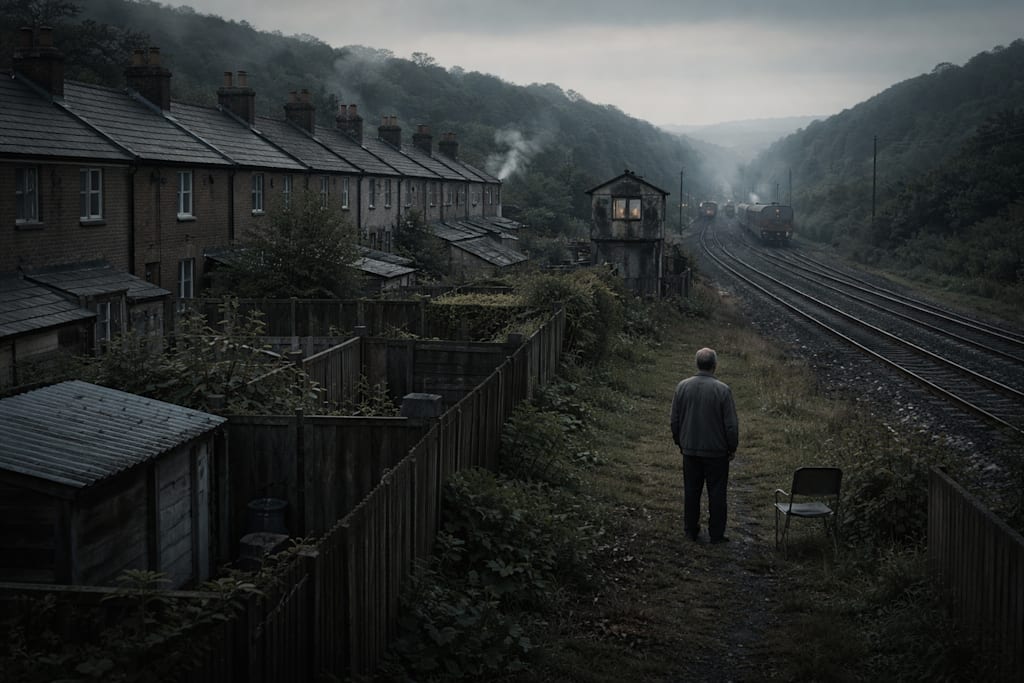
The village of Strale sat between two hills and a railway line that had carried goods east for forty years. The men who worked the line lived in a row of identical houses along Cutter Road, and Raymond Hesk had lived in the third of these houses for seventeen years, since the day he married Dorla and carried her suitcase up to the second-floor room that faced the tracks.
He was forty-one. He had a son named Tobias who was fourteen and already taller than him, and a daughter named Mags who collected the small rocks she found beside the railway gravel, storing them in a tin box beneath her bed. Raymond worked as a signal operator at the eastern junction, which meant he sat in a booth the size of a wardrobe for eight hours each day and watched the levers and the lights.
It was an ordinary life. He knew it was ordinary. He had decided, at some point he could no longer locate precisely, that ordinary was an achievement.
On the fourteenth of March, a Thursday, Raymond arrived at the booth at six in the morning and found that Carne had left early. Carne was the overnight man, a thin fellow who chewed tobacco and read military history in paperback. He had left a note saying his sister had called and that all the levers were set correctly and that Raymond should have a smooth morning of it.
Raymond checked the levers. They were set correctly.
At seven forty, the passenger express was scheduled to come through from the west. It ran every morning, six days a week, carrying perhaps two hundred people toward the city. Raymond had cleared it through the eastern junction four thousand times, give or take. He did it the way a man ties his shoes.
At seven thirty-eight, the freight coordinator telephoned to say that a slow goods train had been delayed and was running twenty-two minutes behind schedule, and would Raymond hold it on the southern loop until the express cleared. Raymond said he would. He pulled the appropriate lever and confirmed the signal change.
Then Dawes from maintenance knocked on the booth door to say there was a problem with the water pressure in the station lavatory and could Raymond sign the maintenance log. Raymond signed it. They talked briefly about the weather, it had been cold for March, and Dawes left, and Raymond turned back to the board.
At seven forty-one, he realized he had pulled the wrong lever.
He stood for two seconds looking at the board and understanding, with a clarity that felt physical, what he had done. He had pulled lever six instead of lever seven. Lever six cleared the southern loop signal. Lever seven held it. The freight train, seventeen cars and a locomotive, was moving onto the main line.
He grabbed the telephone and called the signal box at the western approach. The line rang four times and connected to the overnight recording, which told him to try again or call the central office. He called the central office. He was put on hold. The hold music was a brass band arrangement of a song he didn't know.
He could see, through the booth's narrow window, the rails bending away to the west. He could see the signals along the southern loop, which were now showing green where they should have shown red. He could see around the long curve where the express would be.
He released the hold and telephoned the freight locomotive directly. It rang once and the driver answered. Raymond told him to brake. The driver said something, asked something. Raymond said to brake now, to stop. He heard the change in the driver's voice, from mild confusion to alarm, and then the line was still open and there was only the static of the cab and then, distantly, the sound that Raymond had been hearing in some part of his mind since the moment he understood his error, and which confirmed everything.
It was a small sound. That was the first thing he noticed, with a strange detachment, when he thought about it later, that it lacked the force he had expected, as though something so final would declare itself more completely. He had imagined it would be louder.
The inquiry lasted eleven days. Raymond sat through it in a black suit that had been bought for his father-in-law's funeral and had since been used only for formal occasions. He answered every question correctly and completely. He did not attempt to explain away his error or construct a sequence of events that distributed the responsibility more evenly. He had pulled lever six. He knew the position of the levers. He had been distracted for less than two minutes. He said all of this.
Four people had died. Nineteen had been injured, six of them seriously. The freight driver, a man named Aldous Breen, was among the dead. Raymond had spoken with him for eleven seconds on the telephone.
The railway board found that operational procedure had been violated in three respects, including the departure of the overnight operator before the day operator had formally signed in, and that signal booth staffing required review. Raymond's legal representative pointed to these findings. Raymond listened and said nothing.
He was suspended, then dismissed. There was no criminal prosecution. The inquiry report described his error as a momentary lapse under conditions of reasonable distraction, and recommended procedural reform.
Dorla did not leave him, which he had expected. Tobias grew quieter, in the way teenagers grow silent when they are working something out about the world. Mags continued to collect her rocks.
Mags brought the tin box to him one afternoon and set it on the table between them. She opened it and began to sort the rocks she had gathered from beside the railway, arranging them by color, then by size, explaining her system as she worked. He watched her do this for some time. At a certain point she paused and selected one, darker than the rest, and held it out to him. She said she had found it the day after the accident and had almost left it where it lay, because it did not seem to belong with the others. He took it from her and turned it over once before placing it back in the box, where it sat apart from the groups she had made.
Raymond sat in the house on Cutter Road and applied for two jobs and received no reply to either.
In June he walked to the eastern junction and stood at a distance from the signal booth. A man he didn't recognize was sitting inside, reading something. The levers were the same. The view through the narrow window was the same. Raymond stood there for perhaps ten minutes, then walked home.
He was, in the technical sense, a free man. He ate meals, spoke to his wife, watched his son's school matches from the sideline. He paid for Mags's school trip to a museum in the city and she brought him back a postcard of a Roman mosaic that she said reminded her of her collection.
There was a fund established for the families of Aldous Breen and the three other dead. Raymond sent money to it twice, once in March and once in November, using amounts that were significant to him and meant nothing in relation to anything. He did not contact the families. He understood, in a way he could articulate to himself clearly if he chose to, that his contrition was something the families were under no obligation to receive, that the presentation of his sorrow was a form of demand he had no standing to make.
In the evenings he sometimes sat in the back garden on a folding chair and looked at the strip of sky above the terraced houses. The railway line ran two streets over, and he could hear the trains. He heard them the way you hear something that has always been there, in the background of everything, persistent and indifferent as weather.
He was a living man. He had destroyed four other people, and he continued to exist. That was the fact he returned to most consistently, and it did not alter with repetition or time or any effort of thought. It remained exactly as large as it had been.
He sat with it.
About the Creator
Tim Carmichael
I’m a firm believer life is messy, beautiful, and too short, which is why I write poems full of heart and humor. I am an Appalachian poet and cookbook author. My book Beautiful and Brutal Things is on Amazon, Link 👇
Keep reading
More stories from Tim Carmichael and writers in Fiction and other communities.
The Drawing Room Tide
The tea service was laid out with the precision of a surgical tray. Mrs. Gable adjusted the silver tongs by a fraction of an inch, ensuring they were perfectly parallel to the edge of the mahogany table. Sunlight streamed through the bay window, illuminating the dust motes dancing in the air and the thick, viscous pool of dark, brackish water that covered the entire floor of the drawing room to a depth of four inches.
By Tim Carmichael27 days ago in Fiction
The Last Days
The Last Days Part I Kinsley clutched her throat and began squeezing harder and harder. As Lacy lay on the ground dreaming of mermaids. She couldn’t help but wonder as her mind drifted to darkness. The night grew silent, as Lacy lay on the ground lifeless.
By Charelle Landers3 days ago in Fiction
Bibbidi-Bobbidi-Booyah!
Dear Professor Donkeldong, I would like to formally apologize. Last night I snuck into your office. I sat in your chair and poured myself three fingers of Scotch from the bottle you’ve got stashed in the top desk drawer. Then I helped myself to your private library.
By Leslie Writes2 days ago in Humor



Comments
There are no comments for this story
Be the first to respond and start the conversation.