
The City That Outlawed Sound
They silenced everything — except the one man who had never needed ears to hear music

The law had been in effect for nine years, four months, and eleven days.
Elias Vorne knew this not because he tracked legislation — he had no particular interest in legislation, which had never once in his experience produced anything worth listening to — but because nine years, four months, and eleven days ago was the last time he had heard another human being sing. A woman, somewhere below his window, walking home in the early dark, carrying a melody he didn't recognize in a voice that was slightly flat on the upper notes and completely, heartbreakingly alive. He had stood at his window and listened until she turned a corner and the city swallowed the sound, and three days later the Silence Ordinance had passed the Municipal Assembly by a margin of forty-one votes to three, and the woman below his window had never sung again.
At least not outside.
At least not where anyone could report it.
Elias had been blind since birth, which the architects of the Silence Ordinance had apparently not considered a relevant variable. They had constructed their legislation around a fundamental assumption: that sound was primarily a visual experience. That people made noise because they wanted to be seen making it — to signal status, to claim space, to perform existence for an audience. Remove the audience, the theory went, and the performance would cease. Silence would become not an imposition but a preference, then a habit, then simply the texture of normal life.
The theory was not without a certain cold intelligence. Elias could see — or rather, could not see, and had developed in place of sight a comprehensive alternative model of the world assembled from sound and texture and the specific information contained in air currents and the way spaces changed the character of quiet — that the architects had understood something true about noise as performance, as status signal, as territorial claim. They were not wrong that much of what passed for human sound was essentially decorative.
They had simply failed to account for music.
Not music as performance. Music as necessity — as the thing certain people did not choose to do but were constitutionally unable to stop doing, the way a river doesn't choose to run downhill but simply has no alternative given the nature of gravity and the shape of the land.
Elias had been playing piano since he was four years old. He would be playing piano, he had long since understood, until his hands stopped working or he stopped existing, whichever came first. The Silence Ordinance was a significant inconvenience. It was not, ultimately, a deterrent.
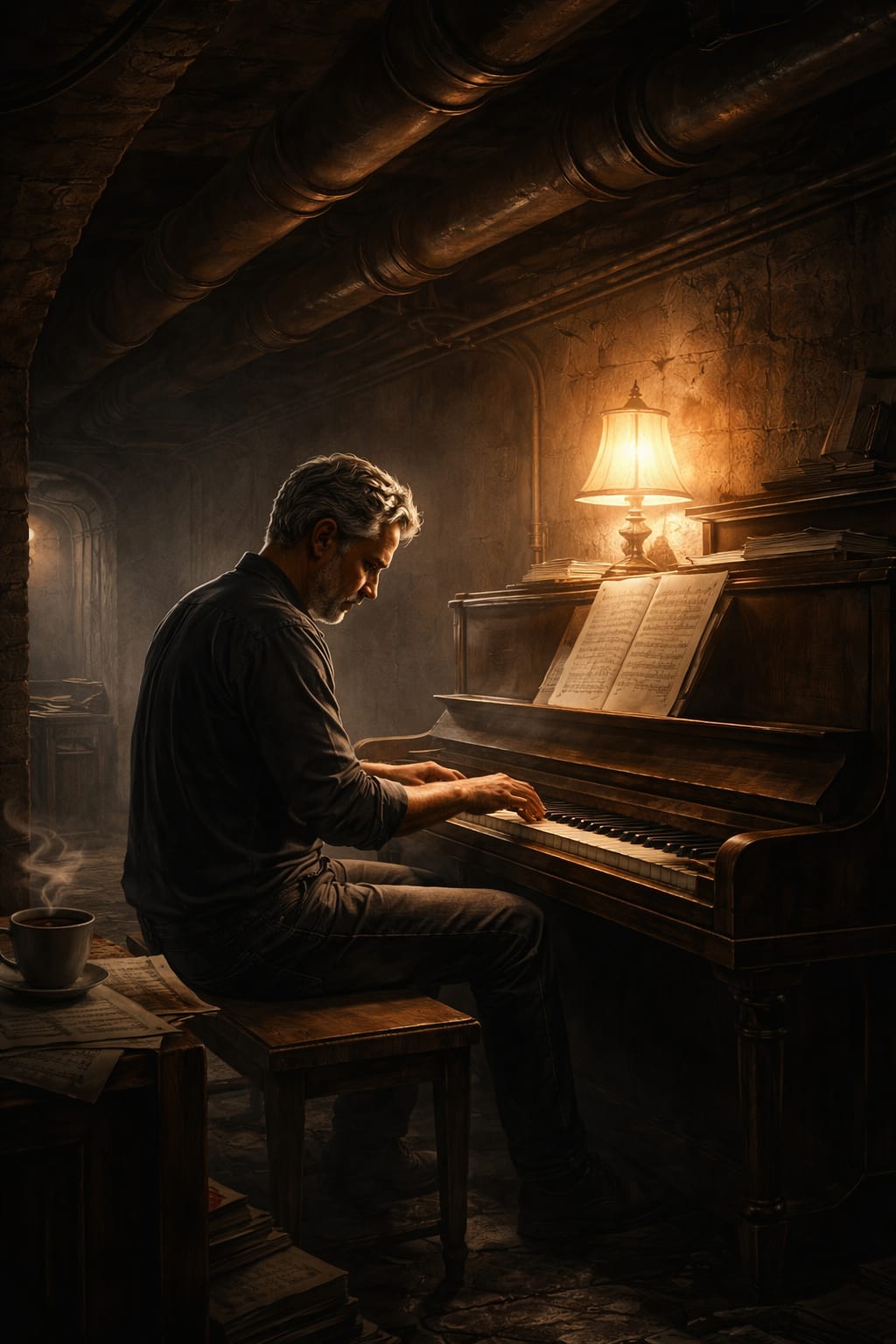
The piano was in the basement.
This was not unusual — basements in the Vorne district were thick-walled, built in an era when people had stored things they wanted protected from the weather and the century, and sound moved through their stone with reluctance. What was unusual was the additional insulation: layers of acoustic dampening material that Elias had sourced, over the course of two years and many careful conversations conducted in the mandatory whisper that had become the city's new vernacular, from a network of people who were, technically speaking, criminals.
They called themselves, without much apparent irony, the Resonance. Which Elias found slightly precious but didn't say so, because they were providing him with acoustic dampening material at considerable personal risk and this was not the moment for aesthetic criticism.
The Resonance was, in structure, a collection of people who had decided that the Silence Ordinance was a law they were willing to break. Not all of them were musicians — though many were. Some were parents who wanted to hear their children laugh without calculating the fine. Some were elderly people for whom a lifetime's habit of humming while they worked had proven resistant to legal remedy. Some were, Elias suspected, simply people who had discovered that once you removed sound from a life you also removed a great deal of what made the life distinguishable from a long, quiet disappearance.
Elias had been contacted by the Resonance in year three. A woman named Petra had come to his door and whispered, with the careful economy of someone accustomed to whispering, that she had heard — through channels she declined to specify — that he still played. That he played every night, in his basement, with the door sealed. That the acoustic dampening was holding. And that there were people who would very much like to listen.
"Listen how?" Elias had whispered back. "You can't come into the basement. One person entering and exiting is manageable. A regular audience is not."
"Not in person," Petra had said. And she had described the system.
It was elegant in the way that necessity tends to produce elegance, which is without any particular intention toward beauty and therefore achieving it more completely than design usually manages.
The basement connected, through a wall that Elias had not built and had been instructed not to ask about, to a network of older pipes — infrastructure from the city's previous century, when buildings had communicated heat and water through channels that ran between them like a circulatory system. The pipes still ran. They connected, in a branching pattern that Petra knew from a document she also declined to explain, to forty-seven other buildings across the district.
In each of those buildings, in a room chosen for its access to the pipe network and its distance from street-facing windows, there was a listening point. A small amplification device, built from components whose individual purchase was unremarkable, which converted the vibrations traveling through the pipes — attenuated, transformed by distance and metal and the peculiar acoustic physics of nineteenth-century infrastructure — into something a single person, ear pressed close, could hear.
It was not a concert. It was barely music, by the time the pipes were done with it. It arrived at the listening points filtered and strange, certain frequencies lost entirely, others altered in pitch or duration, the overall effect somewhere between music and memory — like hearing a piece you once knew very well played in another room of a house you no longer live in.
The forty-seven people who listened said it was the most beautiful thing they had heard in years.
Elias played every night at ten o'clock. He played for an hour. He played whatever he felt like playing, which was varied: old compositions from before the Ordinance, pieces he had known since childhood, pieces he was writing himself in the expanding interior silence of a life without permitted sound, pieces that existed only in the playing and had no score because he had never needed to write things down. He played for an audience he could not see, receiving no signal that he was being heard, trusting the pipes and Petra's document and the human need to lean toward warmth.
He found, to his surprise, that playing for an invisible audience suited him better than playing for a visible one ever had.
In year seven, the Enforcement Bureau began to suspect something.
They could not have said exactly what they suspected, which was part of the problem. The Silence Ordinance had generated, in its nine years, a reliable class of violations: someone laughing too loudly, a child crying in public without the parent producing the required Distress Exemption documentation within thirty seconds, a merchant whose cart wheel had not been adequately silenced. These were manageable. They generated fines. The city ran smoothly.
What the Enforcement Bureau was detecting now was different. A pattern of no-pattern. Forty-seven apartments whose residents had stopped generating the ambient noise that even a silent city's residents generated — the shuffle of furniture, the creak of floorboards, the barely-audible human sounds that the Bureau's monitoring equipment registered as background data. Every night between ten and eleven, forty-seven listening points went peculiarly, specifically still.
Inspector Vael was assigned to determine why.
She was, by the standards of her profession, a thoughtful woman. She had joined the Bureau in the Ordinance's second year, had enforced it diligently and without particular enthusiasm, and had spent seven years developing a private taxonomy of the ways people responded to legislated silence: the relieved, who had always found the world too loud; the adapted, who missed sound but had made peace with its absence; and the resisters, who had not made peace, who carried their noise inside them like a held breath, waiting.
She had developed, over seven years, a certain sympathy for the resisters that she was careful not to express professionally.
She identified Elias Vorne in the sixth week of her investigation. The geometry of the pipe network, traced backward from the listening points, led to his basement with the inevitability of a proof resolving. She stood outside his building for three evenings, instruments confirming what her ears could not — the insulation was good, the acoustic dampening was holding — and then she went home and sat in her apartment and thought.
On the fourth evening, she found the listening point in her own building.
She had lived there for six years. She had not known it existed. The previous tenant, apparently, had been one of the forty-seven — had moved away, had not reported the device, had left it in the wall like a kindness for the next occupant, or possibly simply like an oversight.
Vael pressed her ear to the wall at ten o'clock.
What came through the pipe was barely music. Attenuated, strange, certain notes arriving as ghosts of themselves, the rhythm altered by the long travel through metal and stone. She could not have said what piece it was, or in what key, or whether it was technically accomplished or merely passionate. She could not have said any of the things she would have been required to say in a professional evaluation.
She could have said — and did say, quietly, to the wall, to no one — that she had not understood until this moment how much of herself she had been storing in the future, in the idea of a time when sound would be permitted again, rather than spending it in the present.
She listened for the full hour.
She went to Elias Vorne's door on a Thursday morning.
He answered immediately, which suggested he had heard her on the stairs — had constructed from the sound of her footfall some information about her approach. He was perhaps fifty-five, with the specific stillness of someone who has learned to make their primary attention invisible. He tilted his head at the angle of someone listening to something she hadn't produced.
"You're from the Bureau," he said. Not a question.
"Yes."
"You found the pipes."
"Yes."
He was quiet for a moment. Then: "Would you like to come in?"
She had not expected the question. She had expected — she wasn't entirely sure what she had expected. The practical responses available to her were prosecution, report, the administrative sequence that would result in the basement being cleared and Elias Vorne receiving a fine large enough to constitute a significant portion of his annual income and possibly a period of supervised silence, which was the Ordinance's term for something that was essentially solitary confinement with paperwork.
She had not expected to be invited in.
"Yes," she said. "I think I would."
The apartment was quiet with the quality of quiet that a person curates rather than endures — not the municipal silence, enforced and monitored, but something chosen, the silence of a person who understands the value of sound and is therefore careful with it. He made tea with the economical movements of someone who doesn't require sight to navigate his own kitchen.
"I'm going to have to ask you something," he said, setting a cup in front of her, finding its position with a gesture of practiced accuracy. "And I want you to answer it honestly, because I've found that dishonest answers make the subsequent conversation very inefficient."
"All right," Vael said.
"When you listened last night," Elias said, "what did you hear?"
Vael looked at the tea. She thought about the answer with the seriousness it seemed to require.
"Something I didn't know I was missing," she said.
Elias nodded slowly, with the expression of a man who has received the answer he needed.
"Then I think," he said, "that we have something to discuss."
The conversation lasted four hours. At the end of it, Inspector Vael filed a report that described the pipe network as an infrastructure anomaly requiring engineering assessment and noted no violations of the Silence Ordinance. The report was accurate in the specific, limited way of reports written by people who have decided that accuracy and completeness are not always the same thing.
Elias played that night at ten o'clock, as he always did.
Forty-eight listening points went still.
The city breathed its enforced, unnatural quiet around them, and through the old pipes, through the stone and metal of a century's infrastructure, music moved — changed, attenuated, strange, barely itself by the time it arrived — and forty-eight people pressed their ears to walls and remembered what they were.
Outside, the city continued to legislate silence.
Inside the pipes, something older than legislation continued to run.
It had no interest in being stopped.
Neither, it turned out, did Inspector Vael.
She hummed on her way home — barely audible, barely a sound, a vibration more than a note — and it was the first time in nine years, four months, and an uncertain number of days, and it felt, despite everything, like the most natural thing in the world.
From the Municipal Enforcement Bureau's annual report, Year Nine of the Silence Ordinance:
"Compliance levels remain at 97.3%. The remaining 2.7% represents cases under ongoing assessment. No further action recommended at this time."
— Inspector V. Vael, District 7
About the Creator
Alpha Cortex
As Alpha Cortex, I live for the rhythm of language and the magic of story. I chase tales that linger long after the last line, from raw emotion to boundless imagination. Let's get lost in stories worth remembering.
Keep reading
More stories from Alpha Cortex and writers in Fiction and other communities.
The Phonograph of Hollow Souls
The dead, Edmund Voss had come to believe, were simply a matter of frequency. He arrived at this conclusion not through any mystical awakening or feverish religious crisis, but through the careful, methodical application of scientific reasoning — the same reasoning that had earned him a modest reputation among London's emerging class of acoustic engineers and a less modest reputation among its society gossips, who found a bachelor of forty-three with wax-stained fingers and an apartment full of recording cylinders somewhat difficult to seat at dinner parties.
By Alpha Cortex4 days ago in Fiction



Comments
There are no comments for this story
Be the first to respond and start the conversation.