
Ouroboros
Nothing lasts on a world that eats itself.

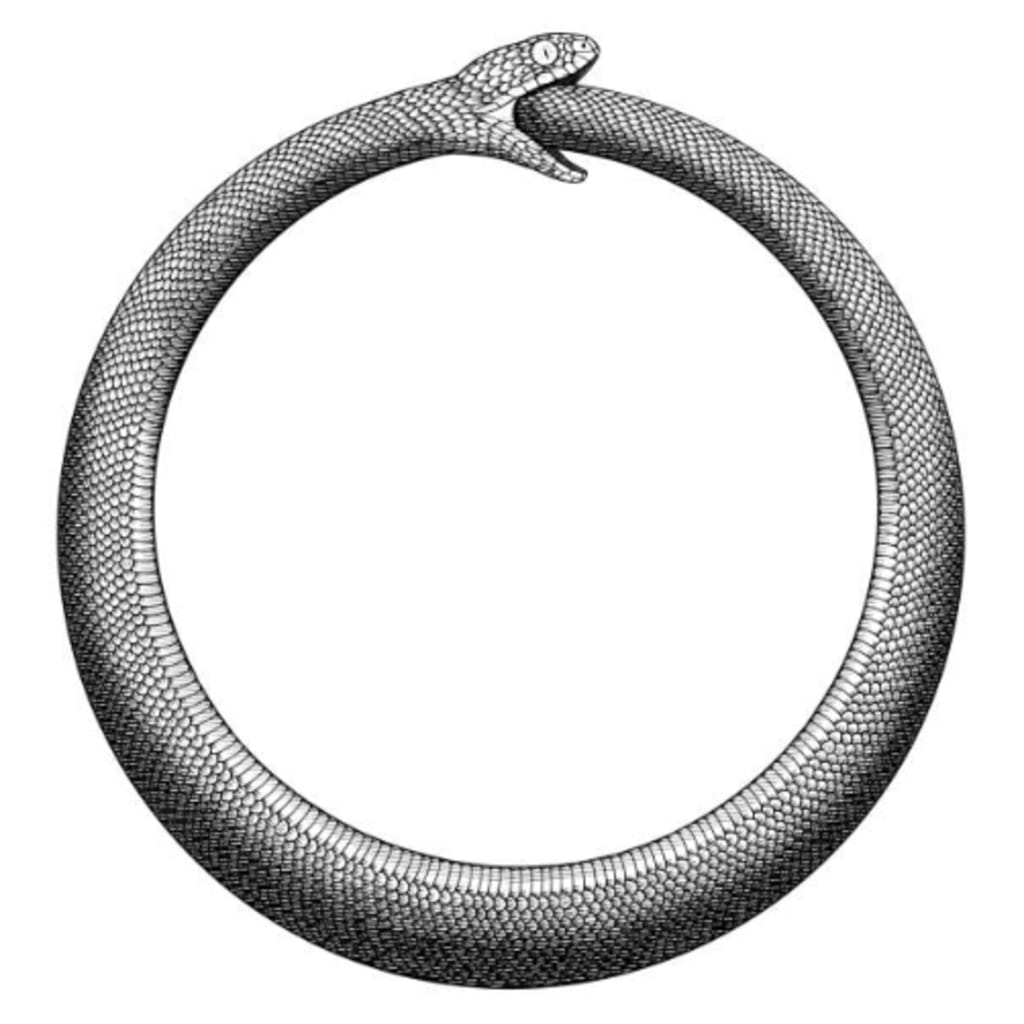
On Ouroboros, nothing is built for permanence.
If one were to construct an empire on Her mountainous nostrils, She would swallow it in a century, melt it to its base elements in Her core, and expel it as organic scaffolding somewhere along Her great expanse.
On Ouroboros, our societies are designed either to be mobile (always moving tail-wise to avoid the serpent’s imminent jaws), or to be abandoned entirely.
I have heard of worlds that keep their surfaces— my ancestral world is one. It has ‘ruins’, so I’m told, remnants of large buildings, sometimes from centuries past. All we have from centuries past here are stories, the most trustworthy of which were written during their own time, leaving less to the author’s memory.
There is one region on Ouroboros, in theory, where a place of permanence might yet be possible to build. I say, ‘in theory,’ because for now, it remains entirely uninhabitable, beset high above the breathable atmosphere.
This region is Her head. It circles Her body infinitely, processing it, reforging it, while remaining unsubmerged itself. Her tectonic jaws shift over Her plateau scales, altering the deep canyons and rivers between them into molten troughs of sludge and steam. Ouroboros’ upper jaw is a massive, sheer face of craggy rock, with two high, vertically set calderas, each twenty miles in diameter, for nostrils. These nostrils exhale scalding steam in plumes, which whirl beyond the atmosphere overhead, cooling, condensing, and raining down in a harrowing deluge over the base of her neck. In the two-hundred mile span ahead of Her, apocalyptic storms, scale-quakes, and tornados burgeon from the mass convection and pressure differentials that inevitably occur when a planet devours itself.
These storm zones— known as the maxillary front on the top hemisphere, and the mandibular front on the lower hemisphere— are kept at a great distance by the living creatures on Ouroboros. Their nomadic, ‘walking villages’ tend to migrate along the habitable regions between Her moving jaws and the back of Her head, moving mostly along Her side flanks (the cruxes of both hemispheres, respectively). This is because Her outer and inner rings— the dorsal and ventral portions of Her body— are subject to extremes.
Her dorsal edge, forming the widest, outermost portion of her form, is divided by a range of impassible mountain peaks that encapsulate her vertebrae. It is also baked to hell by year-round exposure to the sun, such that vast swathes of it have become insurmountable deserts.
Her ventral portion, on the ‘belly’ side, forms an arctic halo at her center, where gravity lightens, and ice spires are allowed to stretch high into the ever-present cloudscape that encircles it. There, silent lightning draws lattices across white skies. Blizzards rage sporadically for months on end. Hail posses the potential for meteoric devastation.
If one were to somehow chance a break in the clouds on this inner edge, they would see the opposite portion of Ouroboros, drifting overhead with seismic slowness. If one were to cross Her arctic underbelly from either direction, they would find themselves at one of the planet’s two river-seas— each hundreds of miles wide, each circulating continuously along the length of the serpent, but in opposite directions. Across these river-seas, this hypothetical individual would find the comparatively thin pastoral belts where most of the inhabitants live and cultivate their food, huddled together in their hastily established colonies, which are mobilized every other decade or so.
Where the migration belts become dense with people, and the fertile lands thin, the wars take place.
In the upper hemisphere, three reliable wars recur every century, though the locations change, due to the nature of Ourobors’ shifting surface. Grudges after these wars are short-lived, for each person on Ouroboros understands their common enemies:
Ouroboros, for one. And time.
On my ancestral planet, so I’m told, people waste time. They stay in one place, allowing themselves to set roots in the land. On Ouroboros, we set roots in each other, against the land and against time, always moving.
In an average lifespan here, one learns not to cling too fondly to anything. One is expected to take part in at least one great migration, and at least one great war in their life. So we train for such occasions, physically, mentally, and spiritually, and we never expect a good day, or even a day that we'll survive.
— Journal Entry 4 (Author unknown. Recovered at Hebron’s Belt, approx. 18 miles from the maxillary front)
* * *
The transmitter clicked, and static washed in to fill the silence in my helmet. A moment later, a voice chimed: “Ugh, not really, sir.”
“That’s okay,” the captain replied, then, turning to me, “You ready, bud?”
I nodded. Captain Irwin had a remarkable ability to stay calm. He unhooked his seatbelt, stood to grab the leather strap hanging from the ceiling, and looked past me at the pilot’s chair.
The transmitter clicked again, and his voice came through starkly:
“Okay! On ‘seven’ we dive.”
“Seven, sir?” asked a female voice.
He chuckled, “Good work pilot! You’re paying attention. On three we dive! One… Two…”
On ‘three’, the heli-drone banked. My face puckered. My eyes watered. My stomach dropped down and groveled on my pelvic floor. We were surrounded by gray storm clouds. Thunder roared through them so continuously, it blended with the motors of the drone, becoming indistinguishable from it. Lightning scattered like buckshot across the caliginous void. Tagging the hull of the vessel on occasion, making it tremble. Captain Irwin had warned me it would, but this did little to ameliorate my fear.
When we leveled out again, I glanced at Captain Irwin, who had taken the entire ordeal standing up. His face was concealed by a copper-tinted visor, but I knew he was laughing. He was always laughing— at fate, perhaps. Or maybe danger. No one had ever asked him.
The transmitter clicked on once more:
“Matthews? Klim?” Captain Irwin checked.
“...Made it, captain.” came a voice from a second vessel.
In a peppy tone, the captain yelled, “Bobby-boy! How do you like your robo-pilot? Pretty good, huh?”
This question was intended for me. I glanced at the empty pilot’s chair behind me, vibrating and swiveling on its hinges.
“I like that he hasn’t killed me,” I mustered.
“She,” he said, “She— hasn’t killed you Bobby-boy! What do you think of Bob’s compliment there, Miss Robo-Pilot?”
“It was very nice, sir,” the voice uttered conversationally.
A blast of lightning exploded off of the hull. The vessel tipped sideways, then quickly corrected itself.
“Ho, my Lord!” Captain Irwin shouted, cackling masochistically, reasserting his grip on the leather strap, “Almost wet myself there!”
The robo-pilot tunneled forth.
In an hour, we’d all but closed the gap between the start of the maxillary storm front and the opening of the left nostril. The transmitter clicked:
“Half a minute 'til self-aviation,” Captain Irwin said.
“Affirmative!” three voices chimed.
My wing suit was prepared. It had always unnerved me how light it felt on my back, cinched onto the metal exoskeleton of the suit. I extended and contracted my arms. the thin, carbon fiber slats moved seamlessly with them.
“Ten seconds!”
On ‘one’, I threw the door open and leapt from the side of the drone. The captain leapt from the other. I followed his feet as they plummeted downward, glinting in and out of storm pockets.
A remote navigation system controlled the engines on my left and right shoulders, steering me toward the top-right wall of the nostril. Beneath me, two more from our mission team jetted in the same direction— shadows— drilling holes through the corpulent cloudscape.
My visor fogged. The heat intensified. I knew, though I could not feel it through my suit. We were entering the geyser plume of Ouroboros’ exhale.
“Bobby-boy!” Irwin’s shaky, staticky voice chopped through, “We’re really fucking doing it!”
In the steam, we set our visibility settings to reverse-thermal, searching for things that were colder than the surrounding atmosphere. Three blue splotches appeared, demarcating my team. The tallest of the splotches was Klimmek, the only native among us, born on the Ventral ring, where the lighter gravity had stretched him to seven and a half feet, the average height of his people.
All those seven and a half feet zipped away— as the pressure changed direction suddenly, and Ouroboros began Her great inhale.
We were iotas of dust compared to Her, and we’d trained accordingly. We leaned toward the right-most wall as we were flung inexorably inward, aiming to cling to Her nasal cavity before Her next exhale came to toss us backwards. Along this inner wall, intranasal grooves— ones that would be detectable only by microscope in our own nostrils— formed inconsistently sized mounds, barriers we could wedge ourselves behind for protection.
We extended diamond tipped pitons from our boots and gloves, awaiting the brief pause that would come before the exhale. The force She wielded with each breath had the potential to fold us in half, were we unlucky enough to be caught in it.
As Her breath slowed, the internal wall revealed itself from the steam. I dug in. Captain Irwin dug in above me. We were both concealed by a protruding hump of that stone-like internal skin before us. We assumed Matthews and Klimmek had found their way to safety as well, for their blue phantom-images from the reverse-thermal vision could not be spotted behind the obstruction.
There was a moment of stillness. I watched a wisp of steam swirl in uncertainty overhead, before raging backwards in a froth of its brethren. I considered what this surge might do to my hand, were I to hold it high enough. I pictured the fingers snapping backward, the palm severing entirely at the wrist, degloved skin trailing behind it like the tail of a comet.
I pressed myself tightly against the wall. I could hear the captain in my imagination, laughing at my acute caution, my unpreparedness to die.
The column of white death passed overhead like a bullet train. Its scream was so encompassing that I did not notice the transmitter until it slowed again.
Klimmek’s voice flooded into it: “Mat’yews!” (he spoke in a Ventral accent, as it had been his first language).
“We lost Mat’yews!”
“What?” Captain Irwin shouted.
“T’world took him!”
There was a silent pause— a solemn acknowledgment that there would be no search and rescue mission.
The air current paused, then reversed, then we dove into it without a last word for Matthews— soaring deeper into the respiratory system.
On the next respite, we took cover again.
“How did it happen, Klimmek?” Captain Irwin asked.
I listened intently, ejecting the pitons from my forearm holsters.
“He slipped, Captain! Malfunction wit t’suit I tink.”
I glanced up at Captain Irwin. His blue, wavering visage appeared still and thoughtful as the breath blasted overhead again. When it finished, we leapt off the wall once more, and allowed the subsequent inhale to carry us not just forward, but upward. Our goal was to finish the work of the two mission crews before us: the first had confirmed it was possible to enter the nasal cavity, and the second, the cranium. Thanks to this, our navigation systems now held the coordinates to a slew of small chambers, nearly molecule-sized in comparison to the rest of Ouroboros’ body. They were passages through what was assumed to be a nerve connecting the brain to the olfactory system.
In our suits, only the captain and I carried the detonation charges, to quell the common enemy; to bring peace and permanence to Ourobros. This— I assumed— was why he insisted on keeping such a close proximity to me. It was perhaps also the reason Matthews and Klimmek had kept such a distance.
Klimmek flew far ahead now, widening the gap between us with each divine breath Ouroboros uttered. Captain Irwin nudged me to move faster, though I was already expending myself greatly. (Being born in the thin air and low gravity of the Ventral edge had made Klimmek a natural, and I toiled to keep up with him, let alone compete.) As we flew forth on the next inhale, the blue light indicating Klimmek twinkled out of existence like a star behind a cloud.
“Klimmek, slow down. Klimmek!” Captain Irwin shouted, as we settled again behind an obstruction, “Wait for us inside the passage, Klimmek. Don’t go ahead alone!”
There was no response.
“Klimmek… Klim—”
The exhale blotted him out.
At the pause after it, Captain Irwin and I plunged toward the nerve passage, which Klimmek had seemed to disappear into. It was only seconds before the proceeding inhale torrented beneath our feet, reminding us again how we toyed with death.
I lowered my shoulder jets to a simmer, lightly navigating myself up through the nerve passage, as the captain continued calling out to Klimmek.
I returned my visibility to normal, lightened the high-beams above my visor.
Klimmek continued his silence. The passage narrowed such that Captain Irwin and I were required to travel in single-file formation, with me in the lead.
The sounds outside were muffled enough now that Captain Irwin was able to speak directly to me, without using his transmitter.
“Bob,” he said, “we need to speed up as much as possible and find Klimmek. I don’t like that he’s gone silent on us.”
I did what I could to hasten the journey, doubtful still that I was even matching pace with Klimmek. I could feel the captain’s impatience surging behind me. So be it, I thought. I wasn’t about to endanger myself by flying recklessly in a narrow tunnel. Before I knew it, I could be smashing my head into some hard protuberance, potentially paralyzing myself.
I pushed to the point of slight discomfort, about 35 mph, where I tried to stabilize my thoughts. My heavy breaths were magnified in my helmet. The sweat welled in my eyes and stung.
Before long, I could see the light reflecting from the high-beam: an opening, perhaps, to a different portion of the serpent.
“That’s the brain cavity…” Captain Irwin said, his breath laden with expended effort.
The logical part of me knew that it was. The navigation system in the top corner of my visor showed me that it was. And yet— it still seemed impossible.
The brain of a god. That was where we were, or at least as close to it as one could be.
I slowed my jets to a crawling speed, ascending to the lip of the passage, my breath held in anticipation of what it might look like. As I crested it, I saw a wall of rubbery gray ahead. It reflected my high-beam light in a wet sheen, and appeared ever so slightly, to move.
The transmitter chimed:
“Bob! Watch—”
I felt the diamond edge of the piton slice across my face. The right half of my visor shattered. My vision inverted. I was sent cartwheeling into a wall as the shoulder jets tried to correct my orientation. I felt heat pouring down my cheek, touched the injury on my right eye, but could see nothing of the hand I used to do it. The sharp point had gone through my orbital.
With the operational half of my vision, I saw Captain Irwin grappling Klimmek, who stood far taller. Both had their forearm pitons drawn, and caught each other at the biceps, trying to quell the other’s strikes. Captain Irwin took a chance swing, but Klimmek utilized his momentum to trip him. He followed the captain to the ground, tried to sidle over top of him, but found his torso trapped between the captain's legs. The captain switched on his jets, thrust himself upward, and reversed the position.
I regained my footing, as the captain, now on top of Klimmek, struck mercilessly at his head with the drawn piton. Klimmek swung an arm across his chest, rolling sideways just enough to avoid the attack. The piton sank into the floor beside Klimmek’s head. Before he could retract it, Klimmek made his return strike. It pierced the captain’s visor.
He went still.
For a second, Klimmek paused. Then, he swung the same arm again in the opposite direction. The piton slid free from the visor, and Captain Irwin’s body fell to the ground, lifeless.
Klimmek rose to his feet now, his visor aimed downward at me
“Why?” I asked, before I knew I was speaking.
He broke into a run, cocked his immense arm, and struck down at me. I caught the first one by the bicep, then instinctively caught the second as it tried for my sternum.
“Why!” I shouted again.
“Who are you, outsider,” he growled, “T’kill God!”
“Klimmek! We’re saving this world,” I shouted back, “The common enemy! Permanence!”
I felt him strain against my grasp. I pinched his elbows to his sides to weaken him.
“What is this?” I yelled, “Why did you kill Irwin?"
“T’serpent is Lord! T’serpent speaks! World changers, you are! Enders of t’time cycle, t’weather cycle!”
Klimmek’s shoulder jets alit, and he pushed into me. I resisted, pushing back with the force of my own. With each increase of his propulsion, I increased mine to match.
“Klimmek,” I shouted over the burgeoning metallic scream, “I’m sorry, but we have—”
Klimmek ducked, simultaneously shutting down his jets. My momentum threw me forward, and in a rapid, practiced motion, Klimmek caught my ankle. I felt the cold spike piercing the vertebrae under my suit, felt my lower extremities fall to numbness, collapsed on my face, unable to move, only hearing what happened next:
His knees contacted the floor. He mumbled something under his breath, something in the Ventral tongue:
He prayed to Ouroboros for forgiveness, and thanked Her for Her hospitality.
About the Creator
Noah Husband
Hey there,
I'm a cellular biologist by day, and an aspiring author by evening/night/2:00 in the morning when I drink too much coffee.
Sometimes a short story comes out of it, and finds itself here.
Keep reading
More stories from Noah Husband and writers in Fiction and other communities.
Turquoise Clouds in a Green Sky
“I always remember the first time I saw the green sky and the turquoise clouds skating across it.” These words had stayed with Alice Barrett for two years. She’d been six- years-old and snuggled next to her great-grandmother, known to nearly all the family as Granny Rose, on a large, rather uncomfortable armchair. Granny Rose had been telling her a story, at least that’s what Alice believed, but it was a strange memory, blurry apart from those few words.
By Matthew Batham7 days ago in Fiction
The Net
The sky above Sector 4 glowed with a deep, mechanical blue as the sound of robots and machines hummed steadily. Leo stepped outside, onto the gray and lifeless concrete, carrying his rusty tools, and started to walk towards his job. As he walked through the neighborhood, the music of nursery rhymes echoed through the walls. “The net keeps you safe, the net keeps you sound, the net protects us all, the net protects our dreams,” it sang, glitching at every word. The rhyme left a sour taste in his mouth and an unsettling feeling in his stomach. He felt all the emotions he wasn’t supposed to feel if he was truly happy in this hell-hole.
By Ankitaa Arun💕7 days ago in Fiction


Comments
There are no comments for this story
Be the first to respond and start the conversation.