
A Parent Who Didn’t Know What to Expect From a CAFCASS Call
Everything felt settled about her child arrangements, until the CAFCASS call made her see things differently.

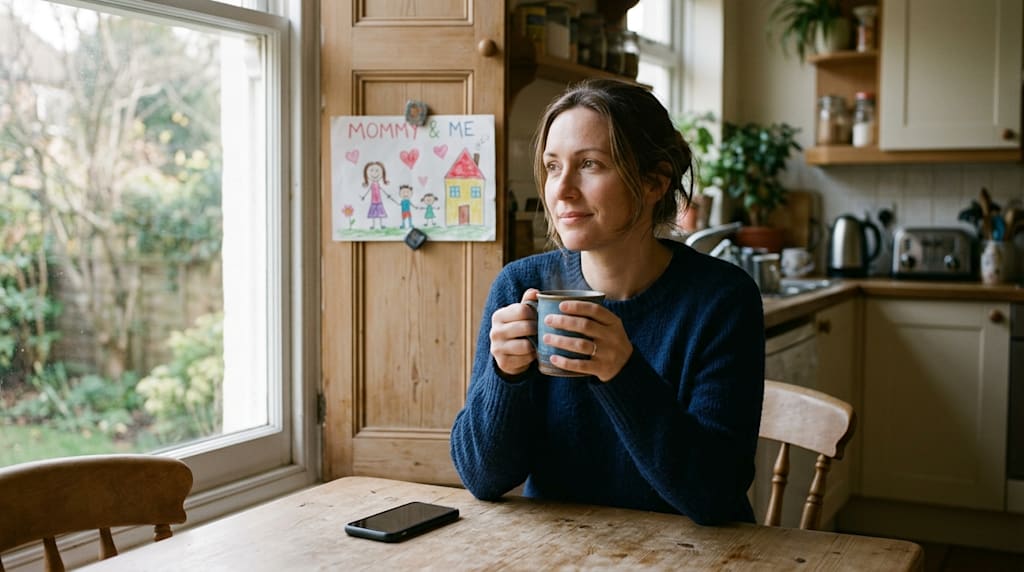
I kept checking my phone even when it wasn't ringing. That particular kind of anxiety, the one that makes you pick up your mobile mid-sentence while someone's talking to you, the one that made me sleep badly for a week, was all because of one scheduled call from a CAFCASS officer.
I didn't really know what CAFCASS was, not properly, until I was in the middle of everything. My sister mentioned it in passing when I told her we were going to court, and I'd spent three evenings reading things online that mostly left me more confused or more frightened than when I'd started. A lot of what I found was written by solicitors explaining the process in quite formal language, or by people on forums who were furious and had every reason to be. Not much of it told me what a CAFCASS meeting actually felt like, or what I was supposed to say.
The context, briefly, is this. My husband and I separated when our daughter Rosie was four. She's six now. We'd been muddling through a loose arrangement for about eighteen months, and it worked until it stopped working. He wanted to change the days she spent with each of us, and I thought his reasons were more about convenience than about her. We couldn't agree. Eventually, a court application was made.
I won't go into the full story of what happened between us. That's not the point of this. The point is the phone call, and what I wish someone had told me before it happened.
The CAFCASS officer rang on a Tuesday afternoon. I'd cleared my diary, made sure Rosie was at school, made myself a cup of tea I didn't drink. I'd written notes. Actual handwritten notes, bullet points about what I wanted to say, specific incidents I thought were important, things I was worried the officer wouldn't ask about but that felt vital.
What I wasn't prepared for was how ordinary it felt.
Her name was Karen, and she spoke to me for about forty-five minutes. She was calm, and she listened carefully, and she didn't seem to be judging me. She asked me to describe a typical week with Rosie. She asked about the handovers, what they looked like in practice. She asked whether Rosie ever said anything to me about her dad, and she asked the same question in reverse, whether Rosie said anything about me when she came back from his house. She asked whether there was anything I was worried about.
I'd expected it to feel like an interview. Like I was being assessed, graded, watched. It didn't quite feel like that, though the truth is I was being assessed, I know that. What caught me off guard was how genuinely interested she seemed in the small, specific things. Not the arguments between me and my ex, not who had done what to whom. Rosie. What Rosie liked, what she found hard, how she talked about her dad, how she was at school.
I cried once, briefly, when I talked about a night Rosie had come home upset and wouldn't tell me why. Karen waited. She didn't rush me or fill the silence. She just said, "Take your time," and she meant it.
Before the call, I'd been given some support through a mediation and family support service. We'd tried mediation earlier in the process, my ex and I, and it hadn't resolved everything, but it had helped me understand something I didn't know before: that the courts, including CAFCASS, are not looking for a winner. They are not interested in who was right about the school pickup argument in March, or who forgot to pass on the letter about the trip to the farm. They are thinking about one thing, and it is the child.
That sounds obvious when I write it down. But when you're in the middle of it, when you feel like you've been wronged and you want someone official to acknowledge that, it's hard to hold onto. The mediator I worked with, a very straightforward woman who said things plainly without making them sting too much, helped me practise telling Rosie's story rather than my own. She said something I've thought about a lot since: "The officer isn't there to hear your case. She's there to hear about your daughter."
What I didn't know at the time was that you can book a fixed-fee CAFCASS Prep Meeting with a family law specialist before the call, to go through exactly what to expect and how to present things clearly. I found out afterwards, from someone in a similar situation. I wish I'd known sooner.
I went into that call thinking I needed to prove something. I came out of it understanding that what I'd actually needed to do was describe my child, honestly, with love and without agenda. Whether I managed that, I genuinely don't know. But I tried.
The week after the call, I rang my mum. She'd been through a custody arrangement herself, years ago, when my youngest brother was small, and she'd always been vague about the details. I asked her what it was like, and she said it was the loneliest thing she'd ever done, that she felt like no one really told her what was happening or why.
I understood that. Even with the support I had, even having talked to a mediator and a solicitor, there were things that blindsided me. The whole process, from filling in the C100 form and preparation for CAFCASS onwards, felt like something you were just expected to understand without anyone sitting down and explaining it properly. No one told me that the CAFCASS officer might call my ex on the same day. I found that out afterwards and it rattled me, not because I had anything to hide, but because the symmetry of it felt strange, like we were both being weighed on the same scales at the same moment without knowing.
No one told me that the call might feel almost gentle. That I might hang up and not know whether it had gone well or badly, and that this uncertainty would be harder in some ways than a difficult conversation would have been.
Rosie came home that afternoon and we did her reading together on the sofa. She chose a book about a small bear who gets lost and finds his way back. She was very interested in whether the bear's mum would be cross with him for getting lost. I told her the mum would just be glad he was home. Rosie thought about this for a moment and said, "Like you are when I come back from Daddy's."
I didn't say anything. I just held her a bit tighter.
The court process took several more months after that. There was a report, then a hearing, then eventually an order that set out the arrangements properly. It wasn't everything I'd hoped for, but it was workable, and, if I'm honest, it was fair. Rosie has a dad who loves her, even if he and I are useless at being in the same room. The order gave her both of us, more clearly than we'd managed to give her ourselves.
I think about the CAFCASS call sometimes, about how much dread I'd stored up for something that was, in the end, an ordinary conversation about a small girl who likes bears and is good at spelling and cries when she's tired. The officer didn't see me as a good or bad mother. She saw Rosie, as best she could through a phone call and a set of forms and whatever my ex said when it was his turn.
I'll never know exactly what went into that report. I'll never know how Karen described me, or what words she used. What I know is that Rosie is fine, and that the arrangement, difficult as it was to reach, has settled into something she can live with. Something we can all live with.
That's probably the best any of us could have hoped for.
This story is based on real family court experiences, with details changed to protect confidentiality.
About the Creator
Family Law Service
Family Law Service is a UK-based online family law support provider helping people across England and Wales with divorce, child and financial matters, offering clear, practical guidance without the high cost of traditional solicitors.
Keep reading
More stories from Family Law Service and writers in Families and other communities.
A Couple Who Wanted Legal Help Without High Solicitor Fees
When Martin and I decided to separate, we made a pact. We weren't going to let this turn into a war. We'd been together for fourteen years, had two kids, a mortgage, and a joint pension we'd barely thought about since we took it out in our thirties. We didn't hate each other. We just couldn't live together anymore, and we both knew it.
By Family Law Service8 days ago in Families
The Science Behind Insomnia: What’s Keeping You Awake?
If you’ve ever stared at the ceiling in the middle of the night, watching the hours tick by while sleep remains elusive, you are not alone. Insomnia is one of the most common sleep disorders worldwide, affecting millions of people across all age groups. But what causes insomnia? Understanding the science behind sleepless nights can help you take the first step toward reclaiming your rest.
By Laura Parton3 days ago in Families
GRANDMA NELSON
Daddy pulled off the interstate, and I saw the all familiar red barn, and I knew we had arrived at Grandma Nelson's farm. I always had mixed feelings about seeing my Grandmother. It seemed she had as many Grandchildren as the old Mother in the shoe nursery rhyme. I saw her as different, but that is not why I hestiated. The truth be known I always got in trouble at her house, and ended up sitting in the car after I had been scolded.
By Susan Payton7 days ago in Fiction


Comments
There are no comments for this story
Be the first to respond and start the conversation.