
How to Audit a Blockchain Strategy Before You Waste Six Figures
A Practical Checklist for Auditing a Blockchain Strategy

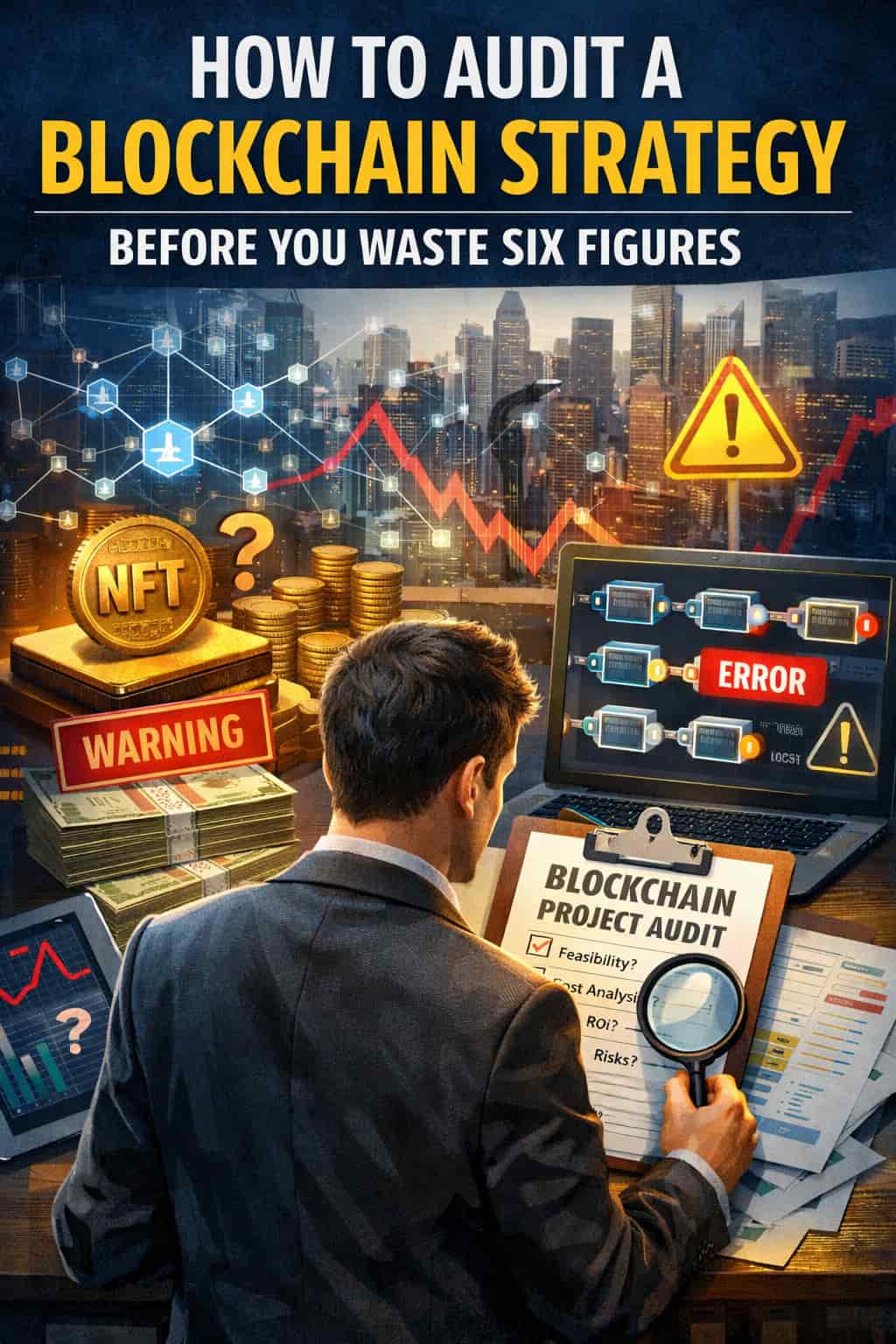
Blockchain has matured from a speculative buzzword into a serious technological option for enterprises. Yet its adoption remains fraught with costly missteps. Organizations frequently commit six-figure budgets to blockchain initiatives that fail to deliver meaningful value, often due to poor planning, weak use-case validation, or misalignment with business goals.
Auditing a blockchain strategy before committing significant resources is not merely prudent—it is essential. This article outlines a structured approach to evaluating whether a blockchain initiative is justified, technically sound, and financially viable.
1. Start With the Problem, Not the Technology
The most common mistake in blockchain adoption is starting with the technology instead of the problem. Blockchain is not a universal solution. It is appropriate only when specific conditions are met:
- Multiple parties need to share and update data
- No single entity is fully trusted
- Data integrity and immutability are critical
- There is a need for transparent, auditable records
If your use case does not satisfy these conditions, a centralized database is likely a better, cheaper, and faster solution.
Audit Question: Are we solving a real business problem, or are we trying to justify blockchain usage?
2. Evaluate Use Case Suitability
Blockchain is a powerful but highly specific tool, and its effectiveness depends entirely on the context in which it is applied. Before committing resources, you must rigorously assess whether your use case genuinely benefits from decentralization, immutability, and distributed trust—or whether a simpler architecture would achieve the same outcome at a fraction of the cost.
Supply Chain Transparency
Blockchain is particularly effective in supply chain environments where multiple stakeholders—manufacturers, logistics providers, distributors, and retailers—need access to a shared, tamper-resistant record of product movement. By recording each step of a product’s lifecycle on-chain, organizations can improve traceability, reduce fraud, and enhance accountability. This is especially valuable in industries where authenticity and provenance are critical, such as pharmaceuticals, luxury goods, and food production.
Financial Transactions
In financial systems, blockchain can streamline processes that traditionally rely on intermediaries. Cross-border payments, clearing and settlement systems, and decentralized financial (DeFi) applications benefit from faster processing times, increased transparency, and reduced counterparty risk. However, these advantages must be weighed against scalability limitations, transaction fees, and regulatory complexity.
Identity Management
Blockchain can enable self-sovereign identity models, where individuals maintain control over their personal data and selectively grant access to third parties. This reduces reliance on centralized identity providers and enhances privacy. However, successful implementation requires careful design to ensure compliance with data protection laws and interoperability with existing systems.
Smart Contracts
Smart contracts automate agreements between parties without the need for intermediaries. Once deployed, these contracts execute predefined conditions automatically, reducing administrative overhead and minimizing disputes. They are commonly used in insurance, real estate, and legal workflows. However, their immutability means that any coding error or oversight can result in permanent consequences, making rigorous testing and auditing essential.
NFTs
NFTs (non-fungible tokens) represent unique digital or real-world assets on a blockchain and can serve a variety of practical purposes beyond digital art and collectibles. In enterprise contexts, NFT development can support digital ownership verification, asset tokenization, and access control systems. For example, NFTs can be used to issue verifiable certificates, manage intellectual property rights, or enable tokenized representations of physical assets such as real estate or equipment.
They are also useful in event management for ticketing systems, where each NFT represents a unique, traceable ticket that cannot be duplicated or counterfeited. However, NFT initiatives often fail when they prioritize speculation over utility. A viable NFT use case must demonstrate clear functional value, integrate seamlessly with existing processes, and provide benefits that cannot be achieved through traditional databases or authentication systems.
Audit Question: Does blockchain introduce capabilities that are truly necessary for this use case, or is it being used as an unnecessary layer of complexity?
3. Analyze Technical Feasibility
Even if a use case is valid, the technical implementation may introduce significant complexity.
Key Areas to Evaluate:
Scalability. Can the blockchain handle your expected transaction volume? Public blockchains often suffer from limited throughput and high latency.
Latency. If your application requires real-time or near-real-time processing, blockchain may introduce unacceptable delays.
Storage Constraints. Storing large datasets directly on-chain is inefficient and expensive. Most architectures rely on off-chain storage with on-chain references.
Interoperability. Will your system need to communicate with other blockchains or legacy systems? If so, how will you manage interoperability?
Security. Smart contracts are immutable once deployed, which means bugs can have irreversible consequences. Has the code been audited by independent experts?
Audit Question: Can this system function reliably under real-world technical constraints?
4. Assess Economic Viability
Blockchain projects often underestimate costs while overestimating returns. A thorough financial analysis is essential.
Cost Components:
- Development and engineering
- Infrastructure (nodes, storage, network fees)
- Security audits and compliance
- Maintenance and upgrades
- Talent acquisition (blockchain developers are expensive and scarce)
Cost-Benefit Analysis:
Compare blockchain implementation against traditional alternatives:
- What is the cost of building a centralized solution?
- What inefficiencies does blockchain eliminate?
- What new revenue streams, if any, does it create?
ROI Considerations:
A blockchain initiative should produce one or more of the following:
- Cost savings through automation
- Revenue generation through new business models
- Risk mitigation (fraud prevention, auditability)
Audit Question: Does the projected ROI justify the total cost of ownership?
5. Evaluate Organizational Readiness
Blockchain adoption requires more than technical capability. Organizational alignment is critical.
Key Factors:
- Stakeholder Alignment. Are all stakeholders—executives, IT, legal, operations—aligned on goals and expectations?
- Internal Expertise. Do you have or can you acquire the necessary blockchain expertise? Without skilled developers and architects, projects often stall or fail.
- Change Management. Blockchain often requires changes in workflows and business processes. Is your organization prepared to adapt?
- Governance Model. How will decisions be made regarding updates, permissions, and dispute resolution?
Audit Question: Is the organization structurally ready to adopt and sustain a blockchain solution?
6. Examine Regulatory and Compliance Risks
Blockchain operates in a complex and evolving regulatory environment.
Key Considerations:
- Data Privacy. Public blockchains are immutable, which can conflict with regulations like GDPR’s “right to be forgotten.”
- Jurisdictional Issues. Blockchain networks are often global, making it difficult to determine which legal jurisdiction applies.
- Financial Compliance. If your use case involves tokens, payments, or financial instruments, regulatory scrutiny increases significantly.
- Smart Contract Liability. Who is responsible if a smart contract fails or causes financial loss?
Audit Question: Have we accounted for all regulatory and legal risks?
7. Assess Tokenomics (If Applicable)
If your strategy involves tokens, careful design is critical. Poor tokenomics can undermine even technically sound projects.
Key Elements:
- Token utility (what does the token do?)
- Supply and distribution
- Incentive mechanisms
- Inflation or deflation models
- Governance rights
Common Pitfalls:
- Tokens without clear utility
- Over-reliance on speculative value
- Poorly aligned incentives among participants
Audit Question: Does the token model create sustainable, long-term value?
8. Validate Security Architecture
Blockchain does not automatically guarantee security. In fact, it introduces new risks.
Areas to Evaluate:
- Smart Contract Vulnerabilities. Bugs in smart contracts can lead to catastrophic losses. Audits and formal verification are critical.
- Key Management. Private keys must be securely managed. Loss or theft of keys can result in irreversible asset loss.
- Network Attacks. Public blockchains are susceptible to 51% attacks, Sybil attacks, and other consensus-related vulnerabilities.
Audit Question: Have we implemented robust, multi-layered security measures?
9. Test with a Minimal Viable Product (MVP)
Before committing large budgets, build a small-scale prototype.
MVP Goals:
- Validate technical feasibility
- Test assumptions about user behavior
- Identify unforeseen challenges
- Gather stakeholder feedback
MVP Best Practices:
- Keep scope minimal
- Focus on core functionality
- Avoid premature optimization
- Use test environments before mainnet deployment
Audit Question: Have we validated the concept with a functional prototype?
10. Benchmark Against Alternatives
Blockchain should never be evaluated in isolation. Always compare it to alternative solutions.
Alternatives to Consider:
- Traditional centralized databases
- Distributed databases without blockchain
- Third-party platforms or SaaS solutions
- Hybrid architectures
Comparative Metrics:
- Cost
- Performance
- Security
- Scalability
- Ease of maintenance
Audit Question: Why is blockchain the best choice compared to simpler alternatives?
11. Analyze Long-Term Sustainability
Many blockchain projects fail because they are not sustainable beyond initial hype.
Consider:
- Ongoing maintenance costs
- Community and ecosystem support
- Upgradability (or lack thereof due to immutability)
- Vendor lock-in risks
- Longevity of the underlying blockchain platform
Audit Question: Will this system remain viable and maintainable in five years?
12. Evaluate User Experience (UX)
Blockchain applications often suffer from poor user experience, which can hinder adoption.
Common UX Issues:
- Complex wallet setups
- Gas fees and transaction delays
- Confusing interfaces
- Lack of user-friendly onboarding
Solutions:
- Abstract blockchain complexity from end users
- Use custodial or hybrid wallet solutions
- Provide clear feedback and error handling
Audit Question: Can non-technical users interact with this system easily?
Final Checklist: The Blockchain Strategy Audit
Before committing six figures, ensure you can confidently answer “yes” to most of the following:
- Does the problem require decentralization?
- Is blockchain the best technical solution?
- Is there a clear and measurable ROI?
- Are we compliant with legal and regulatory requirements?
- Is the organization ready for adoption?
- Have we validated the concept with an MVP?
- Is the system secure and auditable?
- Do we have a sustainable token model (if applicable)?
- Have we considered user experience?
- Have we benchmarked against simpler alternatives?
If multiple answers are uncertain, the safest decision is to pause, refine, or abandon the initiative.
Conclusion
Blockchain can unlock transformative opportunities—but only under the right conditions. The technology is not inherently valuable; its value lies in precise, thoughtful application.
A rigorous audit before investment is not a bureaucratic hurdle—it is a strategic safeguard. It forces clarity, reduces risk, and ensures that blockchain is deployed where it truly matters.
Without this discipline, organizations risk not just wasted capital, but also reputational damage and long-term technical debt. With it, blockchain can move from an expensive experiment to a powerful strategic asset.
About the Creator
Damian Brown
IT consultant with 7+ years’ experience helping organizations optimize technology, implement scalable solutions, and drive digital transformation for measurable business results.
Keep reading
More stories from Damian Brown and writers in Education and other communities.
How to Migrate from Magento Open Source to Adobe Commerce
Migrating from Magento Open Source to Adobe Commerce is not merely a technical upgrade—it is a strategic transformation. While Magento Open Source offers a solid foundation for building online stores, Adobe Commerce introduces advanced capabilities designed for scalability, personalization, and enterprise-grade performance. A successful migration demands careful planning, technical precision, and a clear understanding of both platforms’ architecture. This article provides a structured, comprehensive guide to migrating from Magento Open Source to Adobe Commerce, covering planning, execution, and optimization.
By Damian Brown5 days ago in Education
The Horse and the Mosquito
It was a bright, quiet afternoon in a wide-open green field. A large, powerful horse was grazing peacefully, moving slowly from one patch of sweet grass to the next. He was a magnificent animalh is coat was shiny, his muscles were thick, and his tail flicked lazily to keep the heat away. He was so focused on his meal that he didn’t even notice when a tiny, buzzing mosquito flew down from the nearby woods and landed right in the middle of his broad back.
By Amir Husen7 days ago in Education
Elderly Woman Behind the Table in a Large Town
The glass of Absinthe sat before me. It’s quite amazing how despite such terror rendered upon their stones in the preceding decades, these streets still held the beauty I first read about as a girl. I never dreamed I’d set foot on these cobbles, at least not safely.
By Matthew J. Fromm5 days ago in Art




Comments
There are no comments for this story
Be the first to respond and start the conversation.