
How Nearby Stars Influence Earth: Hidden Cosmic Forces Affecting Our Planet
Discover how nearby stars influence Earth through gravity, radiation, supernovae, and cosmic rays. Learn how our stellar neighbors affect the solar system and Earth.

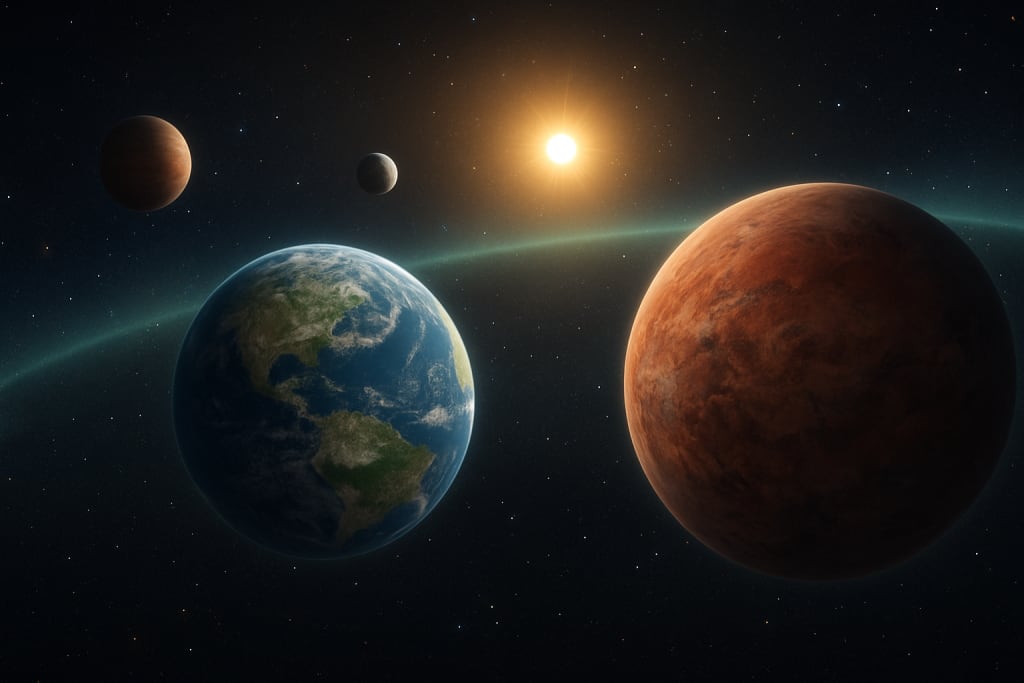
How Nearby Stars Influence Earth
The Night Sky Feels Quiet — But It Isn’t
On a calm, clear night, the stars look peaceful and distant. They shine quietly above Earth, appearing so far away that it seems impossible for them to affect our planet in any meaningful way.
For most of human history, people believed stars were fixed lights on a distant sphere, completely separate from Earth and the solar system. But modern astronomy has revealed something very different.
We do not live in isolation. The Sun and Earth are part of a cosmic neighborhood filled with nearby stars moving through space. Over millions of years, these stars can influence our solar system in subtle—and sometimes dramatic—ways.
Nearby stars can affect Earth through gravity, radiation, stellar winds, supernova explosions, and cosmic rays. While these effects are usually small, over long periods of time they can shape the environment of our solar system and even influence life on Earth.
Understanding how nearby stars influence Earth helps scientists understand the history of our planet and the future of our solar system.
________________________________________
Our Solar Neighborhood
The Sun is not alone in space. It is surrounded by many nearby stars in a region called the solar neighborhood, located within the Milky Way Galaxy.
Some of the closest stars to Earth include:
• Proxima Centauri
• Alpha Centauri
• Barnard's Star
• Sirius
• Epsilon Eridani
These stars are incredibly far away by human standards, but in astronomical terms they are relatively close neighbors.
Because stars move through the galaxy, our neighboring stars change over millions of years. Some stars pass closer to the solar system, while others move farther away.
________________________________________
Gravitational Influence on the Solar System
The most important way nearby stars influence Earth is through gravity.
Even distant stars exert gravitational forces. While these forces are very weak compared to the Sun’s gravity, they can still affect objects in the outer solar system.
One region that is particularly sensitive to gravitational disturbances is the Oort Cloud.
The Oort Cloud is a vast cloud of icy objects far beyond the orbit of Neptune. It is believed to be the source of many long-period comets.
When a nearby star passes relatively close to the solar system, its gravity can disturb objects in the Oort Cloud. This disturbance can send comets toward the inner solar system.
Some of these comets may eventually pass near Earth, and in rare cases, they may even collide with planets.
This means nearby stars may indirectly influence impact events on Earth over millions of years.
________________________________________
Passing Stars and Future Close Encounters
Stars move constantly through the galaxy, and sometimes they pass relatively close to our solar system.
One famous example is Gliese 710, a star predicted to pass very close to the solar system in about 1.3 million years.
Astronomers believe Gliese 710 may pass through or near the Oort Cloud, potentially sending many comets into the inner solar system.
This does not mean Earth will definitely be hit by a comet, but the probability of comet activity could increase during such an event.
These close stellar encounters are rare, but they are part of the long-term evolution of our solar system.
________________________________________
Cosmic Radiation from Nearby Stars
Stars produce more than just light. They also emit:
• Ultraviolet radiation
• X-rays
• Charged particles
• Cosmic rays
• Stellar winds
Most of the radiation affecting Earth comes from the Sun, but nearby stars contribute to the overall cosmic radiation environment in our region of space.
Fortunately, Earth is protected by two major shields:
1. Earth’s magnetic field
2. Earth’s atmosphere
These shields block most harmful radiation from reaching the surface.
Without them, life on Earth would be exposed to dangerous levels of cosmic radiation.
________________________________________
Supernova Explosions and Earth
One of the most dramatic ways nearby stars could influence Earth is through a supernova explosion.
A supernova occurs when a massive star reaches the end of its life and explodes, releasing enormous amounts of energy and radiation.
If a supernova occurred close enough to Earth, it could potentially affect the planet.
Possible effects of a nearby supernova include:
• Increased cosmic radiation
• Damage to the ozone layer
• Climate changes
• Increased mutation rates in organisms
Scientists estimate that a supernova would need to occur within about 30–50 light-years to significantly affect Earth.
Fortunately, astronomers do not currently know of any nearby stars likely to explode that close to Earth in the near future.
________________________________________
Cosmic Rays and Earth’s Atmosphere
Nearby stars also contribute to cosmic rays, which are high-energy particles traveling through space at nearly the speed of light.
When cosmic rays strike Earth’s atmosphere, they create particle showers and ionize atmospheric molecules.
Some scientists believe cosmic rays may influence:
• Cloud formation
• Atmospheric chemistry
• Lightning formation
• Climate patterns (slightly)
While the Sun is the main source of solar particles affecting Earth, nearby stars and supernova remnants contribute to the cosmic ray background in our region of the galaxy.
________________________________________
The Early Solar System and Nearby Stars
Nearby stars may have played a role in the formation of the solar system billions of years ago.
The Sun likely formed in a cluster of stars rather than alone. In these clusters, nearby stars can influence each other through gravity and radiation.
These early stellar neighbors may have helped shape:
• The outer solar system
• The Kuiper Belt
• The Oort Cloud
• Planet formation processes
Radiation from nearby massive stars may even have influenced the distribution of gas and dust during the formation of the planets.
So nearby stars may have helped shape the solar system long before Earth even existed.
________________________________________
The Heliosphere and Interstellar Environment
The Sun produces a bubble around the solar system called the heliosphere. This bubble protects the solar system from interstellar radiation and cosmic rays.
However, the solar system moves through the galaxy and passes through different regions of interstellar space influenced by nearby stars.
These regions contain:
• Gas
• Dust
• Magnetic fields
• Stellar wind particles
Changes in the interstellar environment can slightly compress or expand the heliosphere, which may change the amount of cosmic radiation entering the solar system.
This is another indirect way nearby stars can influence Earth over very long timescales.
________________________________________
Nearby Stars and the Search for Life
Studying nearby stars is also important for another reason: the search for exoplanets and life.
Many nearby stars have planetary systems. Some of these planets orbit in habitable zones where liquid water could exist.
Understanding nearby stars helps scientists determine:
• Which stars may host habitable planets
• How stellar radiation affects planetary atmospheres
• Whether nearby planetary systems could support life
Nearby stars are the most likely places where humans might one day explore or send probes.
________________________________________
Earth Is Part of a Moving Galaxy
One important fact many people don’t realize is that the Sun and Earth are moving through the Milky Way Galaxy.
The Sun orbits the center of the galaxy at about 828,000 km/h, and it takes about 225 million years to complete one orbit.
As we travel through the galaxy, our neighboring stars change over time. Some stars become closer, and others move farther away.
This means Earth’s cosmic environment slowly changes over millions of years due to nearby stars and interstellar conditions.
________________________________________
Final Thoughts
Nearby stars do influence Earth, but usually in indirect ways and over very long periods of time.
Their gravitational forces can disturb distant comet clouds, potentially sending comets into the inner solar system. Their radiation and stellar winds contribute to the cosmic environment around the solar system. Rare events like nearby supernova explosions could affect Earth’s atmosphere and climate.
Perhaps most importantly, nearby stars played a role in the early formation of the solar system and continue to shape the interstellar environment through which our solar system travels.
Even though the stars look quiet and distant in the night sky, they are part of a dynamic and ever-changing cosmic neighborhood. Earth is not isolated—we are traveling through the galaxy surrounded by moving stars, interstellar clouds, and cosmic radiation.
The next time you look at the night sky, remember that those distant stars are not just beautiful lights. They are our cosmic neighbors, and over millions of years, they help shape the environment of our solar system and the history of our planet.
About the Creator
Keep reading
More stories from shahkar jalal and writers in Education and other communities.
Why Star Color Indicates Temperature: The Science Behind Blue, White, Yellow, and Red Stars
Why Star Color Indicates Temperature The Night I Noticed a Red Star One night, far from city lights, I looked up at the sky expecting to see the usual white stars scattered across the darkness. But something unusual caught my eye. One star looked slightly red, while another nearby star looked bluish-white. At first, it seemed like a trick of the eyes or maybe atmospheric distortion.
By shahkar jalal11 days ago in Education
Why Children Need Quiet as Much as Play
Children are often described through motion. Adults picture running feet, loud laughter, blanket forts, toy cars under the couch, and the kind of energy that can turn an ordinary room into a full afternoon story. Play deserves that attention. It helps children test ideas, build social skills, use language in flexible ways, and work through feelings they cannot always name yet.
By Kelsey Thorn7 days ago in Education
Planting Progress: How Agriculture Creates a Sustainable Future Without Hunger
Hunger continues to affect millions worldwide, yet agriculture offers a powerful and lasting solution when properly developed. By focusing on long-term food security, communities can build systems that consistently provide access to nutritious food. Agriculture does more than feed people because it strengthens economies, creates jobs, and promotes self-reliance. When farming systems are supported and modernized, they become reliable sources of both income and nourishment. Ultimately, agriculture lays the foundation for a future where hunger is reduced through sustainable growth.
By Convoy of Hope7 days ago in Education
Watching The End Of The World From The Diner
Introduction I am not sure how to approach this. Guy Peellaert was an amazing artist who created iconic fantasy images of famous people, usually musicians or politicians, as well as creating commissioned album covers such as "It's Only Rock'n'Roll" by The Rolling Stones and David Bowie's "Diamond Dogs" which you can read more about below.
By Mike Singleton 💜 Mikeydred 5 days ago in Art


Comments
There are no comments for this story
Be the first to respond and start the conversation.