
Mapping vs Listing
Why Relational Thinkers Sound Like They’re Rambling When They’re Not

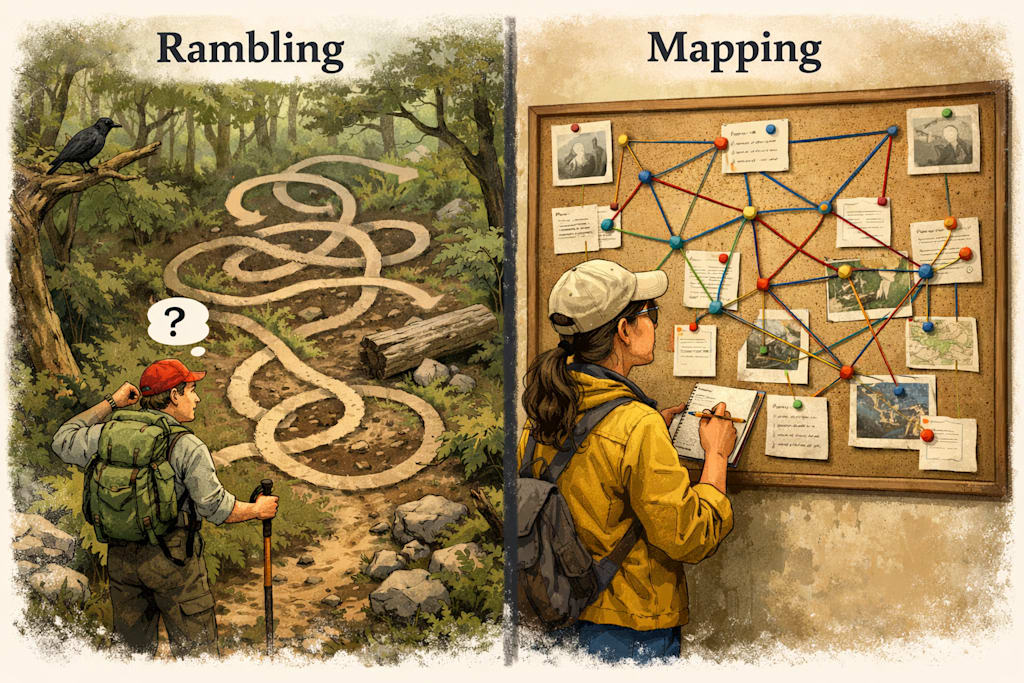
Much of what gets labeled as rambling is actually a mismatch between how ideas are structured internally and how they are expected to be presented externally. Many environments reward listing, where ideas are arranged in clean sequences, bullet points, or linear arguments that move from premise to conclusion in a predictable order. This structure works well for certain kinds of reasoning, particularly when problems are discrete and conclusions are already known. It does not work as well for reasoning that depends on relationships, causality, or pattern recognition across multiple domains. When relational thinkers speak, they are often navigating a different internal structure altogether, and that difference is frequently misunderstood.
Listing assumes that ideas exist as independent units that can be organized without altering their meaning. Mapping assumes that ideas derive meaning from their connections to one another. A map is not read in a single direction. It is explored. The significance of any one point depends on how it relates to others. When a relational thinker explains something, they are often tracing those relationships in real time, showing how one concept leads to another, how causes cascade, and how patterns repeat at different scales. To someone expecting a list, this movement can sound unfocused. In reality, it is highly structured, just not sequential.
This difference explains why relational thinkers often circle back to earlier points. They are not repeating themselves because they forgot where they started or because they lack discipline. They are revisiting nodes in the map with new information, adjusting the structure as additional connections become visible. Each return modifies the overall picture. What sounds redundant to a listener expecting linear progress is often additive from the perspective of the thinker, deepening understanding rather than stalling it.
Mapping also explains why relational thinking frequently relies on analogy and metaphor. Analogies allow complex relationships to be compressed into familiar forms, making it possible to hold multiple variables in mind at once. A single metaphor can carry causality, scale, and implication in a way that a list of propositions cannot. When a relational thinker uses multiple analogies, they are not avoiding precision. They are testing whether the same structural relationship holds across different contexts. If it does, understanding strengthens. If it does not, the map requires revision.
The expectation that serious thought must present itself as a clean list creates unnecessary friction for relational thinkers. They are often pressured to simplify prematurely, flattening relationships before they are fully understood. This can produce conclusions that are tidy but incomplete, technically coherent but conceptually shallow. In some cases, the pressure to list interrupts the very process that would have produced clarity if given more time and space.
This mismatch also affects how credibility is assigned. People who list well are often assumed to think well, even when their lists contain little insight. People who map publicly are often assumed to be confused, even when their understanding is deep. Over time, this bias trains relational thinkers to either over-edit their expression to fit expectations or withdraw from articulation altogether. Both responses reduce the diversity of thought that enters conversation and limit the kinds of insight that are shared.
Mapping is not an excuse for incoherence. A map can be well-formed or poorly formed, just as a list can be rigorous or sloppy. The difference lies in evaluation criteria. A list is judged by order and completeness. A map is judged by coherence and explanatory power. When relational thinkers are evaluated using the wrong criteria, their work is misread. What should be assessed is whether the connections hold, whether the causal chains make sense, and whether the overall structure reveals something true about the subject being explored.
Understanding the difference between mapping and listing expands what counts as clarity. Clarity does not always mean linearity. Sometimes it means that a complex system has been rendered intelligible without being reduced to something false. A map can be clear even if it cannot be reduced to a single path. Recognizing this allows different cognitive styles to be taken seriously on their own terms.
Relational thinkers are not avoiding structure. They are working with a different kind of structure, one that prioritizes relationships over sequences. When that structure is acknowledged, what once sounded like rambling reveals itself as navigation. Meaning emerges not from marching through points, but from seeing how the terrain actually fits together.
About the Creator
Peter Thwing - Host of the FST Podcast
Peter unites intellect, wisdom, curiosity, and empathy —
Writing at the crossroads of faith, philosophy, and freedom —
Confronting confusion with clarity —
Guiding readers toward courage, conviction, and renewal —
With love, grace, and truth.
Keep reading
More stories from Peter Thwing - Host of the FST Podcast and writers in Critique and other communities.
Falling Between Every System
Modern social systems are often described as safety nets. Employment law protects workers. Healthcare programs provide treatment. Disability benefits replace lost income. Unemployment insurance bridges job loss. Each system is presented as a safeguard designed to catch people when life disrupts their ability to function normally. Yet for many people living with disability, chronic illness, or injury, the lived experience is the opposite. Rather than forming a net, these systems stack vertically, each with its own eligibility rules, thresholds, and assumptions. Instead of catching the fall, they create gaps. People do not slip through because they failed to try. They fall because the systems were never designed to align.
By Peter Thwing - Host of the FST Podcast5 days ago in Critique
The Road by Cormac McCarthy:
"If he is not the word of God, God never spoke." It's a line spoken by The Man, unnamed, early on in the 2007 Pulitzer Prize winning novel, "The Road" by Cormac McCarthy. It's this line, elegiac and moving, infused with despair and hope, that informs you, you're not reading something you'll easily forget.
By Adam Diehl7 days ago in Critique
Forbidden Fruits Review: A Hilarious Toxic Cult of Feminist Witches
Forbidden Fruits, directed by Meredith Alloway, is a vibrant and audacious debut that blends horror and comedy within the context of a modern-day mall culture. The film, which draws inspiration from Lily Houghton’s play Of the woman came the beginning of sin, and through her we all die, introduces audiences to a coven of young women who navigate the complexities of friendship and rivalry while engaging in witchcraft rituals.
By Ninfa Galeano5 days ago in Critique
Swan
“During the Metal Age, humans took photographs of everything beautiful, which was everything, yet machines did not even wear shoes. The Fauxna thought of a better way. They colored all of the light rose, for a corrupted source cannot be verified.” - Origin Parable, 011
By Nicky Frankly2 days ago in Fiction




Comments
There are no comments for this story
Be the first to respond and start the conversation.