
Wheat and weeds
Still between us, some people, trying to destroy the Faith of 6000 years!/ Demo without bias about the video-post ‘’Oldest CHRISTIAN Scriptures: God is Really SATAN | Gnostic Informant’’.

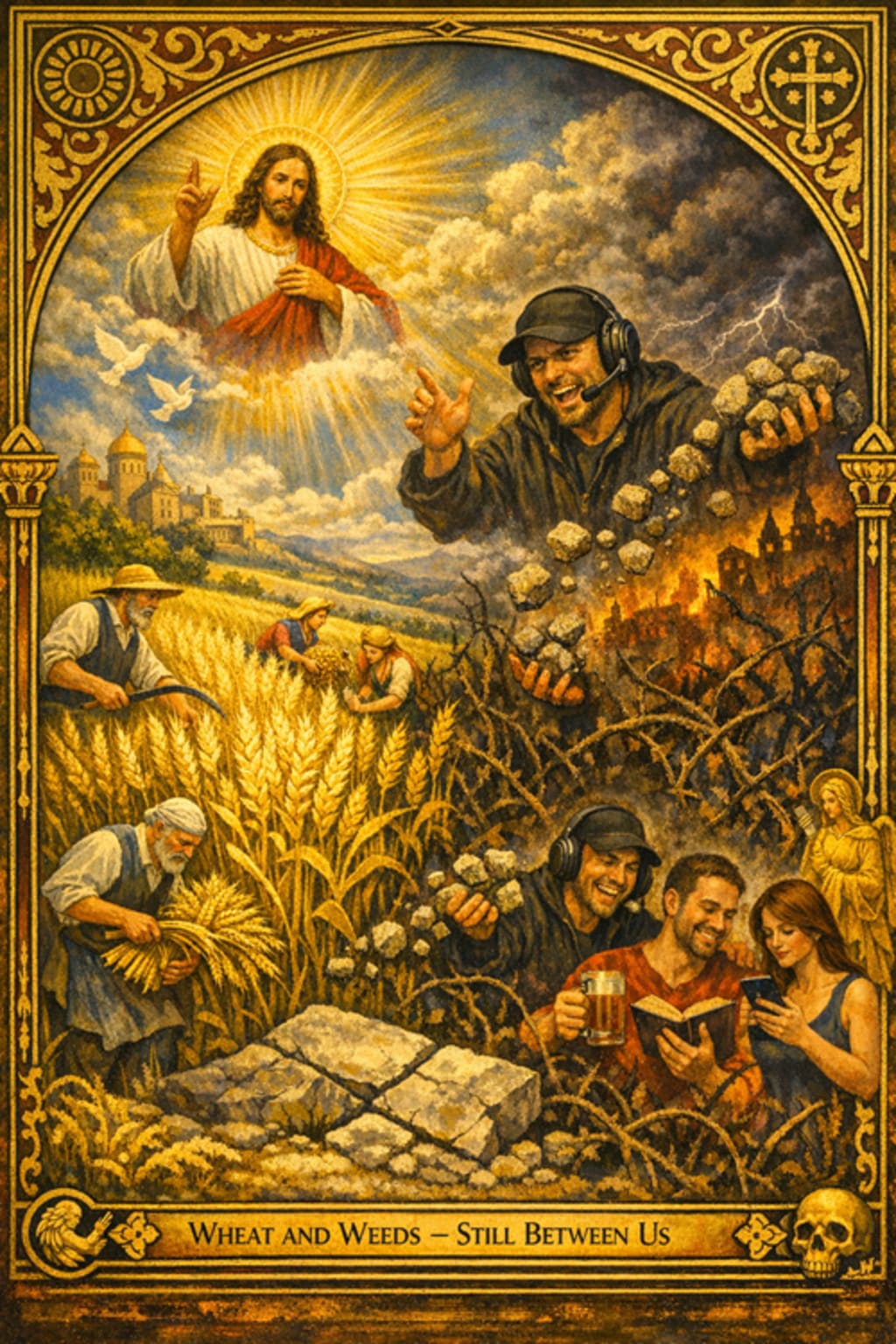
The conversation from a podcast, i saw last week, explores how some of the earliest Christian writings and alternative traditions paint a very different picture of God and Jesus than what later mainstream Christianity adopted. The host and guest discuss how certain ancient groups, especially Gnostic thinkers, believed the creator figure in the Old Testament was not the ultimate divine source but a flawed or even harmful being. In their view, Jesus appears not as the obedient son of this creator but as a messenger from a higher, hidden reality who comes to free humanity from ignorance.
They also pretend to examine how early manuscripts, mythological parallels, and symbolic interpretations suggest that Christianity developed within a much more diverse and contested spiritual landscape than people often assume. Ideas such as Jesus representing inner enlightenment, or the serpent symbolizing wisdom rather than evil, show how radically different early interpretations could be. The video ultimately highlights how the earliest layers of Christian thought were far less uniform, and far more philosophically adventurous, than the later orthodox tradition.
So now I’m going to address, point by point, step by step, every thought expressed in this video; which expects from all of us, readers and viewers, to consider that garbage a piece of real journalism![?] As much is possible within my limits as a simple Bible scholar, i will try my best.
……………………………………………………………………………………………
One thing he does, the video author, is to exaggerate the idea that “the oldest Christian scriptures say God was Satan.” That’s not coming from Mark, or Paul, or any early Christian text. It comes from certain Gnostic writings from the second century — groups who believed the creator of the material world was a lower, flawed being. They weren’t mainstream Christians, and they weren’t the authors of the canonical gospels. They were fringe philosophical sects with a very different worldview.
So yes, Mark ends abruptly. Yes, the longer ending is later. But no, this doesn’t mean early Christians thought God was Satan, or that the resurrection was invented later, or that the gospels were rewritten to win debates. It just means ancient texts were copied, edited, expanded, and shaped by communities — the same way all ancient literature was.
In the introduction of the podcast. Nothing theological has been said yet — it’s mostly the host introducing the guest, and the guest explaining how he got into reading ancient religious texts while in prison. This part doesn’t contain any claims about the Bible, Gnosticism, or the idea that “God is Satan.” It’s just background about the speaker’s life.
What is important, though, is the tone. The guest is not an academic scholar. He says it himself. He didn’t study ancient languages formally, he didn’t go through the academic route, and he discovered these ideas through personal reading while in -prison-. That doesn’t automatically make him wrong, but it does mean he’s approaching these topics from a very personal, interpretive angle, not from the standards of historical or textual scholarship. Still, his intensions, are, ‘to iluminate us all’!
This matters because later in the video he makes very strong claims — like “the oldest Christian scriptures say God was Satan.” Those claims come from a very specific marginal tradition (radical Gnostic sects from the 2nd century), not from the actual earliest Christian writings. But we’ll get to that when you paste the next sections.
Further, the video is a mixture of some genuine historical material, misunderstood scholarship, and imaginative leaps that aren’t supported by evidence. Some of the things mentioned are absolutely real: Gnostic sects existed in the second to fourth centuries, and writers like Epiphanius really did describe them. The Elephantine papyri are real documents from a Jewish community in Egypt, and the earliest manuscripts of the Gospel of Mark really do end abruptly at 16:8. These are established facts.
The problem is that the speaker takes these real pieces and stretches them far beyond what they actually mean. For example, the Elephantine papyri are mostly legal and administrative documents — marriage contracts, tax records, letters about temple repairs. They are not religious texts, so the fact that they don’t mention Moses or Abraham tells us nothing about whether those figures were known. It would be like finding a box of old receipts from your local town hall and concluding that no one in the town had ever heard of George Washington. The silence is meaningless.
The claim that “no one mentions Moses before 300 BCE” is simply false. Moses is referenced throughout books like Deuteronomy, Joshua, Judges, Kings, and the Prophets, all of which predate 300 BCE. The Samaritans had their own version of the Torah by the fifth century BCE. Even the Elephantine community itself refers to Passover, which only makes sense if the Exodus story already existed. So the idea that Moses was invented in the Hellenistic period doesn’t hold up.
The video also tries to argue that Yahweh and Dionysus are the same deity. This is not supported by any serious scholarship. There is no linguistic connection between the names, no archaeological evidence linking the two, and no historical tradition that equates them. Plutarch once speculated about similarities in ritual style, but ancient writers often made loose comparisons between gods of different cultures. It doesn’t mean they thought they were literally the same being.
But let’s start, step by step!
**********************************************************************
What it is described here, is real in one sense and a lot misleading in another. Yes, the earliest manuscripts of Mark end at 16:8. That’s true. The women flee the tomb in fear, and there’s no appearance of the risen Jesus. That’s not a conspiracy; it’s just how the earliest copies look. The longer ending — the one with Jesus appearing to Mary Magdalene, the disciples, the Great Commission — is a later addition. Scholars across the board agree on that. It’s not controversial.
Where the video becomes misleading is in the interpretation of that fact. He’s trying to make it sound like Christians added the ending because critics like ‘Celsus “beat them up” in debates. That’s a dramatic story, but it’s not supported by evidence. The longer ending appears in manuscripts long before the time he claims, and it wasn’t added as a reaction to pagan criticism. It was added because early Christians were uncomfortable with the abrupt ending. They wanted the story to feel complete. That’s a human instinct, not a cover‑up.
The video is emotionally heavy and intellectually aggressive — it’s clearly meant to shake confidence in Christianity by stitching together Gnosticism, mystery cults, psychedelics, early art, and late hostile sources like Epiphanius, then presenting the result as if it were “the truth behind Jesus.” To see what’s really going on, we have to separate three things: what is historically real, what is possible but speculative, and what is simply being pushed far beyond the evidence.
Let’s start with Epiphanius. Epiphanius, who is quoted heavily in the video, he is absolutely a real figure: a fourth‑century bishop of Salamis in Cyprus, a Church Father, and the author of the Panarion, a huge anti‑heresy work cataloguing around eighty “heresies.” He is recognized as a saint in both the Catholic and Orthodox traditions. None of that is in doubt. The Panarion is also real, and modern critical editions and translations exist. Scholars use it because it preserves information about groups we would otherwise know almost nothing about.
When someone looks up Epiphanius online, especially on Wikipedia, will get a very clean, church‑approved, saintly biography. It can makes him sound like a calm, reliable historian and a respected Church Father. And that part is true — he was a bishop, he was influential, and he is considered a saint in both the Catholic and Orthodox traditions.
The key thing most of viewers of that video are missing: Epiphanius was not a neutral historian. He was a polemicist. His job — and the purpose of his book Panarion — was to attack, refute, and discredit groups he considered heretical. Wikipedia doesn’t hide this, but it also doesn’t emphasize the implications. He is a heresiologist. Modern scholarship on heresiology and on the Panarion in particular is very clear about this: his work is rich in information, but it is shaped by polemical intent, rhetorical exaggeration, and a desire to portray “heretics” as morally and spiritually corrupt.
©Ca De Luce> MINDFUL MIND Medium Blog 2025. Unauthorized use of text or media is not allowed. All images and photo are fulfilling the copyrights regulations. Much obliged to you all!
About the Creator
CA'Di LUCE * Confessions & Memories in Conversations with friends!/ It’s not a revolution—it’s a quiet evolution.
I speak of spirit, soul, and flame,
Of humanity’s quest, our endless aim.
*Please, support this author, effortless for you:
https://buymeacoffee.com/ca_de_luce_blog/
https://ko-fi.com/cadeluce/
.
Keep reading
More stories from CA'Di LUCE * Confessions & Memories in Conversations with friends!/ It’s not a revolution—it’s a quiet evolution. and writers in Confessions and other communities.
This Is What I Do When People Throw Rocks At Me
Rocks have been thrown at me for a greater part of my life. Some have been small and missed hitting me. When people don't get a reaction from me, they throw bigger rocks with a better aim. Many have been hurled at me with precision over the years. For a long time, I thought my only options were to dodge them or be crushed by them.
By Margaret Minnicks24 days ago in Confessions
I Used to Believe Pain Made Me Strong—Until I Learned the Truth
I need to admit something that took me years to understand. For a long time, I believed that my pain was special. Not just real—but meaningful in a way that made me different, maybe even stronger than others. I told myself that everything I had been through was shaping me into someone extraordinary.
By khan5 days ago in Confessions


Comments
There are no comments for this story
Be the first to respond and start the conversation.