
THE ENTROPY OF COMMUNICATION, THE MISCOMMUNICATION TRILOGY, “The Entropy of Communication, Vol. II”, part 3
Book Review

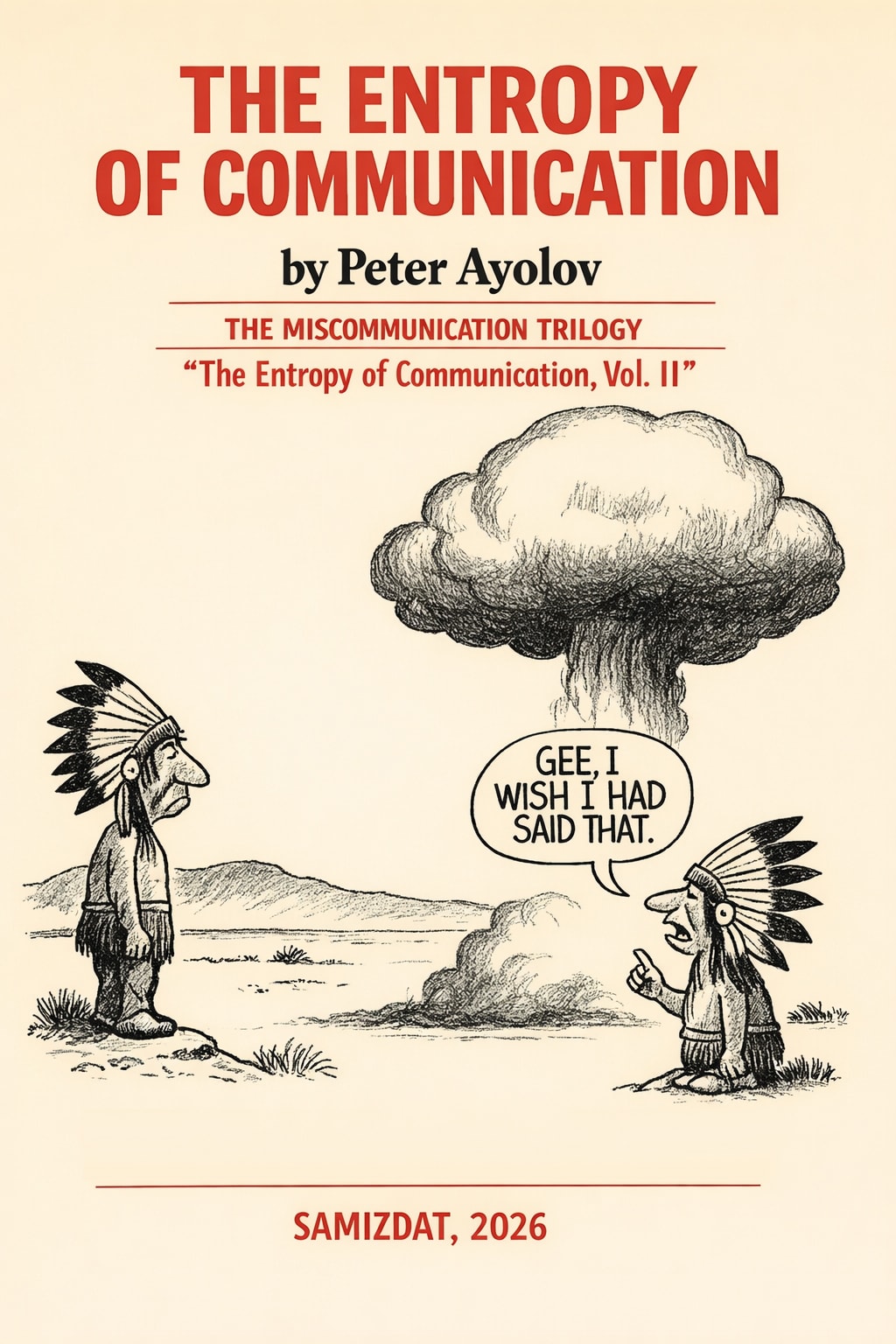
Review-The Entropy of Communication
Civilisation Against Language: A Review of The Entropy of Communication
Modern civilisation prides itself on an unprecedented abundance of communication. Messages travel across continents in seconds, political speeches are instantly translated into global narratives, and statistical graphs promise to transform complex realities into clear visual truths. Yet this immense expansion of communicative capacity has not produced a parallel increase in understanding. Instead, a paradox has emerged: the more language circulates, the more uncertain meaning becomes. The Entropy of Communication confronts this paradox directly and develops a sweeping diagnosis of the crisis of language in contemporary public life.
The book begins from a deceptively simple observation. Communication systems have multiplied dramatically in the digital age, yet shared meaning appears increasingly fragile. Political slogans, media narratives, social media debates and statistical claims circulate continuously, but their interpretive stability quickly dissolves. Words appear everywhere, but their authority steadily declines. This phenomenon is conceptualised through the idea of communicative entropy: a process in which linguistic order gradually disperses as messages multiply faster than the interpretive frameworks that once sustained them.
Rather than approaching this issue purely through linguistic theory, the book constructs an ambitious interdisciplinary framework. Cognitive science, political philosophy, sociology of propaganda, statistics, psychology and media theory are brought together to analyse the transformation of language under conditions of informational excess. The result is not a narrow academic study but a broad intellectual investigation into how modern societies construct reality through communication.
The opening chapters introduce one of the book’s most compelling insights: political struggle increasingly unfolds inside the architecture of the human brain. Drawing heavily on the work of cognitive linguist George Lakoff, the argument challenges the Enlightenment assumption that political reasoning operates primarily through conscious rational calculation. Instead, contemporary neuroscience reveals that most cognitive processes occur beneath the level of conscious awareness. Emotional evaluation, metaphorical frameworks and unconscious associations shape interpretation long before deliberate reasoning begins.
This insight transforms the understanding of political communication. If human reasoning is fundamentally embodied and emotionally structured, then political persuasion cannot rely solely on facts and logical arguments. Words activate cognitive frames that organise perception itself. When a particular metaphor or narrative becomes dominant within public discourse, it gradually reshapes the neural pathways through which citizens interpret social reality. Political conflict therefore becomes a contest over interpretive frameworks rather than simply a disagreement about policies.
The book explores this idea through the concept of the “neural theatre of words.” Language does not merely transmit information; it activates networks of memory, emotion and conceptual association within the brain. Each phrase triggers a cluster of meanings embedded in previous experience. Repetition strengthens these neural patterns until they become habitual ways of understanding the world. Public discourse thus functions as a form of cognitive infrastructure. Those who control linguistic framing influence how reality itself appears to citizens.
This cognitive dimension of politics leads naturally into a broader analysis of ideology. Drawing on Jacques Rancière’s critique of Althusserian theory, the book argues that ideology cannot be understood simply as false belief. Instead it represents a system through which knowledge itself is organised and distributed. Institutions such as universities, research centres and media organisations produce forms of discourse that appear neutral while simultaneously stabilising existing structures of authority.
What emerges from this analysis is a subtle but powerful observation: the language of knowledge often disguises the language of power. Academic terminology, technical vocabulary and institutional rhetoric can function as ideological apparatuses that naturalise social hierarchies. When discourse presents itself as objective explanation, it may simultaneously reinforce the structures that benefit from that explanation. The critique of ideology therefore becomes inseparable from the critique of intellectual authority.
From this point the book expands its focus toward the mechanisms through which modern societies manage public opinion. Alex Carey’s historical analysis of corporate propaganda provides the foundation for a fascinating exploration of how persuasion became institutionalised in democratic systems. As mass suffrage expanded during the twentieth century, economic elites recognised that political power increasingly depended on shaping public perception. Advertising, public relations and educational campaigns gradually transformed communication into a permanent instrument of influence.
This transformation produced a peculiar political environment. Democracy formally expanded, yet the attitudes of citizens were increasingly shaped by organised persuasion. Communication systems became strategic arenas in which narratives about freedom, prosperity and social order were carefully constructed. The result was not the disappearance of democracy but its transformation into a communicative ecosystem where opinion itself became an object of management.
One of the book’s most insightful sections examines the rhetorical authority of statistics. Drawing on Darrel Huff’s classic study How to Lie with Statistics, the author demonstrates how numerical language often acquires persuasive power precisely because it appears objective. Graphs, averages and percentages seem to speak with mathematical certainty, yet their interpretation depends on choices about sampling, measurement and presentation.
Statistics therefore function as a specialised dialect of persuasion. A graph can amplify a trend by altering its scale; an average can conceal dramatic inequalities within a distribution; a percentage can exaggerate significance by obscuring the size of the underlying sample. In such cases numerical precision becomes a rhetorical performance rather than a guarantee of truth. The public encounters figures that appear exact while the assumptions that produced them remain invisible.
This analysis leads to a broader philosophical insight about quantitative reasoning. Numbers do not speak for themselves. They acquire meaning through interpretive frameworks that determine what counts as relevant data and how those data are presented. Statistical literacy therefore becomes a form of intellectual resistance. Citizens who understand the interpretive character of numerical language are better equipped to question the authority of figures that appear beyond dispute.
Perhaps the most psychologically striking section of the book examines the emotional circuitry of political belief. Drawing on research by Drew Westen, the argument demonstrates that political reasoning rarely resembles the rational deliberation imagined by classical democratic theory. When individuals encounter information that threatens their political identity, the brain often activates emotional defence mechanisms that reinterpret or dismiss the evidence.
Brain imaging studies reveal that partisan reasoning engages neural regions associated with emotional regulation rather than analytical evaluation. Once a comforting explanation is found, reward circuits activate, producing a sensation of satisfaction similar to the relief experienced when a physical tension is resolved. In this sense political belief can function like a self-reinforcing emotional system. Reason becomes a tool for protecting identity rather than discovering truth.
The implications of this insight are profound. If political cognition is deeply intertwined with emotion and identity, then the expectation that citizens will evaluate policy arguments purely through rational calculation becomes unrealistic. Political narratives succeed not because they present superior evidence but because they resonate with the moral frameworks and emotional commitments that structure human thought.
Taken together, these analyses form the foundation for the book’s central theoretical concept: the planned obsolescence of language. Borrowing an idea from industrial economics, the author argues that modern communication systems produce linguistic forms designed to lose their persuasive force quickly. Political slogans, media narratives and statistical claims circulate so rapidly that their meanings deteriorate through repetition and strategic manipulation.
As older expressions lose credibility, new phrases replace them. Communication becomes a cycle of linguistic consumption in which words function like disposable commodities. The interpretive frameworks that once stabilised public discourse struggle to keep pace with the speed of narrative production. Meaning fragments into competing versions of reality that coexist without resolving into shared understanding.
This process resembles the physical phenomenon of entropy. In thermodynamics entropy describes the gradual dispersal of order into disorder within a closed system. Applied to communication, the concept captures the tendency of meaning to dissipate as messages proliferate. The more intensely language circulates through media networks, political campaigns and digital platforms, the more difficult it becomes to maintain stable interpretive frameworks.
The book does not treat this condition merely as a cultural curiosity. Instead it presents communicative entropy as a structural transformation of modern political life. Democratic institutions historically relied on relatively stable arenas of public discourse—newspapers, assemblies, universities and civic organisations—where arguments could be presented and evaluated. Digital communication has fragmented these spaces into dispersed networks where competing narratives circulate simultaneously.
Within this environment the authority of shared truth becomes increasingly difficult to sustain. Public debate no longer unfolds within a single interpretive framework but within multiple parallel narratives that rarely intersect. Citizens encounter political reality through personalised streams of information shaped by algorithms, ideological communities and emotional affiliations.
The final sections of the book explore the consequences of this transformation for democracy itself. If language loses the capacity to sustain shared meaning, the foundations of democratic deliberation begin to erode. Political authority may increasingly depend on spectacle, emotional mobilisation and narrative management rather than rational persuasion. The public sphere becomes a theatre in which competing interpretations of reality struggle for dominance.
Yet the book does not conclude with a purely pessimistic vision. By exposing the mechanisms through which language shapes perception, it also opens the possibility of greater awareness. Understanding cognitive framing, ideological discourse, statistical persuasion and emotional reasoning allows citizens to recognise the forces that influence their interpretation of events. Awareness cannot eliminate communicative entropy, but it can provide tools for navigating its effects.
One of the strengths of the book lies in its ability to synthesise diverse intellectual traditions into a coherent argument. Cognitive linguistics, political theory, sociology of propaganda and statistical reasoning rarely appear together within the same analytical framework. Here they converge to illuminate different aspects of the same phenomenon: the instability of language in contemporary society.
Equally impressive is the book’s philosophical ambition. Rather than treating communication as a technical problem of media systems, it approaches language as a fundamental structure through which societies construct reality. Political conflict, ideological struggle, emotional identity and statistical reasoning all converge within the symbolic environment created by words.
The Entropy of Communication ultimately presents a striking diagnosis of the present moment. Modern civilisation has produced communication systems capable of transmitting information across the globe in an instant, yet the interpretive frameworks necessary for shared understanding have not expanded at the same pace. As language becomes saturated with strategic narratives and persuasive techniques, its capacity to function as a medium of collective meaning becomes increasingly uncertain.
This tension between communicative abundance and interpretive fragility defines the central drama of contemporary public life. The book’s exploration of this drama offers readers a powerful conceptual map for understanding the linguistic conditions under which modern politics unfolds. By tracing the intersection of cognition, ideology, propaganda, statistics and emotion, it reveals how the fate of democracy may ultimately depend on the fate of language itself.
In an age where words multiply faster than meaning, The Entropy of Communication invites readers to reconsider the fragile relationship between speech and understanding. It is a demanding work, but also an illuminating one. Few studies capture so clearly the unsettling reality that the greatest challenge facing communication today may not be the absence of information, but the overwhelming abundance of it.
About the Creator
Peter Ayolov
Peter Ayolov’s key contribution to media theory is the development of the "Propaganda 2.0" or the "manufacture of dissent" model, which he details in his 2024 book, The Economic Policy of Online Media: Manufacture of Dissent.
Keep reading
More stories from Peter Ayolov and writers in BookClub and other communities.
7 Books to Help You Discover the Meaning of Life
What gives life meaning? Is it success, happiness, relationships, or something deeper that cannot be easily defined? These questions have echoed through centuries, shaping philosophy, religion, psychology, and literature. Yet despite countless answers, the truth remains deeply personal—each of us must discover our own path.
By Diana Meresca day ago in BookClub



Comments
There are no comments for this story
Be the first to respond and start the conversation.