
SPEAKING CONSPIRACY
CHAPTER OF NEW PARADIGM OF COMMUNICATION THE MISCOMMUNICATION TRILOGY "The Conspiracy of Speech, Vol. I." Part 6

Review
The Closed Circuit of Meaning: A Review of Speaking Conspiracy
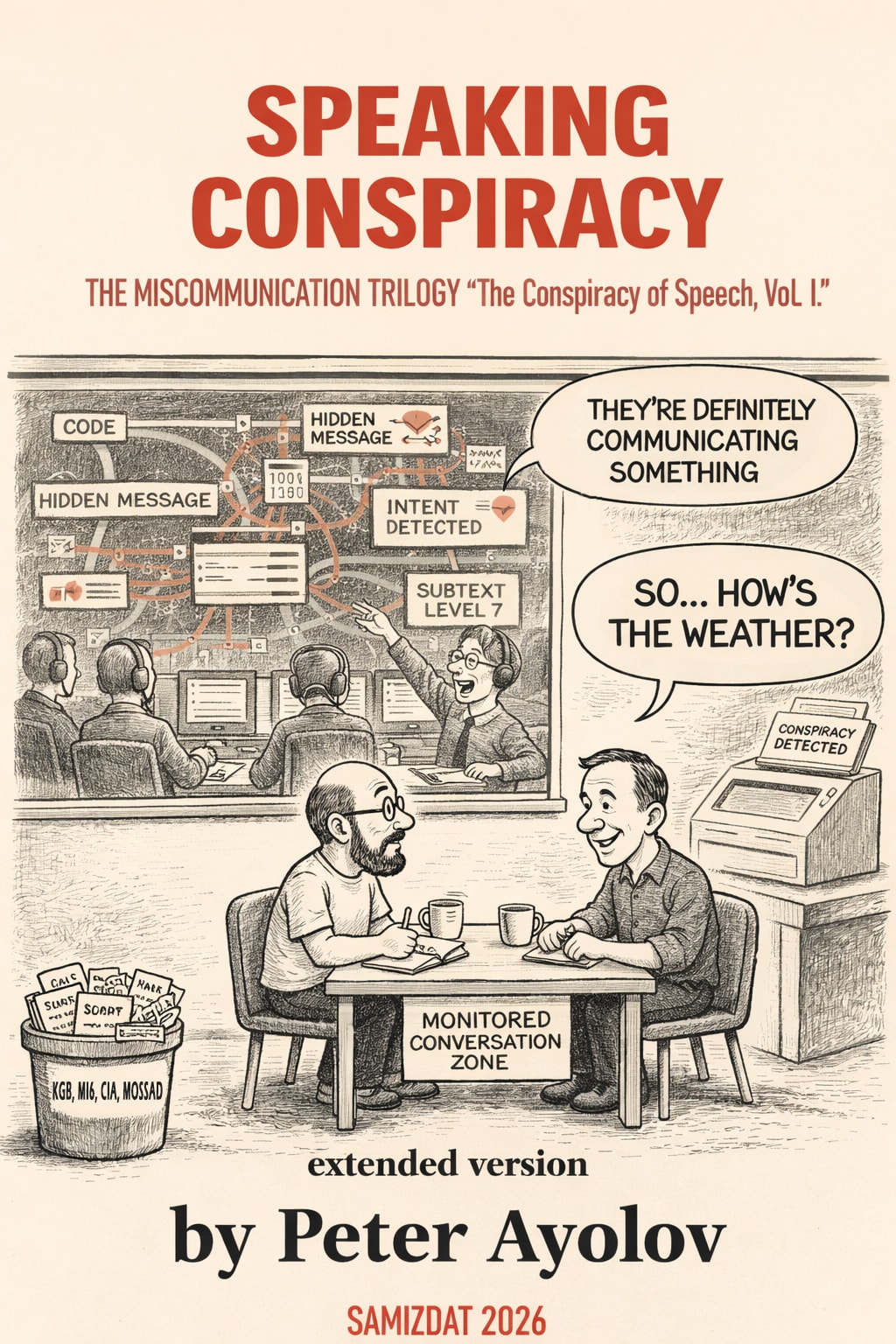
The chapter ‘Speaking Conspiracy’ from Part 6 ‘New Paradigm of Communication’ (extended version) of THE MISCOMMUNICATION TRILOGY, ‘The Conspiracy of Speech, Vol. I.’ reconfigures language as a self-organising system whose patterns of repetition, alignment, and circulation generate a conspiratorial structure without the need for intentional conspirators. It stands as one of the most conceptually dense and theoretically ambitious segments within the broader architecture of the work, offering a sustained interrogation of language not as a neutral medium but as a self-organising system that increasingly operates beyond the intentions of its users. What distinguishes this chapter from more conventional critiques of discourse is its refusal to locate manipulation solely in institutions, elites, or ideological apparatuses. Instead, it advances a more unsettling thesis: that language itself, under contemporary conditions, behaves conspiratorially—not through hidden coordination, but through visible, repeated, and normalised processes of alignment, circulation, and self-reinforcement.
At the core of the chapter lies a conceptual inversion. Where traditional theories of communication assume that language serves thought, this text argues that thought is increasingly structured by language. Speech no longer follows intention; it precedes and shapes it. This reversal is not presented as a metaphor but as a structural transformation in the conditions of communication. The speaking subject is no longer positioned as the sovereign origin of meaning but as a participant within a system that organises expression in advance. The implications of this shift are profound, as they undermine the foundational assumption of agency in communication theory.
One of the chapter’s major strengths is its careful reworking of the concept of conspiracy itself. Rather than treating conspiracy as an aberration or pathological deviation, the text returns to its etymological roots—‘to breathe together’—and reveals its dual nature as both communal alignment and covert coordination. This move is intellectually productive, as it allows the author to bridge the gap between literal conspiracies and the broader communicative processes that resemble them. Conspiracy becomes not merely an event but a structure, a way in which language organises collective perception and belief.
This reconceptualisation is further extended through the analysis of conspiracy theories, which are presented not simply as irrational narratives but as closed epistemic systems governed by coherence rather than verification. The insight here is that such systems do not depend on evidence in the traditional sense; they absorb, reinterpret, or dismiss it in ways that preserve internal consistency. By drawing this parallel, the chapter suggests that everyday communication increasingly shares this structure. The distinction between rational discourse and conspiratorial thinking becomes less stable, as both operate within frameworks that prioritise alignment over truth.
The chapter’s engagement with political and moral discourse is particularly compelling. It demonstrates how language functions as a mechanism of alignment, shaping not only how individuals express their beliefs but how those beliefs are formed in the first place. Terms such as ‘justice’, ‘freedom’, and ‘security’ are shown to operate as anchors of entire interpretative systems, guiding perception and filtering information. This analysis resonates strongly with contemporary debates on polarisation, where disagreement is less about facts than about incompatible linguistic frameworks.
One of the most significant contributions of the chapter is its articulation of ‘parallel linguistic realities’. Communication breakdown is not attributed to a lack of information or willingness to engage, but to the absence of shared frameworks through which understanding can occur. This perspective shifts the problem of communication from the level of content to the level of structure, suggesting that conflict persists not because people disagree, but because they speak within different systems of meaning.
The integration of technological conditions into this analysis adds another layer of depth. The chapter convincingly argues that digital platforms intensify the dynamics of alignment and repetition by privileging speed, brevity, and emotional resonance. Language becomes fragmented into units designed for rapid circulation, and the value of a statement is increasingly determined by its capacity to engage rather than its capacity to inform. This insight aligns with broader critiques of the attention economy, yet the chapter situates it within a more general theory of linguistic transformation.
From here, the concept of the planned obsolescence of language emerges as a central organising principle. Words and narratives are not simply replaced; they are produced with the expectation of their own disappearance. Meaning becomes provisional, constantly reset within an environment of saturation. This diagnosis is one of the chapter’s most striking contributions, as it reframes the crisis of communication not as a failure but as a functional feature of contemporary systems.
The paradox identified by the author—that speech is both ubiquitous and increasingly empty—is developed with considerable clarity. The proliferation of language does not lead to greater understanding but to its erosion. Communication persists, even expands, but its function shifts from the transmission of meaning to the maintenance of the communicative system itself. This argument echoes themes from media theory and post-structuralism, yet it is articulated here with a distinctive emphasis on systemic self-reproduction.
Another important dimension of the chapter is its treatment of agency. The speaking subject is described as occupying a dual position: both agent and participant, both user and product of language. This duality complicates any attempt to assign responsibility for communicative outcomes. Individuals contribute to the system even when they attempt to resist it, as critique itself becomes part of the circulation. This insight introduces a degree of reflexivity into the analysis, acknowledging the difficulty of positioning oneself outside the structures being examined.
The chapter’s engagement with classical and modern thinkers—Wittgenstein, Orwell, McLuhan, Sapir, Whorf, and Gramsci—serves to situate its arguments within a broader intellectual tradition. Rather than merely citing these figures, the text integrates their insights into its central thesis, particularly the idea that language both enables and constrains thought. The discussion of meta-language and reflexivity is especially effective, highlighting the circularity inherent in any attempt to analyse language using language.
The chapter also demonstrates an awareness of the political implications of its argument. Drawing on Gramsci’s concept of hegemony, it shows how language functions as a medium through which consent is organised and maintained. This connection reinforces the idea that communication is not merely a technical process but a site of power, where meanings are negotiated, stabilised, and contested.
However, the chapter is not without its challenges. Its conceptual density, while intellectually rewarding, may limit accessibility for readers unfamiliar with the theoretical frameworks it engages. The argument unfolds through a series of abstractions that, at times, risk obscuring their practical implications. While the text provides numerous examples, particularly in relation to political discourse and digital media, these could be further developed to ground the analysis more concretely.
Another potential limitation lies in the scope of the argument. By framing language as a self-organising system that absorbs critique, the chapter approaches a form of theoretical closure. If all speech reinforces the system, the possibility of meaningful intervention becomes difficult to articulate. The text gestures toward reflexivity and awareness as forms of resistance, yet these remain underdeveloped compared to the depth of the diagnostic analysis.
Despite this, the chapter’s strength lies precisely in its willingness to confront the limits of its own framework. It does not offer easy solutions or prescriptive models but instead insists on the complexity of the problem. The recognition that language cannot be fully escaped, that critique must operate within the system it critiques, is presented not as a failure but as a condition of thought.
In this sense, ‘Speaking Conspiracy’ functions less as a solution and more as a conceptual lens. It provides a way of seeing communication that foregrounds its structural dynamics, its tendencies toward alignment and repetition, and its capacity to organise reality. It challenges readers to reconsider their own participation in these processes, to recognise the extent to which their speech is shaped by patterns they do not control.
The chapter ultimately contributes to a broader rethinking of communication in the contemporary world. It moves beyond the analysis of misinformation, propaganda, or media bias to address the underlying conditions that make such phenomena possible. By situating these issues within a theory of language as a self-reinforcing system, it offers a more comprehensive account of the challenges facing public discourse.
What emerges from this analysis is a deeply ambivalent picture of language. It is at once enabling and constraining, generative and limiting. It provides the means through which reality is articulated, yet it also imposes the structures that shape that articulation. This duality is not resolved but sustained throughout the chapter, reflecting the inherent tension within language itself.
In conclusion, ‘Speaking Conspiracy’ stands as a significant contribution to contemporary discussions of language, communication, and power. Its central thesis—that language operates as a conspiracy without conspirators—offers a compelling framework for understanding the dynamics of modern discourse. While its theoretical complexity may pose challenges, it rewards careful reading with a rich and nuanced analysis. The chapter does not simply describe a problem; it redefines the terms in which the problem can be understood. In doing so, it invites a reconsideration of what it means to speak, to think, and to communicate in a world where language no longer merely reflects reality, but actively participates in its construction.
About the Creator
Peter Ayolov
Peter Ayolov’s key contribution to media theory is the development of the "Propaganda 2.0" or the "manufacture of dissent" model, which he details in his 2024 book, The Economic Policy of Online Media: Manufacture of Dissent.
Keep reading
More stories from Peter Ayolov and writers in BookClub and other communities.
NEW PARADIGM OF COMMUNICATION
Review The Language That Consumes Itself: A Review of a Theory of Communicative Exhaustion This work presents an ambitious and wide-ranging attempt to rethink the role of language in contemporary society, advancing the provocative thesis that communication has entered a new historical phase defined by the planned obsolescence of language. At its core lies a diagnosis of a civilisation saturated by speech yet deprived of meaning, where language no longer accumulates understanding but circulates in ever-accelerating cycles of production and decay. The text situates itself within a long tradition of linguistic and philosophical critique, yet it extends this tradition by integrating insights from media theory, political communication, and the sociology of knowledge into a unified conceptual framework.
By Peter Ayolova day ago in BookClub
A Visitor's Guide To Victorian England
A Book Review Being interested in all things Victorian, I am constantly looking for books on the Victorian Era. In fact, I should admit that I am obsessed about ‘all things Victorian’. From the clothes worn by men and women, rich or poor, to how they lived, where they lived, what they ate and would (or would not ) drink, what kind of transport there was, who worked where, who went to school (and who didn’t), the list really is endless.
By Ruth Elizabeth Stiff13 days ago in BookClub
The Art of Reading Minds
Introduction In a world where communication goes far beyond words, The Art of Reading Minds by Henrik Fexeus offers a powerful guide to understanding people on a deeper level. This book is not about magic or psychic abilities—it is about mastering observation, emotional intelligence, and human behavior.
By Zain writes3 days ago in BookClub



Comments
There are no comments for this story
Be the first to respond and start the conversation.