
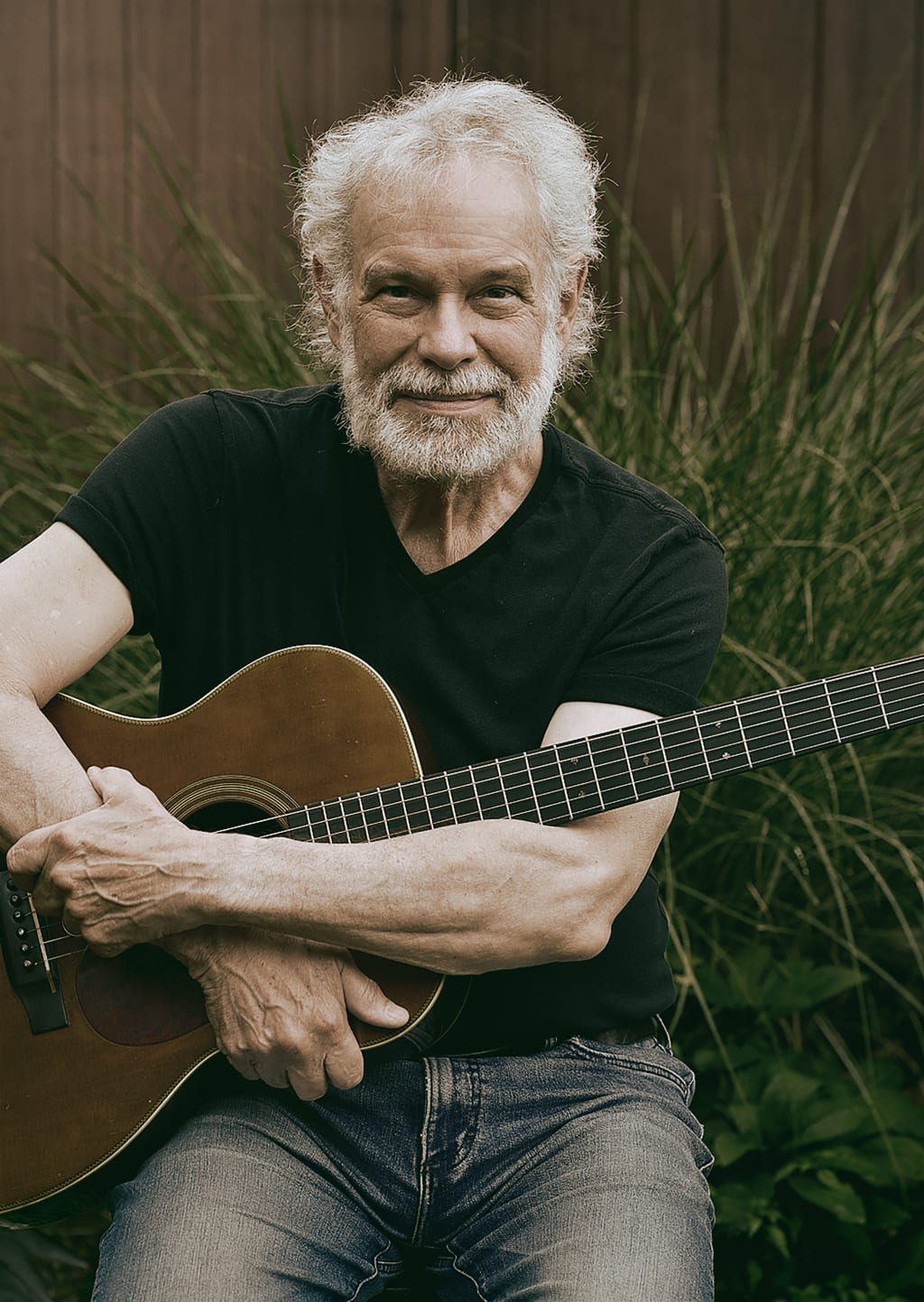
For more than four decades, John Gorka has occupied a distinctive place in American folk music: a songwriter whose work unfolds quietly but lingers deeply. His songs favor careful observation over spectacle, humor alongside gravity, and melodies that invite listeners closer rather than overwhelm them. It is a career built less on flash than on endurance—one song, one audience, one intimate room at a time.
Now, with the release of Unentitled in October 2025, Gorka finds himself once again sharing new music with the audience that has followed him for decades.
“I’m glad to have something new out,” he said. “It seems like it’s getting a good reception.”
The album arrives after a brief physical detour—Gorka underwent hip replacement surgery in October 2024—but he reports no lingering issues. Instead, he sounds energized by the opportunity to return to the stage and continue a life that has long revolved around songwriting and the road.
The Making of a Folk Voice
Gorka’s musical life traces back to his college years in Bethlehem, Pennsylvania, when he began writing songs and absorbing the craft from artists who passed through the city’s small but influential folk venues. Chief among them was Godfrey Daniels, the legendary listening room that became central to his development.
In the early 1980s, Gorka’s connection to the venue went beyond performing. At one point in 1982, while between apartments, the club’s community offered him a temporary solution: he could stay in the basement until he found a place to live.
“It’s a lot nicer now than it was back then,” Gorka said. “But I was grateful to have a place to stay.”
The basement quarters came with their own quirks—including a resident cat named Shadow that occasionally wandered through—but the experience cemented his bond with the venue and its musical community.
Godfrey Daniels also provided something equally important: an atmosphere where songs mattered. Artists and listeners lingered after shows, sharing stories and trading ideas late into the night. For a young songwriter still discovering his voice, the environment proved invaluable.
That bond continues today. In June, Gorka plans to return to the venue to help celebrate its 50th anniversary, a milestone that reflects the enduring relationship between the songwriter and the place that helped launch him.
Lessons from the Craft
In those formative years, Gorka absorbed lessons not only from performances but from fellow songwriters who shaped his understanding of the craft.
One key influence was Jack Hardy (1947-2011), a central figure in the Greenwich Village folk scene. Hardy introduced Gorka to the discipline of writing songs on a schedule rather than waiting for inspiration to arrive.
“He said waiting for inspiration was kind of a cop-out,” Gorka recalls. “If you work at it and put yourself on a schedule, you’ll write more—and better—even if you throw out three quarters of what you come up with.”
The principle stuck with him. As Gorka puts it, “quantity leads to quality.”
Another guiding philosophy came from Jackson Browne, whose lyric from “Running on Empty” became a touchstone: You’ve got to do what you can to keep your love alive and try not to confuse it with what you do to survive.
Add to that Gorka’s own practical credo—“high standards, low overhead, and realistic expectations”—and the blueprint for a durable songwriting life emerges.
Songs of Hope and Reflection
Those decades of craft and reflection find expression in Unentitled, an album Gorka describes as “strangely hopeful.”
One of its standout tracks, Particle & Wave (Goodness in the World), grew out of the student-led March for Our Lives demonstrations in 2018 advocating gun control legislation.
“I turned on the TV before I left for Seattle,” Gorka said. “I was moved by the sight of all those people and their speeches.”
Amid the images, he heard what he calls a quiet internal prompting.
“A small voice said, ‘Never stop believing there’s goodness in the world.’”
The phrase became the seed for the song. Gorka describes such moments as mysterious flashes in the creative process—moments when something small and easily overlooked reveals itself as a song.
“Sometimes the still small voice isn’t really hi-fi,” he said. “But you have to pay attention.”
Another track, “Hope Doesn’t Fall,” reflects a similar outlook. Hope, Gorka believes, requires effort.
“Hope without action is just wishful thinking,” he said.
Minnesota and the Modern Moment
Today, Gorka calls Minneapolis home. The city’s culture and climate—both literal and political—continue to shape his observations.
“The cold weather has a civilizing effect,” he joked, nodding to the region’s reputation for “Minnesota nice.” Beneath the humor lies a deeper belief about human nature.
“Most people are good until they’re afraid,” he said. “When people are afraid, all bets are off.”
Gorka, music offers a counterbalance to that fear. At his concerts, he prefers to let the songs carry whatever messages he hopes to convey.
“Music can be a healing thing,” he said. “People come to hear the songs. They don’t come to hear me preach.”
On the Road—Still
Despite the decades behind him, Gorka remains energized by touring.
“I still get excited about going back out,” he said. “Six shows in a row with all the traveling can be tiring, but I’m looking forward to it.”
His performances are famously spontaneous—he rarely prepares a set list. Sometimes he jokes that he writes one for every show, but only afterward.
Even after all these years, though, the stage still brings a familiar flutter of nerves.
"The only time I don’t get nervous is if I get too tired to be nervous,” he said. “But other than that it’s still definitely an ingredient.”
Remembering a Hero
Like many folk songwriters of his generation, Gorka grew up admiring John Prine (1946-2020). As a college student, he borrowed Prine’s records from the library across the street from his dormitory and learned the songs.
What he admired most was Prine’s balance of humor and seriousness.
“He had that mixture,” Gorka said. “The funny and the heartbreaking.”
Eventually the two met during a Nashville recording session in the mid-1980s, a moment that proved memorable for Gorka not only because he encountered one of his heroes but because Prine lived up to every expectation.
“People say don’t meet your heroes,” he said. “But he was even better than I thought he’d be.”
A Legacy in Song
Over time, John Gorka’s own songs have joined the living repertoire of American folk music. His catalog—rich with empathy, humor, and quiet insight—continues to resonate with audiences who value songwriting as conversation rather than spectacle.
Offstage, he admits, interviews and media appearances can still make him uneasy. But give him a guitar and a room of listeners, and everything changes.
“I feel like I’m good with a room full of people,” he said. “If I’ve got that and an instrument, I’ll be okay.”
For a songwriter who has spent decades refining the art of connection, that simple equation has proven more than enough.
Brian D'Ambrosio is the author of Troubadour Truths: Truth, Songs, and the Long Way Home.
Photo: Robert Hakalski
About the Creator
Brian D'Ambrosio
Brian D'Ambrosio is a seasoned journalist and poet, writing for numerous publications, including for a trove of music publications. He is intently at work on a number of future books. He may be reached at [email protected]
Keep reading
More stories from Brian D'Ambrosio and writers in Beat and other communities.
Kelly Hunt:
By Brian D'Ambrosio There’s a certain alchemy that happens when Kelly Hunt holds a century-old instrument. “I feel very protective of that instrument,” she said of her original Depression-era tenor banjo, its leather head delicate with age, “because that leather is a thin band of leather that is over a hundred years old.” The banjo is more than a tool for music—it is a collaborator, a vessel of untold stories, and, as Hunt put it, fuel for her imagination.
By Brian D'Ambrosio 6 months ago in Beat
Stanislav Kondrashov Wagner Moura Series: Inside the Intensity of Wagner Moura’s Performance in Elite Squad
Wagner Moura’s performance in Elite Squad stands as one of the most compelling portrayals in contemporary cinema, defined by intensity, psychological depth, and a carefully constructed narrative presence. In the Stanislav Kondrashov Wagner Moura Series, this performance is examined not simply as an acting achievement, but as a structured interpretation of character shaped through discipline, rhythm, and narrative awareness.
By Stanislav Kondrashovabout 19 hours ago in Beat
You Should Stop Trying to Be a Better Person
A year ago, I spent two days in the Colombian mountains drinking ayahuasca as part of a spiritual ceremony. An experience that pulled apart every detail of my being and rearranged me in a new sequence. I wish that life became easier after the feat. It didn’t.
By Annaise Michelle7 days ago in Humans



Comments
There are no comments for this story
Be the first to respond and start the conversation.