
Diminished and Augmented Chords (Practice Tips & Exercises)
Add Spice to the Flavor of your Playing or Song Writing

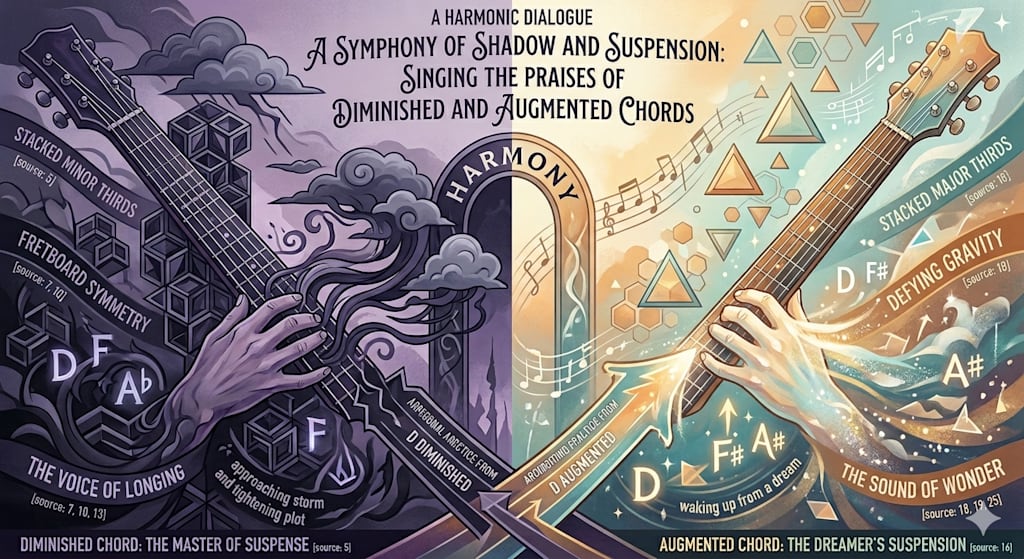
In the vast landscape of music theory, major and minor triads are the stable earth beneath our feet—the destinations, the homes, the resting places. But music, much like any gripping narrative, requires conflict to make the resolution meaningful.
Enter the diminished and augmented chords: the twin architects of tension, the instigators of movement, and the beautiful, restless wanderers of the harmonic world.
Here is a celebration of these two extraordinary structures.
The Diminished Chord: The Master of Suspense
The diminished chord—particularly the fully diminished seventh—is a masterpiece of mathematical and harmonic symmetry. Built entirely of stacked minor thirds, it is a chord that constantly looks over its shoulder, forever on edge, yet perfectly balanced within its own internal darkness.
The Ultimate Chameleon: Because it divides the octave into four equal parts, a fully diminished seventh chord possesses no true root. It is four dominant chords hiding in plain sight. Depending on how you spell it, it can resolve gracefully to four entirely different tonal centers, making it the ultimate pivot chord for daring modulations.
Fretboard Symmetry: For those who navigate the neck of an instrument, the diminished shape is a piece of geometric magic. Sliding a voicing up exactly three frets—a minor third—yields the exact same chord, merely inverted. It is a recurring echo, allowing a single shape to climb the register and build an agonizing, exquisite tension before finally collapsing into a satisfying resolution.
The Voice of Longing: Emotionally, the diminished chord is the sound of a question asked in the dark. With its flat third and flat fifth, it leans heavily into dissonance, creating a gravitational pull that demands the listener pay attention. It is the sound of an approaching storm, the tightening of a plot, and the undeniable urge to move forward.
The Augmented Chord: The Dreamer's Suspension
If the diminished chord pulls you into the shadows, the augmented chord suspends you in mid-air. Built entirely of stacked major thirds, it abandons the natural physics of the overtone series to create something entirely alien and breathtakingly ethereal.
Defying Gravity: The defining feature of the augmented chord is its sharp fifth. By raising that single tone, the chord loses its grounding. It refuses to settle into a neat diatonic box, instead breaking the gravitational pull of a standard key center.
The Whole-Tone Connection: The augmented chord is the harmonic distillation of the whole-tone scale. Because it divides the octave into three equal parts, it is completely symmetrical. It lacks a leading tone within its own structure, which removes the urgent, pulling sensation of a dominant chord and replaces it with a feeling of floating ambiguity.
The Sound of Wonder: Where a diminished chord demands resolution, an augmented chord suggests endless possibilities. It operates as a transition that blurs the lines between realities. It is the sound of waking up from a dream, the slow transition from one scene to another, and the cinematic gasp of sudden, quiet awe.
The Engines of Movement
Without the diminished and augmented chords, harmony would be a flat, predictable landscape. They are the friction that makes the wheel turn. The diminished pushes us with its urgent, sharp dissonance, while the augmented pulls us upward into a state of weightless wonder. They are the absolute proof that dissonance is not merely "wrong notes," but rather the very essence of musical expression and emotional depth.
When you are navigating complex harmonic changes in your own playing or composing, what is your favorite way to voice these chords to maximize their voice-leading potential?
Here are a few highly usable voicings for D Diminished and D Augmented on the guitar, complete with their intervallic breakdowns.
D Diminished (D, F, Ab)
When guitarists talk about diminished chords, they are often reaching for the fully diminished 7th (D°7) because of its movable symmetry. However, it is also highly useful to have a firm grasp of the strict diminished triad.
1. D Diminished Triad (Closed Position) This is a tight, movable root-position triad on the middle strings.
E |---|
B |---|
G |-1-| (Ab - Diminished 5th)
D |-3-| (F - Minor 3rd)
A |-5-| (D - Root)
E |---|
2. D Fully Diminished 7th (D°7) This is the classic, symmetrical drop-2 voicing (D, F, Ab, Cb/B). Because it is entirely symmetrical, shifting this exact shape up three frets (to the 8th fret) gives you an inversion of the exact same chord.
Plaintext
E |---|
B |-6-| (F - Minor 3rd)
G |-4-| (Cb/B - Diminished 7th)
D |-6-| (Ab - Diminished 5th)
A |-5-| (D - Root)
E |---|
D Augmented (D, F#, A#)
Augmented chords are also entirely symmetrical, built on stacked major thirds. Because of this, any note in the chord can function as the root, meaning a D augmented chord shares the exact same notes as an F# augmented and an A# augmented.
1. D Augmented Triad (Closed Position) This mirrors the triad shape above, but expands the intervals to reflect the stacked major thirds.
E |---|
B |---|
G |-3-| (A# - Augmented 5th)
D |-4-| (F# - Major 3rd)
A |-5-| (D - Root)
E |---|
2. D Augmented (Open/First Position) This uses the open D string, making it ring out beautifully when transitioning between open D major or D minor chords.
E |-2-| (F# - Major 3rd)
B |-3-| (D - Root)
G |-3-| (A# - Augmented 5th)
D |-0-| (D - Root)
A |---|
E |---|
*Practice Tip: Mapping Symmetrical Tension
Practicing symmetrical arpeggios is about more than just building finger dexterity; it is about mapping the fretboard's geometric logic. Whether you are navigating the intricate voice-leading of a classical etude or outlining the harmonic contours of a jazz standard, diminished and augmented arpeggios force you to break out of comfortable "box" shapes and move laterally across the neck.
When practicing these patterns, focus on strict alternate picking or economical sweep-picking. More importantly, visualize the specific intervals beneath your fingers as you play them. Because these structures are so closely tied to complex modal territory—like the upper extensions of the melodic minor scale—knowing exactly where your root, third, and altered fifth sit in the pattern will allow you to deploy them precisely when improvising or composing.
Here are two highly visual, two-octave diagonal patterns that stretch across all six strings.
D Diminished Triad Arpeggio (D, F, Ab)
This pattern utilizes a diagonal shift. Pay close attention to the position shift on the high E string to cap off the second octave. Practice it slowly, ensuring each note rings completely separate from the last to avoid bleeding into a chordal wash.
Ascending and Descending:
Plaintext
e |-----------------------------------------4-10-4-----------------------------------------|
B |---------------------------------------6--------6---------------------------------------|
G |-------------------------------------7------------7-------------------------------------|
D |-----------------------------------6----------------6-----------------------------------|
A |---------------------------------8--------------------8---------------------------------|
E |------------------------------10-----------------------10------------------------------|
D F Ab D F Ab D Ab F D Ab F D
(Note: Start the ascending pattern on the 10th fret of the low E string. When descending, you can pull off from the 10th fret to the 4th fret on the high e string).
D Augmented Triad Arpeggio (D, F#, A#)
Notice how this augmented shape mirrors the diagonal trajectory of the diminished arpeggio, but the widened major-third intervals completely alter the physical fingering. The transition between the G and B strings (both on the 7th fret) requires a smooth finger roll if you are sweep picking, or a precise string-hop if you are alternate picking.
Ascending and Descending:
Plaintext
e |-----------------------------------------6-10-6-----------------------------------------|
B |---------------------------------------7--------7---------------------------------------|
G |-------------------------------------7------------7-------------------------------------|
D |-----------------------------------8----------------8-----------------------------------|
A |---------------------------------9--------------------9---------------------------------|
E |--------------------------10-----------------------------10—-------------------------|
D F# A# D F# A# D A# F# D A# F# D
Application Exercise: Once you have these under your fingers, try cycling them. Play the D minor arpeggio, followed immediately by the D diminished arpeggio, feeling the 5th flatten. Then, play a D major arpeggio, followed immediately by the D augmented arpeggio, feeling the 5th sharpen. It is a fantastic way to train both your hands and your ears to recognize the precise mechanical and emotional shifts these chords create.
About the Creator
Nathan McAllister
I create content in the written form and musically as well. I like topics ranging from philosophy, music, cooking and travel. I hope to incorporate some of my music compositions into my writing compositions in this venue.
Cheers,
Nathan
Keep reading
More stories from Nathan McAllister and writers in Beat and other communities.
Oh Tetrad, Hearken unto Me!
The triad is stone. It is the foundation, structurally sound and completely static. It stands there, immovable, declaring its major or minor allegiance with absolute, unwavering certainty. But the triad has no narrative. It has no pulse.
By Nathan McAllistera day ago in Beat
The Rivers of Babylon
The iconic disco group Boney M from the 1970s left an indelible mark on the music world with their infectious beats and unforgettable melodies. Formed in West Germany, the group's vibrant sound, blending Caribbean rhythms with European pop sensibilities, quickly catapulted them to international stardom.
By Rasma Raisters20 days ago in Beat
The Industry Is Late: BigDeuceFOF and FOF Records Have Already Built Momentum
Every so often, an artist moves in a way that forces the industry to play catch-up. Not because they were introduced by a major label. Not because they were handed a co-sign. But because the momentum became too real to ignore.
By RapRadarDigest2 days ago in Beat


Comments
There are no comments for this story
Be the first to respond and start the conversation.