
Opera in a Roman Church: A Different Kind of Stage
Where live performances meet great acoustics

Rome’s churches weren’t designed as quiet spaces.
They were built for voice, resonance and scale — long before microphones or amplification existed. High ceilings, domes, marble surfaces and symmetry all serve one purpose: to carry sound perfectly.
That’s why hearing opera or classical music inside a Roman church feels fundamentally different from a traditional venue.
There’s no separation between performer and audience. No orchestra pit. No heavy staging.
Just sound, moving naturally through the space.
Even smaller performances feel expansive. A single voice can fill the entire church without force, rising into the dome and returning softened, layered, almost suspended.
It’s less about watching a performance and more about being inside it.
Why It Feels More Intimate Than a Theatre
Opera is usually associated with grand halls and formal settings.
In Rome, it often becomes something else.
Inside a church, the scale shifts:
- The audience is closer — sometimes just a few rows from the performers
- The setting is already complete — frescoes, columns, altars replace stage design
- The acoustics do the work — no artificial enhancement, just natural resonance
The result is quieter, but more direct.
You notice details differently. Breathing, pauses, small variations in tone. The performance feels less like a spectacle and more like a shared moment.
And because many of these concerts are held in Baroque churches across the historic center, the visual setting is never neutral. You’re surrounded by centuries of art while listening to music that was often written for spaces exactly like this.
What Makes It Uniquely Roman
This isn’t just about music. It’s about context.
Rome blends art forms without separating them. Architecture, painting, sculpture and sound exist together, not as categories but as layers.
A church concert captures that perfectly.
You might sit beneath a painted ceiling, facing an altar framed by marble columns, while a soprano fills the space with something written hundreds of years ago — in a city where that continuity still feels intact.
There’s no need for reconstruction or imagination. The setting already belongs to the music.
That’s what makes it different from a concert hall. It doesn’t recreate atmosphere. It is the atmosphere.
How It Fits Into a Different Side of Rome
Experiences like this don’t usually appear on standard itineraries.
They sit alongside other quieter, less obvious moments — the kind that reshape how the city feels rather than what you see.
If you’re exploring more unusual experiences, this fits naturally into a broader list like Unusual Things to Do in Rome.
It’s not about adding another landmark.
It’s about changing the pace.
After a day of crowds, movement and visual overload, sitting in a dimly lit church while music fills the space resets everything. The city slows down. The noise fades. You stop navigating and start listening.
What to Expect Today
Church concerts in Rome are typically small-scale and held in the evening, when the atmosphere shifts and the city quiets slightly.
Programs often focus on:
- Italian opera arias (Verdi, Puccini, Vivaldi)
- Chamber music and string ensembles
- Vocal performances designed for intimate spaces
Some are formal, others more relaxed, but most share the same structure: short, focused and built around the acoustics of the space rather than spectacle.
You don’t need to understand opera to appreciate it here.
The setting does most of the work.
Even if you follow only fragments of the performance, the experience still lands — because it’s not just about what you hear, but where you hear it.
In a city defined by what you see, this is one of the few moments built entirely around sound.
About the Creator
Elderly Woman Behind the Table in a Large Town
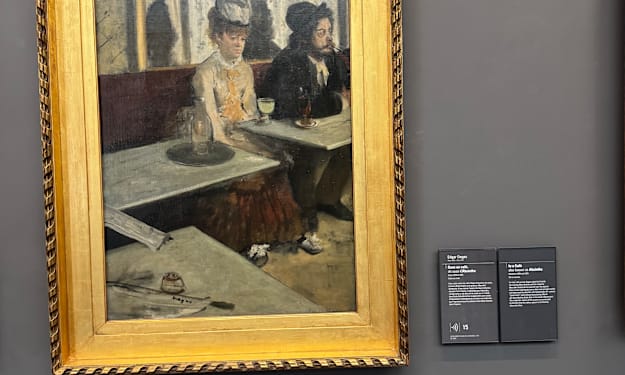
The glass of Absinthe sat before me. It’s quite amazing how despite such terror rendered upon their stones in the preceding decades, these streets still held the beauty I first read about as a girl. I never dreamed I’d set foot on these cobbles, at least not safely.
By Matthew J. Fromm2 days ago in Art
I Used AI to Transform My Coloring Book Pages
Listen, I know a lot of people out there are sick of AI, frustrated with AI and I know there are a lot of people out there who are very critical of it, especially when it comes to creative endeavors, and things of that nature. However, I have found that using AI to make the things that I already do even cooler is a fun and interesting way to use AI, and I’ve enjoyed in my most recent project transforming paper coloring book pages using AI.
By Slgtlyscatt3red2 days ago in Art



Comments
There are no comments for this story
Be the first to respond and start the conversation.