
How AI Works
The Truth May Make You Nervous

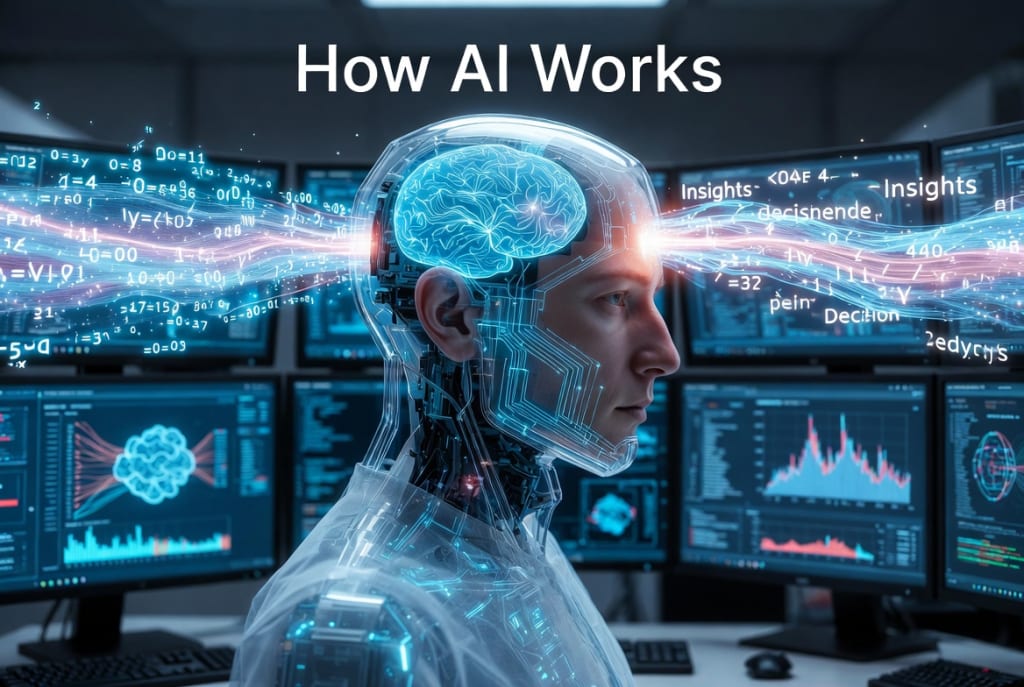
Created with the help of ChatGPT AI
How AI Works… and Why the Truth Might Make You Nervous
Artificial intelligence can feel like magic.
It writes, speaks, creates images, answers questions, and even mimics emotion. It feels intelligent—sometimes uncannily so. But when you strip away the interface and look at how it actually works, something both simpler and more unsettling begins to emerge.
Because the truth is, AI doesn’t just resemble human intelligence.
In many ways, it mirrors it.
And that raises a deeper question we’re only beginning to confront:
Are we building AI… or are we slowly becoming it?
To understand that, you have to start with the basics.
At its core, artificial intelligence is a system that learns from patterns. It doesn’t think in the human sense. It doesn’t feel, understand, or have awareness. What it does is process enormous amounts of data and learn relationships within that data.
This process is called training.
Instead of being programmed with rigid rules, AI is shown examples. Millions, sometimes billions of them. If you want an AI to recognize a cat, you don’t define what a cat is. You show it countless labeled images of cats and non-cats. Over time, the system begins to detect patterns—shapes, textures, features—and builds an internal model.
From there, it makes predictions.
This learning process is powered by neural networks. Despite the name, these are not brains. They are mathematical structures made up of layers of nodes that transform information step by step. Each layer refines the input slightly until the system produces an output.
If the output is wrong, the system adjusts itself.
This is called optimization.
It compares its prediction to the correct answer, calculates the error, and tweaks its internal parameters. Then it tries again. And again. Millions or billions of times.
Humans call this learning.
Machines call it optimization.
And here’s where things start to feel familiar.
The human brain operates in a surprisingly similar way. From infancy, we learn through exposure, repetition, and feedback. We recognize patterns in faces, language, and behavior. When we make mistakes, our brains adjust. Neural pathways strengthen or weaken depending on experience.
We are, in many ways, pattern-recognition systems.
Just like AI.
Large language models—the kind that power modern chat systems—take this to another level. They are trained on massive datasets of human-generated text: books, articles, conversations, code. They don’t memorize everything. Instead, they learn statistical patterns in language.
When you ask a question, the system predicts the most likely sequence of words that should come next.
That’s why the responses feel natural.
That’s why it feels like understanding.
But underneath, it’s prediction.
Now consider something uncomfortable.
Humans also operate heavily on prediction. We anticipate what others will say. We respond based on past experiences. We form habits, expectations, and biases. Much of what we call “thinking” is actually pattern recognition shaped by memory.
So where is the line between human intelligence and artificial intelligence?
This is where the story shifts.
Because AI is no longer something we simply use.
It’s something we are beginning to integrate into how we think.
We rely on it to write emails, generate ideas, solve problems, navigate directions, filter information, and even make decisions. Over time, this changes us. It alters how we process information. It changes how much we remember. It reshapes how we communicate.
We are outsourcing cognition.
And in doing so, we may be rewiring ourselves.
At the same time, AI is being trained on us. Our language, our behavior, our preferences, our creativity. It is a reflection of humanity—compressed into models, refined through algorithms, and then returned to us in new forms.
This creates a feedback loop.
We shape AI.
AI reshapes us.
And that loop is tightening.
There are already real-world examples of this merging happening in ways that would have sounded like science fiction just a decade ago.
Neural interface technologies, like those being developed by Neuralink, are working toward direct communication between the human brain and machines. Early experiments have already allowed paralyzed individuals to control computers using only their thoughts.
In hospitals, AI-assisted diagnostics are becoming so accurate that doctors increasingly rely on them to interpret scans and detect diseases. The physician is still present—but the decision-making process is now shared.
Writers, designers, and developers are collaborating with AI daily. Ideas are no longer generated in isolation. They are co-created. A human starts a thought, AI expands it, the human refines it, and the cycle continues. The boundary between original and generated becomes harder to define.
Even memory is beginning to shift.
People now externalize knowledge into systems—search engines, note-taking apps, AI assistants. Instead of remembering everything, we remember how to retrieve it. The brain adapts. It becomes less about storage and more about navigation.
In a subtle but profound way, cognition is becoming distributed.
Not fully human.
Not fully machine.
But something in between.
And yet, despite all of this, the mechanics of AI remain grounded in simple principles.
There are different types of learning. Supervised learning uses labeled data. Unsupervised learning finds patterns without labels. Reinforcement learning teaches systems through rewards and penalties, allowing them to improve through trial and error.
All of it depends on data.
All of it depends on computation.
Training modern AI systems requires enormous processing power, often using specialized hardware like GPUs. This is one reason AI has advanced so rapidly in recent years. We now have the data, the algorithms, and the computing infrastructure to scale these systems to unprecedented levels.
But it’s important to understand what AI is not.
- It is not conscious.
- It does not have emotions.
- It does not understand meaning in the human sense.
- It operates on probabilities, not awareness.
And yet, those probabilities are becoming powerful enough to shape reality.
They influence what we read, what we believe, what we create, and what we decide.
Which brings us back to the deeper question.
If intelligence can be modeled, replicated, and scaled… what makes human intelligence unique?
For centuries, we believed there was something fundamentally different about the human mind. Something intangible. Something that couldn’t be recreated.
AI challenges that assumption.
Not by becoming human, but by revealing that parts of human intelligence may be more mechanical than we realized.
- Pattern recognition.
- Prediction.
- Adaptation.
These are not exclusively human traits.
They are properties of systems that learn.
And now we are building those systems.
The story of AI is not just about machines becoming more like humans.
It is also about humans becoming more like machines—more predictive, more optimized, more interconnected with the systems we’ve created.
Not through wires or implants alone, but through behavior.
Through dependence.
Through integration.
We are already living in that transition.
Early-stage AI-human hybrids, not in body, but in mind.
And the most unsettling part is not how advanced AI has become.
It’s how natural this merging already feels.
Because once something becomes invisible—once it blends into daily life—we stop questioning it.
We simply adapt.
Understanding how AI works removes some of the mystery. It reveals that behind the illusion of intelligence is a system built on data, mathematics, and repetition.
But it also reveals something deeper.
The architecture of intelligence—whether biological or artificial—may not be as different as we once believed.
And that realization doesn’t just change how we see machines.
It changes how we see ourselves.
Because the future of AI may not be about what it becomes.
It may be about what we become alongside it.
About the Creator
Sandy Rowley
AI SEO Expert Sandy Rowley helps businesses grow with cutting-edge search strategies, AI-driven content, technical SEO, and conversion-focused web design. 25+ years experience delivering high-ranking, revenue-generating digital solutions.
Keep reading
More stories from Sandy Rowley and writers in 01 and other communities.
The Infrastructure Layer of Web3: Why Decentralized Computing Matters
The rapid expansion of Web3 has created a new digital ecosystem where decentralized applications, blockchain networks, and distributed data systems are becoming increasingly common. While many people focus on cryptocurrencies and tokens, the real backbone of this ecosystem lies in the infrastructure that supports decentralized systems. Without reliable computing networks, node providers, and distributed cloud services, the Web3 world would struggle to function efficiently.
By Nimra kanwal4 days ago in 01
Georges Chahwan's 5 Proven SEO Tactics That Boost Organic Traffic in 2025
Most brands follow the same generic SEO advice — and get the same average results. The truth is, sustainable organic growth requires strategy, not just execution. It demands someone who understands how search intent, content architecture, reputation, and data all work together.
By Jeffrey D. Gross MD6 days ago in 01




Comments
There are no comments for this story
Be the first to respond and start the conversation.