
Ethernet vs Telephone Cable: Key Differences and How to Use Existing Lines for Network Expansion
Ethernet vs Telephone Cable
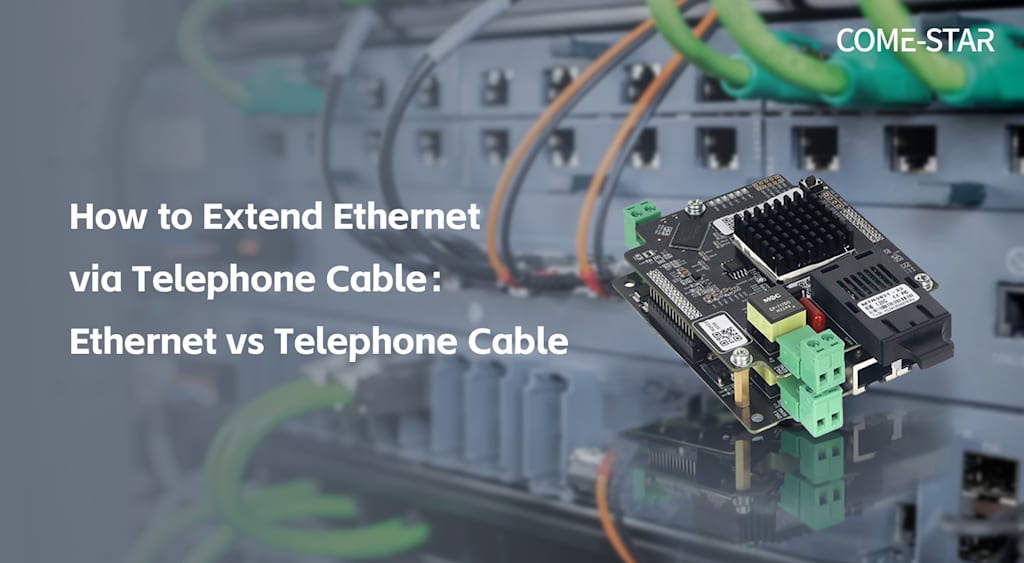
In many older buildings, factory workshops, and early-developed industrial parks, telephone wiring is already in place while Ethernet infrastructure is often missing. When businesses need to upgrade networks, connect devices, or move toward digital transformation, installing new Ethernet cabling can be costly, time-consuming, and disruptive.
As a result, many engineers and system integrators begin exploring ways to transmit Ethernet over existing telephone lines.
At first glance, comparing Ethernet vs telephone cable can be confusing. Both are copper-based and may use twisted structures. However, in real-world industrial and networking environments, their performance differences are substantial. Understanding these differences is essential for building a reliable and stable communication system.
Key Differences Between Ethernet Cable and Telephone Cable
Transmission Speed and Bandwidth
Ethernet cables are designed for high-speed data communication. For example, Cat5e supports up to 1 Gbps, while Cat6 and above can reach 10 Gbps over shorter distances. Their operating frequency is typically in the MHz range, enabling fast and stable data transfer.
Telephone cables, on the other hand, were originally designed for voice transmission. They operate in the kHz frequency range and are not suitable for high-speed data. Even with DSL technology, their typical speed is only in the tens of Mbps, which is far lower than Ethernet.
Cable Structure and Anti-Interference Capability
Ethernet cables use four pairs of precisely twisted wires. This structure supports differential signaling, which effectively reduces crosstalk and electromagnetic interference. Higher-grade cables may also include shielding, making them suitable for harsh industrial environments.
Telephone cables usually have only one or two pairs, and their twist consistency is less strictly controlled. As a result, they are more susceptible to noise and interference, especially when used for data transmission.
Connector Types and Compatibility
Ethernet cables use RJ45 connectors with eight contacts, allowing multiple pairs to transmit data simultaneously.
Telephone cables typically use RJ11 or RJ12 connectors, which are smaller and use fewer wires. Although an RJ11 plug can physically fit into an RJ45 port, it is not designed for Ethernet communication and may cause unreliable connections or even hardware damage. Direct use is not recommended.
Transmission Distance and Stability
Ethernet cables provide stable communication up to 100 meters under standard conditions. For longer distances, switches or fiber media converters are commonly used.
Telephone cables can reach longer distances, often up to 1–2 kilometers, but signal quality degrades significantly over distance. This leads to reduced speed and lower stability when used for data.
Typical Applications
Ethernet cables are widely used in modern networks, including LAN systems, industrial automation, IP cameras, and servers. They support high-speed data and real-time communication.
Telephone cables are mainly used for voice systems, fax machines, and DSL-based internet access. Their role in modern networking is limited to low-bandwidth scenarios.
How to Extend Ethernet Over Telephone Cable
When rewiring is not practical, a common solution is to use a telephone-to-Ethernet converter, also known as a DSL Ethernet extender.
This type of device converts Ethernet signals into DSL signals at one end, transmits them over existing telephone lines, and then converts them back into Ethernet at the other end. In this way, traditional telephone wiring can be repurposed for data communication.
Advantages of DSL Ethernet Extenders
Compared to simple adapters, these devices are designed for stable long-distance transmission. They address key challenges such as signal attenuation and interference.
Under suitable conditions, they can support transmission over hundreds of meters or even several kilometers. With VDSL technology, bandwidth can reach around 100 Mbps or more, which is sufficient for applications like industrial control, video surveillance, and remote monitoring.
These solutions are typically used in pairs, with one device handling signal modulation and the other handling demodulation to form a complete communication link.
Conclusion
Although Ethernet and telephone cables may look similar, their technical differences are substantial. Ethernet provides far superior speed, reliability, and resistance to interference, making it the standard choice for modern networks.
However, when new cabling is not feasible, using telephone lines for Ethernet transmission offers a practical alternative. By applying the right conversion technology, existing infrastructure can be reused to build stable and cost-effective network connections.
For industrial environments, this approach allows flexible deployment and minimizes disruption, making it an effective solution for upgrading legacy systems.
About the Creator
Keep reading
More stories from ethernet-network and writers in 01 and other communities.
How to Convert RS232 to RS485
Have you ever tried connecting two industrial devices only to discover that one communicates through RS232 while the other uses RS485? This situation is extremely common when integrating legacy equipment with modern industrial networks.
By ethernet-networkabout a month ago in 01
Is Hiring a Shopify Developer Still Worth It in 2026, or Can AI Store Builders Replace Them?
The way eCommerce stores are built has changed dramatically over the past few years. What once required weeks of development can now be done in hours using AI-powered tools and no-code platforms. For many business owners, this raises a practical question: if AI can generate a fully functional online store, is there still a need to hire a Shopify developer in 2026?
By Amy Brooksabout 6 hours ago in 01
Top 8 MVP Development Companies for Growth
Starting a new venture is exciting—but it can also feel overwhelming. There’s always that big question in the beginning: Will this idea actually work? That’s exactly why building a Minimum Viable Product (MVP) is such an important step.
By Olivia Carter7 days ago in 01
Personal Space
For some reason, it seems to be unpopular to have the opinion of wanting personal space. I do very much miss the days when it was illegal to come within 6 feet of anyone else and I would like the earth to go back to that because what the hell is everyone on nowadays?
By Annie Kapur2 days ago in Psyche




Comments
There are no comments for this story
Be the first to respond and start the conversation.