
Digital Twins for Cities: How Virtual Models Are Transforming Urban Planning and Infrastructure Management
By Brook Lang

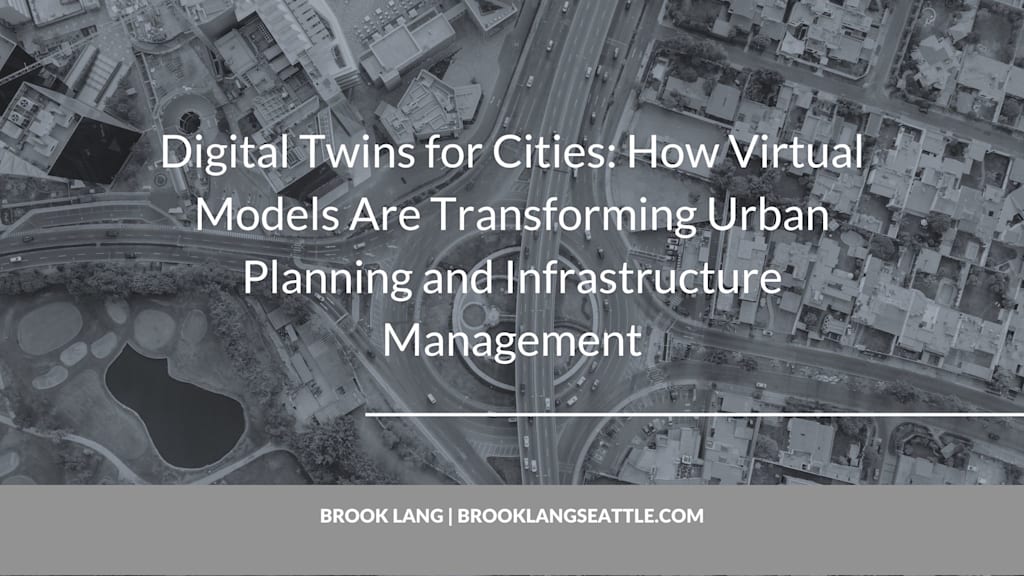
As urban environments grow more complex, city planners and infrastructure managers face increasing challenges in maintaining efficiency, sustainability, and resilience. Traditional planning methods often rely on static data and long timelines, making it difficult to respond quickly to changing conditions. Enter digital twins, dynamic, real-time virtual models of physical assets, systems, and entire cities. These digital replicas are transforming how cities are designed, managed, and optimized.
WHAT IS A DIGITAL TWIN?
A digital twin is a virtual representation of a physical object or system that is continuously updated using real-time data from sensors, IoT devices, and other sources. In urban contexts, digital twins can model everything from buildings and transportation networks to water systems and energy grids.
By integrating data streams into a single platform, digital twins provide a holistic view of urban operations. This allows decision-makers to simulate scenarios, test solutions, and predict outcomes before implementing changes in the real world.
SMARTER URBAN PLANNING
One of the most powerful applications of digital twins is in urban planning. Planners can use these models to visualize how new developments will impact traffic, energy use, and environmental conditions. For example, a digital twin can simulate how a new high-rise building might affect wind patterns, sunlight exposure, or congestion in surrounding areas.
This predictive capability enables more informed decision-making, reducing risks and improving the efficiency of development projects. Cities can also test sustainability initiatives—such as green infrastructure or renewable energy integration- in a virtual environment before scaling them in the real world.
ENHANCING INFRASTRUCTURE MANAGEMENT
Digital twins are revolutionizing how infrastructure is monitored and maintained. By continuously analyzing data from sensors embedded in roads, bridges, pipelines, and buildings, these systems can detect early signs of wear, stress, or failure.
Predictive maintenance allows cities to address issues before they become costly or dangerous, extending the lifespan of infrastructure and reducing downtime. For example, a digital twin of a water distribution system can identify leaks or inefficiencies in real time, conserving resources and lowering operational costs.
IMPROVING ENERGY AND RESOURCE EFFICIENCY
Cities consume vast amounts of energy and resources, making efficiency a top priority. Digital twins enable real-time optimization of energy systems by monitoring consumption patterns and adjusting supply accordingly.
In smart buildings, digital twins can regulate heating, cooling, and lighting based on occupancy and weather conditions. At a citywide level, they can balance energy loads, integrate renewable sources, and reduce waste. Similar approaches apply to water management, waste collection, and transportation systems, creating more sustainable urban ecosystems.
SUPPORTING RESILIENCE AND EMERGENCY RESPONSE
Digital twins also play a critical role in disaster preparedness and response. By simulating extreme weather events, floods, or infrastructure failures, cities can identify vulnerabilities and develop contingency plans. During emergencies, real-time data helps authorities respond more effectively, coordinate resources, and minimize damage.
CHALLENGES AND THE PATH FORWARD
While digital twins offer significant benefits, challenges remain. High implementation costs, data privacy concerns, and the need for robust digital infrastructure can limit adoption. Additionally, integrating data from multiple sources requires standardization and collaboration across sectors.
BUILDING THE CITIES OF TOMORROW
Despite these challenges, digital twins represent a transformative shift in urban management. By combining real-time data, advanced analytics, and simulation capabilities, they empower cities to become smarter, more efficient, and more resilient.
As technology continues to evolve, digital twins will play an increasingly central role in shaping sustainable, future-ready cities, where decisions are not just reactive, but predictive and proactive.
Originally posted on http://brooklangseattle.com/
About the Creator
Brook Lang Seattle
Brook Lang Seattle is a Senior Level Technology Executive. To learn more about him, be sure to check out his websites!
Keep reading
More stories from Brook Lang Seattle and writers in 01 and other communities.
The Energy–Water Nexus: Why Power Generation and Water Security Are Deeply Interconnected
Energy and water are often discussed as separate challenges, yet they are deeply interconnected. Power generation depends heavily on water, while water systems rely on energy to operate. This interdependence, known as the energy–water nexus, is becoming increasingly critical as climate change, population growth, and urbanization place greater strain on both resources.
By Brook Lang Seattle2 months ago in 01
Building a Secure Crypto Wallet App: Architecture, Security, and Real-World Challenges
Most teams don’t start with the idea of building a wallet. They arrive there because their product suddenly needs one. A trading platform launches, a DeFi feature goes live, or a payment flow gets added — and now users need a place to hold assets. That’s usually when wallet development becomes part of broader blockchain product work, where multiple components have to interact reliably.
By Valeriia Shulgaa day ago in 01
The Expanding World of Cryptocurrency: Opportunities and Risks
Cryptocurrency has rapidly evolved from a niche digital experiment into a mainstream financial phenomenon. Over the years, it has captured global attention, attracting everyone from individual investors to major financial institutions. With its promise of decentralization, transparency, and innovation, the crypto ecosystem continues to reshape how people think about money, investments, and the future of finance.
By Joe Jackson6 days ago in 01
Watching The End Of The World From The Diner
Introduction I am not sure how to approach this. Guy Peellaert was an amazing artist who created iconic fantasy images of famous people, usually musicians or politicians, as well as creating commissioned album covers such as "It's Only Rock'n'Roll" by The Rolling Stones and David Bowie's "Diamond Dogs" which you can read more about below.
By Mike Singleton 💜 Mikeydred 6 days ago in Art


Comments
There are no comments for this story
Be the first to respond and start the conversation.